
For most adults, a daily step goal of 7,000–8,000 steps is the sweet spot where major health benefits kick in without requiring marathon-level effort. If you're currently averaging 3,000 steps, you don't need to triple your count overnight. Add 500–1,000 steps per week, and you can reach 7,000 in roughly 8–10 weeks.
The research behind this is solid. A large dose-response meta-analysis in The Lancet Public Health found that 7,000 daily steps was associated with up to a 47% lower risk of all-cause mortality and a 25% lower risk of cardiovascular disease compared with roughly 2,000 steps per day. A Harvard Health summary of cohort studies lands in the same range: a range around 7,000 steps per day is associated with substantially lower mortality risk, with diminishing returns beyond that. The CDC's physical activity guidelines frame the broader target as 150 minutes per week of moderate-intensity activity; daily step counts are a practical, trackable way to get there.
Personalization rule: Take your 7-day average, then add 500–1,000 steps each week until you hit your target range. A person starting at 3,000 steps can realistically reach 7,000 in 8 weeks at that pace.
- Current average under 3,000: aim for 5,000 as a first milestone, then 7,000
- Current average 3,000–5,000: target 7,000–8,000 over 6–8 weeks
- Current average above 5,000: push toward 8,000–10,000 if your goal is weight loss or higher fitness
Key Takeaways
A realistic daily step goal for most adults is in a range around 7,000–8,000 steps per day, where the largest mortality and cardiovascular benefits are documented, with the most effective path being a weekly increase of 500–1,000 steps from your current baseline.
| Point | Details |
|---|---|
| Evidence-backed target range | 7,000–8,000 steps/day is associated with up to 47% lower all-cause mortality vs. ~2,000 steps. |
| 10,000 steps is not a clinical threshold | The number originated from a 1960s Japanese marketing campaign, not clinical research. |
| Start from your real baseline | Measure a 7-day average first, then add 500–1,000 steps per week to reach your target. |
| Movement snacks work | Post-meal walks and pacing during calls can add 2,000+ steps without a dedicated workout session. |
| Peacehealthai for personalized tracking | Peacehealthai's goal-based coaching and symptom tracking help you progress safely and consistently. |
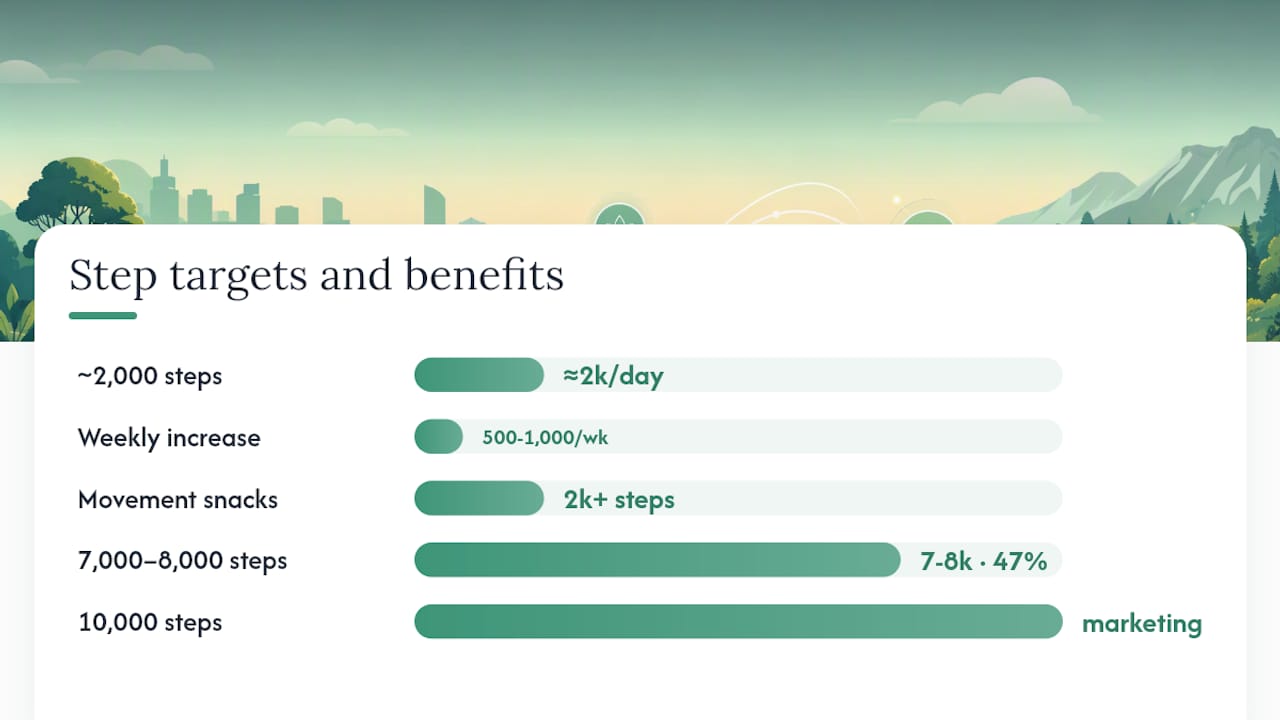
Table of Contents
- Where did the 10,000-step rule come from?
- What does the research actually show?
- What step target fits your goal and age?
- How to set a personalized daily step goal
- Simple ways to add more steps every day
- How accurate is your step tracker?
- When is more steps actually a problem?
- The case for stopping at "good enough"
- Peacehealthai can help you build and track your step plan
- Sources
Where did the 10,000-step rule come from?
The number 10,000 has nothing to do with clinical research. It traces back to a 1960s Japanese marketing campaign for a pedometer called the Manpo-kei, which translates roughly to "10,000-step meter." The device was promoted ahead of the 1964 Tokyo Olympics, and the round number stuck. ACSM confirms the target originated from that campaign, not from any controlled study of health outcomes. A 2007 literature review on PubMed traced the same history and found the evidence base for 10,000 as a threshold was thin at best.
The problem isn't that 10,000 is a bad number. It's that treating it as a hard threshold creates all-or-nothing thinking. Someone averaging 4,500 steps who falls short of 10,000 might feel like they've failed, even though they're already in a range where meaningful health benefits occur. The dose-response relationship for steps is curvilinear: the biggest relative gains happen when you move from very low counts to moderately higher ones. Going moving from very low counts like 2,000 steps to moderate counts like 5,000 delivers a larger proportional benefit than going from already high counts to even higher counts. That's not a reason to stop at 5,000. It's a reason to stop treating 10,000 as the only number that counts.
What does the research actually show?
The evidence base for step counting has grown substantially, and the picture is consistent: more steps are generally better, up to a point, and even modest increases from a low baseline produce real, measurable benefits.
The Lancet Public Health meta-analysis synthesized data across 57 studies and found a steep dose-response curve at lower step counts that levels off at higher volumes. The inflection point sits roughly around 5,000–7,000 steps per day. NIH reporting on cohort data supports the same pattern, with mortality benefits plateauing near 7,500 steps in older adult populations. A Harvard Health analysis of large cohort findings noted that even ~3,900 steps per day was linked to significantly lower all-cause mortality compared with very low step counts.
47% lower risk of all-cause mortality at ~7,000 steps/day vs. ~2,000 steps/day, per the Lancet Public Health meta-analysis.
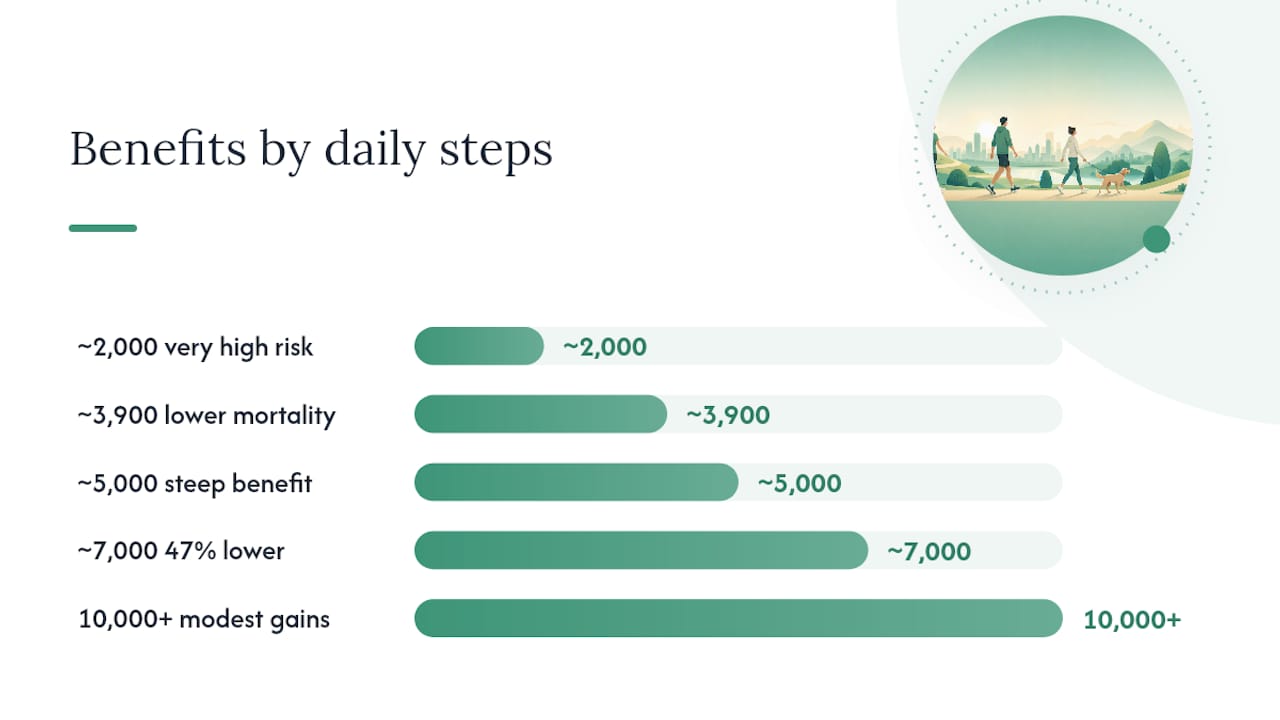
| Daily Steps | Approximate Signal |
|---|---|
| ~2,000 | Reference point; very high mortality and CVD risk |
| ~3,900 | Significantly lower all-cause mortality vs. lowest activity levels |
| ~5,000 | Steep portion of the benefit curve; meaningful CVD and mortality risk reduction |
| ~7,000 | Up to 47% lower all-cause mortality, 25% lower CVD risk vs. ~2,000 steps |
| ~10,000+ | Modest additional gains; benefits largely plateau for most outcomes |
A word on limitations. Most of this evidence comes from observational cohort studies, which show association, not causation. Device variability is real: wrist-worn trackers, hip-worn pedometers, and smartphone accelerometers can produce different counts for the same walk. Studies also vary in how they measure wear time and what counts as a valid day. These gaps don't undermine the overall picture, but they do mean you shouldn't treat any single step number as a precise clinical threshold.
What step target fits your goal and age?
The right daily step target depends on what you're trying to accomplish and where you're starting from.
-
General health maintenance (adults under 60): 7,000–8,000 steps per day covers the range where the largest mortality and cardiovascular benefits are observed. This is the target most evidence points to for adults without specific fitness goals.
-
Weight-loss-oriented volume: Research reviewed by UCLA Health suggests that weight loss typically requires higher total steps combined with moderate-to-vigorous intensity minutes. A target of 10,000–12,000 steps per day, with some of those at a brisk pace, is more appropriate here. Steps alone without intensity rarely produce clinically meaningful weight loss.
-
Higher fitness or performance goals: 10,000–12,000+ steps, combined with structured exercise sessions. Steps become a floor, not the ceiling.
-
Adults 60 and older: The Lancet Public Health review supports age-adjusted targets. Meaningful benefit in older adults appears at lower absolute counts, with mortality risk plateauing near 6,000–8,000 steps. The NIH summary of cohort data showed benefits leveling near a range near 7,500 steps in older women. A target of 6,000–8,000 is well-supported for this group.
-
People with mobility limitations or chronic conditions: Start lower, progress slower, and work with a clinician to set a realistic baseline. Even 2,000–4,000 steps per day represents a meaningful improvement over near-sedentary levels, and the evidence shows real benefit at those counts.
For rough context: 2,000 steps is approximately 1 mile, and a 150-pound person burns roughly 80–100 calories per mile walked at a moderate pace. These are conservative estimates; actual numbers vary by body weight, terrain, and pace.
How to set a personalized daily step goal
The process is straightforward, and it works better than picking an arbitrary number off a chart.
Step 1: Measure your baseline. Wear your tracker consistently for 7 days, including weekdays and a weekend. Calculate the daily average. That number is your starting point, not 10,000.
Step 2: Set your first target. Add 500–1,000 steps to your baseline. That's week one's goal. For a personalized progression plan, this incremental method consistently outperforms large jumps in adherence.
Step 3: Progress weekly. Increase by 500–1,000 steps each week, or roughly 10–20% of your current target. A sample 8-week plan from a 3,000-step baseline:
- Week 1: 3,500 steps
- Week 2: 4,000 steps
- Week 3: 4,500 steps
- Week 4: 5,000 steps
- Week 5: 5,500 steps
- Week 6: 6,000 steps
- Week 7: 6,500 steps
- Week 8: 7,000 steps
Step 4: Reassess every 2–4 weeks. If you're hitting your target most days, increase. If you're missing it consistently, hold the current level for another week before adding more.
Signs you're progressing too fast: persistent joint soreness that doesn't resolve overnight, unusual fatigue by midday, or sleep disruption. Any of those signals means you hold the current level, not push through.
Simple ways to add more steps every day
The tactics that actually work are the ones that attach to something you're already doing.
- Post-meal walks: A 10-minute walk after breakfast and lunch adds roughly 1,000–1,200 steps with minimal schedule disruption. UCLA Health specifically highlights these "movement snacks" as effective for raising daily totals.
- Walking meetings: Any call that doesn't require a screen is a walking call. A 20-minute walking meeting adds 1,500–2,000 steps.
- Active commuting: Park at the far end of the lot, get off transit one stop early, or walk to a farther coffee shop.
- Stairs over elevators: Three flights of stairs twice a day adds up faster than it sounds.
- Pacing during calls: Standing and pacing during a 30-minute phone call can add 1,500–2,500 steps.
A simple daily schedule that adds roughly 2,000 steps without a dedicated workout: 10-minute walk after breakfast (+600 steps), 15-minute walk at lunch (+900 steps), 10-minute evening walk (+600 steps). That's 2,100 steps layered onto whatever you already do.
For habit consistency, chain walks to existing cues. Put your shoes by the coffee maker. Set a phone reminder tied to your lunch calendar block. The cue-routine-reward loop is more reliable than willpower alone.
Pro Tip: Research on habit formation suggests that "temptation bundling" — pairing a walk with something you genuinely enjoy, like a podcast or an audiobook you only listen to while walking — significantly improves long-term adherence compared with walking alone. Reserve that content exclusively for walks.
For keeping up your step count while traveling, these practical tips cover how to maintain momentum when your routine is disrupted.
How accurate is your step tracker?
Most wearables and smartphones count steps using an accelerometer, which detects movement patterns and converts them into step estimates via a proprietary algorithm. The accuracy varies more than most people realize.
Wrist-worn devices tend to overcount during activities that involve arm movement without walking (folding laundry, driving) and undercount during slow shuffling. Hip-worn or clip-on pedometers are generally more accurate for straight walking but miss steps during activities where the hip doesn't move much. Smartphone step counts depend heavily on where the phone is carried: pocket versus bag versus desk produces meaningfully different numbers.
None of this means your tracker is useless. It means consistency matters more than absolute accuracy. Use the same device, worn the same way, every day. Your baseline and your progress are both measured with the same instrument, so the relative change is what counts. A 7-day rolling average smooths out the noisy days.
Practical rules: Wear your tracker from the moment you wake up. Charge it overnight or during a sedentary period so you're not missing active hours. If you switch devices, run both simultaneously for a week to understand the offset before resetting your baseline.
When is more steps actually a problem?
More steps are almost always better than fewer, but the pace of increase matters. Sudden large jumps in daily volume are a common cause of overuse injuries, particularly shin splints, plantar fasciitis, and knee pain. The connective tissue in your feet and lower legs adapts more slowly than your cardiovascular system, which means you can feel aerobically fine while accumulating mechanical stress.
Simple safety rules:
- Limit weekly increases to 10–20% of your current average. The body adapts to load gradually.
- Plan at least one lower-step day per week. Recovery isn't optional.
- Use pain as a stopping signal, not a motivation problem. Sharp or persistent joint pain means stop, not push through.
- Cross-train. Swimming, cycling, or strength work gives your joints a break while maintaining cardiovascular gains.
When to see a clinician before or during a step-count increase: new chest pain or pressure during activity, dizziness or lightheadedness, significant shortness of breath that's disproportionate to effort, rapid swelling in the legs or feet, or an inability to recover normally within 24 hours of a walk. These aren't signs to walk more slowly. They're signs to get checked. If you're unsure whether a symptom is activity-related, a daily health check-in can help you track patterns before your appointment. Guidance on exercising when sick is also worth reviewing if you're managing an illness alongside a step goal.
The case for stopping at "good enough"
The most underrated insight in the step-count literature is this: the gap between 2,000 and 7,000 steps matters far more to your health than the gap between 7,000 and 10,000. Yet most step-goal content focuses on the second gap, not the first.
The Physical Activity Guidelines for Americans and the CDC's activity framework both emphasize that moving more than you currently do is the highest-leverage intervention for most sedentary adults. Not hitting a specific number. Moving more than yesterday.
What this means practically: if you're at 4,000 steps and you push to 6,500, you've captured the majority of the mortality and cardiovascular benefit the research documents. That's a genuinely meaningful outcome, and it's achievable for most people without a gym membership, a fitness tracker upgrade, or a dramatic lifestyle change. The 10,000-step target isn't wrong for people who can reach it comfortably. But framing it as the only valid goal has pushed a lot of people into discouragement when a more modest, consistent target would have served them better.
Peacehealthai's position is straightforward: personalized, incremental goals beat arbitrary round numbers every time. The evidence supports it, and the adherence data supports it even more.
Peacehealthai can help you build and track your step plan
Knowing your target range is one thing. Turning it into a consistent daily habit, while keeping an eye on how your body responds, is where most people need support.

Peacehealthai's AI-powered platform gives you daily activity insights, goal-based coaching for targets like general wellness or fat loss, and symptom history tracking that flags patterns before they become problems. If you're increasing your step count and notice recurring soreness, fatigue, or other symptoms, the platform's early-alert system and AI health chat help you decide whether to adjust your plan or check in with a clinician. You get a health score that reflects your activity trends over time, not just today's count.
The symptom checker and personalized coaching tools are available now. Start with your baseline, set your first weekly target, and let the platform track your progress from there.
Sources
The claims in this article draw on the following primary sources. Each is observational in design, which means they show associations rather than proven causation. Review them directly for methodology and population details.
- Just 7,000 daily steps reduces heart disease risk - Harvard Health
- Hot Topic | How Many Steps Do You Really Need? - ACSM
- How many steps do you need a day to see health benefits? | UCLA Health
- Physical Activity Basics: Guidelines for adults - CDC
- How many steps better health - NIH Research Matters
- Daily step goal of 10000 steps: a literature review - PubMed
- Physical Activity Guidelines for Americans, 2nd edition - ODPHP
This article is for general informational purposes only and is not a substitute for professional medical advice. Confirm any health-related targets with your clinician, particularly if you have a chronic condition or are new to regular physical activity.