
A daily health check-in is a brief self-assessment that takes about a minute that scans your physical, mental, and emotional state to catch early signs of stress, fatigue, or illness before they escalate. The structure is simple and designed to be completed in about one minute, including centering yourself, a body scan, a symptom check, and setting a daily intention. That's it. This article is written by Peace Health AI and is general health information, not a medical diagnosis. Use it alongside professional care, not instead of it.
A note on AI tools: Symptom checkers like Peacehealthai can help you interpret patterns and decide when to call a clinician. They cannot replace one.
Table of Contents
- What is a daily health check-in and why does it matter?
- How to do your daily health check-in in 60 seconds
- What should you track and how do you build a useful baseline?
- When should you contact a clinician or call 911?
- How can an AI symptom checker support your daily routine?
- Is your health data safe when using AI symptom tools?
- How do you make daily check-ins stick long-term?
- Key Takeaways
- What responsible AI health support actually looks like
- Peacehealthai makes your daily check-in faster and more useful
What is a daily health check-in and why does it matter?
The goal of a daily health check-in is awareness, not diagnosis. Think of it as taking your health's temperature each morning: you're not trying to identify a disease, you're noticing whether something feels different from your normal baseline.
Public-health guidance positions daily checks as symptom-identification tools that prompt timely decisions about care. The practice is especially useful for people managing chronic conditions, where small deviations from baseline can signal something worth tracking.
Three core benefits stand out:
- Early detection: Spotting a pattern (say, three days of low energy and a mild headache) is far easier when you have a log than when you're relying on memory during a rushed clinic visit.
- Better clinical conversations: A week of brief notes gives your provider concrete data instead of vague recollections.
- Reduced decision fatigue: A structured, awareness-first routine removes the daily "should I be worried about this?" spiral by giving you a consistent framework for evaluation.
How to do your daily health check-in in 60 seconds
Anchor this to something you already do every morning, like brewing coffee or brushing your teeth. The habit stacks onto an existing cue, which dramatically improves long-term follow-through.

| Step | Time | What to do |
|---|---|---|
| Center | about 10 seconds | Close your eyes, take one slow breath, notice your overall state |
| Body scan | about 20 seconds | Move attention head to toe: head, throat, chest, stomach, limbs |
| Symptom quick-list | about 20 seconds | Run through 3–5 core indicators (see table below) with a Yes/No |
| Daily intention | about 10 seconds | Name one thing you'll do today to support your health |
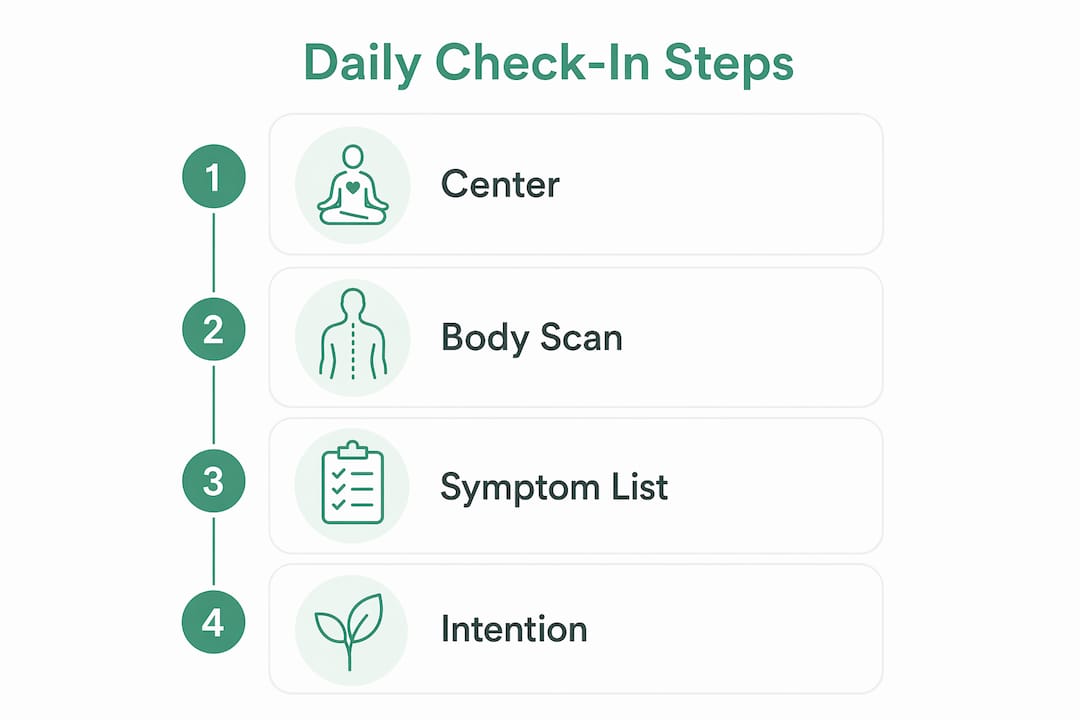
The symptom quick-list is where most of the value lives. Keep it to Yes/No answers so the whole step takes under 30 seconds.
Pro Tip: Set a recurring phone alarm labeled "60-second check" at the same time each morning. After 30 days, the prompt becomes automatic and you can drop the alarm.
What should you track and how do you build a useful baseline?
Tracking too much kills the habit. Experts recommend limiting your daily wellness log to 3–5 core indicators and keeping them consistent day to day. Here's a practical starting template:
| Indicator | Example entry | Format |
|---|---|---|
| Temperature / fever | No fever | Yes / No |
| Energy level | Low | a subjective scale |
| Sleep quality | Woke twice, several hours | Brief note |
| Mood / mental state | Anxious, distracted | One word |
| Key symptom (chronic) | Knee pain mild | Brief note |
Pick your 3–5 and stick with them for at least 30 days. Swapping indicators mid-month breaks the baseline you're building.
For people managing ongoing conditions, daily logs create a baseline that helps clinicians detect meaningful deviations faster than ad hoc recollection. A log entry doesn't need to be long. "Day 4: fatigue persists, appetite low, no fever" is more useful to a provider than "I've been tired lately."
A few domains worth covering in your personal health check:
- Physical: fever, cough, pain location and intensity, digestive changes
- Mental/emotional: mood, anxiety level, cognitive clarity
- Functional: sleep duration and quality, appetite, exercise tolerance
- Chronic-condition flags: whatever your provider has asked you to watch
When should you contact a clinician or call 911?
A wellness check routine is not a substitute for clinical judgment. Certain signs require immediate action, and knowing the threshold in advance prevents both under-reacting and unnecessary panic.
Emergency signs — call 911 now: Sudden severe chest pain or pressure, difficulty breathing that is getting worse, sudden confusion or inability to speak, signs of stroke (face drooping, arm weakness, speech difficulty), or severe allergic reaction. Do not wait to log these. Call first.
For non-emergency but urgent concerns, contact your clinician within 24 hours if you notice:
- A fever that persists beyond 3 days or spikes above 103°F
- Worsening shortness of breath without a clear cause
- New neurological symptoms: numbness, vision changes, sudden severe headache
- Any symptom that is rapidly worsening rather than holding steady
Clinical guidance consistently flags persistent high fever, worsening breathing difficulty, and new neurological signs as thresholds for prompt evaluation. When in doubt, call your provider's nurse line. That's exactly what it's there for.
How can an AI symptom checker support your daily routine?
AI tools add the most value in the gap between "I noticed something" and "I know what to do about it." Peacehealthai's AI symptom checker lets you describe what you're feeling in plain language and receive instant, structured guidance on likely next steps.
Concrete benefits of pairing AI with your daily health assessment:
- Trend detection: When you log symptoms across multiple days, AI can flag patterns you might miss, like three consecutive days of low-grade fever combined with fatigue.
- Instant triage guidance: Rather than searching symptoms on a general search engine and landing on worst-case scenarios, you get structured, evidence-informed suggestions.
- Clinician-ready summaries: Symptom history formatted for a provider visit saves time and improves the quality of the conversation.
The limit that matters most: AI tools interpret the information you give them. They cannot examine you, order tests, or account for your full medical history. Peacehealthai is informational guidance, not a diagnosis. Use it to decide whether to monitor, call your provider, or seek urgent care — not to replace any of those steps.
For people with chronic conditions, AI-assisted baseline monitoring is particularly useful. Early alerts for repeated symptoms, a feature Peacehealthai offers, can prompt a clinician call before a manageable issue becomes an urgent one.
Is your health data safe when using AI symptom tools?
Health data is sensitive. Before you start logging daily symptoms in any app, run through this quick checklist:
| Privacy factor | What to look for |
|---|---|
| Data storage | On-device vs. cloud; local storage carries lower profiling risk |
| Encryption | Data encrypted in transit and at rest |
| Retention policy | How long is your data stored? Can you delete it? |
| Data sharing | Is your data sold or shared with third parties? |
| Export controls | Can you download your symptom history? |
Apps that process data on-device and store logs locally typically offer stronger privacy than cloud-first platforms. Before onboarding with any wellness tracking system, read the privacy policy for the retention and sharing sections specifically.
On Peacehealthai: The platform is built with secure access in mind. Before you start, confirm the current storage and sharing settings in the app's privacy section to make sure they match your comfort level.
How do you make daily check-ins stick long-term?
The biggest threat to a wellness check routine isn't forgetting. It's overcomplicating it. Behavioral research warns that excessive symptom checking can increase anxiety in people prone to health worry, so the goal is a light, consistent practice, not a comprehensive daily audit.
Three tactics that actually work:
- Anchor to an existing cue. Pair your check-in with something you never skip: morning coffee, brushing teeth, or a daily commute. The existing habit carries the new one.
- Track completion, not perfection. Mark the day done even if your answers were rough estimates. Consistency beats accuracy in the early weeks.
- Limit your indicators. Three to five core items is the ceiling. More than that and the routine starts to feel like a chore.
For practical mindfulness techniques that pair well with the centering step, short breathing exercises take under 30 seconds and measurably lower the stress response before you begin your scan.
Pro Tip: Start with a firm 30-day commitment at once-a-day. After 30 days, you'll know whether the data is actually changing your decisions. If it isn't, simplify further. If it is, you've built something worth keeping.
Tracking your emotional wellness alongside physical signs rounds out the picture, especially for adults managing stress-related conditions where mood and energy often shift before physical symptoms appear.
Key Takeaways
A daily health check-in works because regularity beats comprehensiveness: 60 consistent seconds every morning builds a baseline that no single clinic visit can replicate.
| Point | Details |
|---|---|
| 60-second structure | Four steps: center, body scan, symptom list, intention. |
| Limit your indicators | Track 3–5 core items daily; more than that increases cognitive load and drop-off. |
| Know your red flags | Call 911 for chest pain, severe breathing difficulty, or stroke signs; contact your clinician for persistent fever or worsening symptoms. |
| AI as a triage layer | Use AI tools for trend detection and next-step guidance, not as a replacement for clinical diagnosis. |
| Peacehealthai | Offers daily symptom entry, trend tracking, and clinician-ready summaries to support your routine. |
What responsible AI health support actually looks like
Most people expect AI health tools to either overpromise or hedge so heavily they're useless. The honest middle ground is narrower than the marketing suggests, and it's worth naming directly.
The value of a tool like Peacehealthai isn't that it knows what's wrong with you. It's that it helps you organize what you're noticing, compare it against patterns, and make a faster, calmer decision about your next step. That's a genuinely useful function. It's also a limited one, and any tool that obscures that limit is doing you a disservice.
Daily check-ins work the same way. The practice doesn't make you your own doctor. It makes you a better-informed person walking into a doctor's office, or a more confident one deciding to wait another day. That distinction shapes how you use both the routine and the AI that supports it.
Peacehealthai makes your daily check-in faster and more useful
Logging symptoms in a notes app works, but it doesn't tell you what the pattern means. Peacehealthai gives you a structured daily entry, AI-generated trend analysis across your symptom history, and exportable summaries you can share directly with your provider at your next visit.
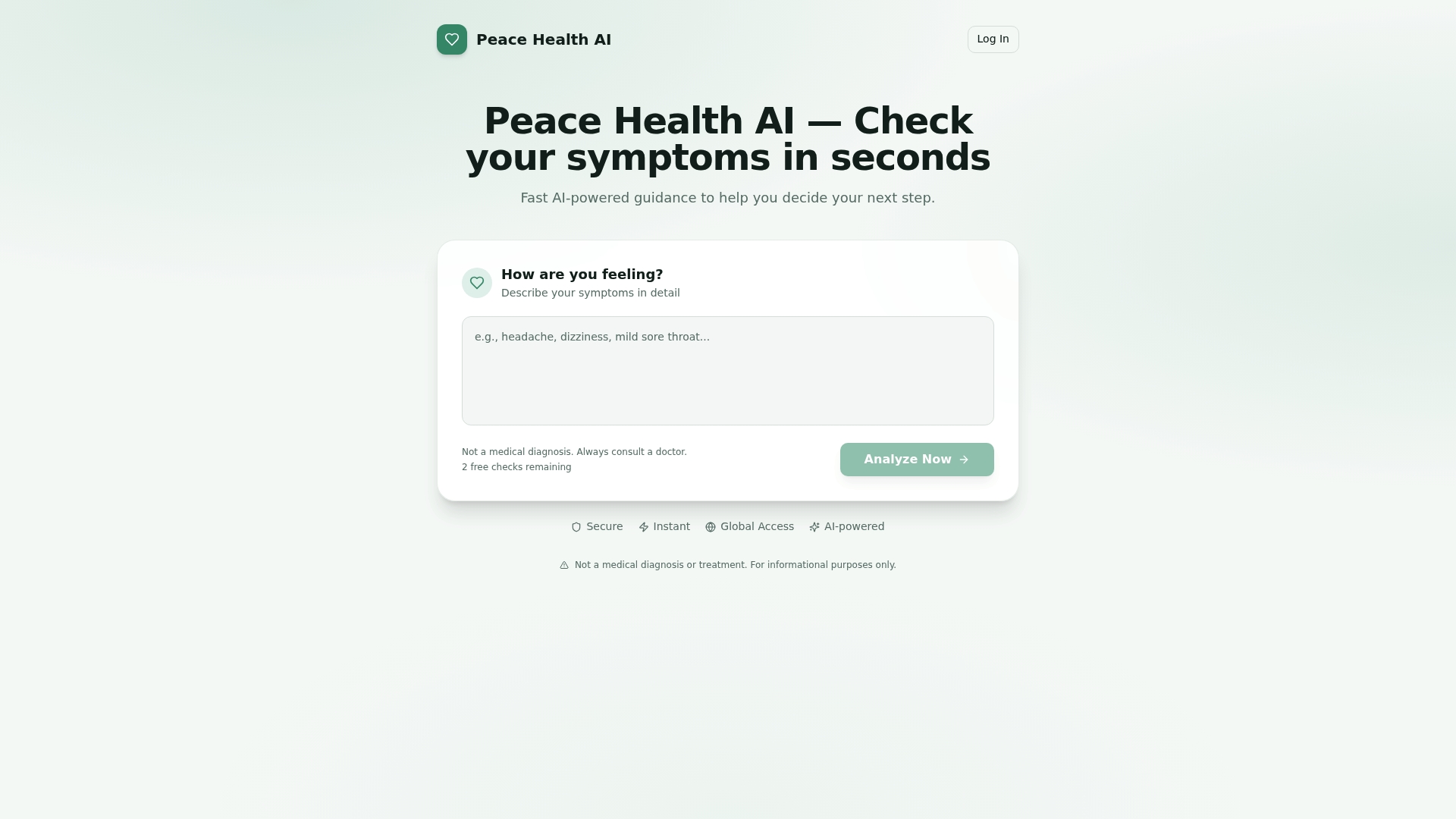
The features page covers the full capability set, including early alerts for repeated symptoms, health score analytics, and goal-based coaching for fat loss, muscle gain, or general wellness. Plans range from a free tier to advanced monthly and annual options with priority response and extended analytics.
Peacehealthai is informational guidance only. It does not diagnose, prescribe, or replace clinical care. Use it to support your daily routine and to decide when to call your provider.
Ready to run your first check? Start your symptom check now, or explore plans to find the tier that fits your needs.