
Start with one SMART daily goal: 30 minutes of moderate-intensity movement, five days a week, tied directly to the CDC's recommendation of 150 minutes per week. Right now, before you read further, open your calendar and block a 30-minute slot for today. That single action puts you ahead of the majority of adults who never convert good intentions into a protected time commitment. Peacehealthai can personalize that target further based on your symptoms, health history, and current capacity, so your goal fits your actual day, not a generic template.
Quick stat: The American Heart Association notes that only about 20% of adults currently meet physical activity recommendations. A single, specific daily goal is the most direct fix.
Table of Contents
- How do you set daily activity goals using the SMART framework?
- How do you break 150 minutes a week into manageable daily chunks?
- When should you plan your daily workout goals?
- Which metrics should you track to measure daily progress?
- How do you tailor activity goals when symptoms or chronic conditions are involved?
- How and when should you revise your daily activity goals?
- Three ready-to-use daily goal templates
- Which tools help you set, track, and adapt daily activity goals?
- Three steps to lock in today's daily activity goal right now
- Key Takeaways
- Why small, revised goals beat ambitious ones every time
- Peacehealthai helps you set, track, and adapt your daily activity goals
- Useful sources and further reading
How do you set daily activity goals using the SMART framework?
The SMART framework is the recommended approach for fitness goals because it converts vague intentions into testable outcomes. Each letter does real work.
Specific names the exact activity. Not "exercise more" but "walk briskly around the neighborhood." Measurable attaches a number: 30 minutes, 3,000 steps, two sets of squats. Attainable means the goal fits your current fitness level, not your aspirational one. Relevant ties the daily goal to something you actually care about, whether that's managing blood pressure, losing weight, or simply feeling less stiff. Time-bound sets a deadline, usually "by end of today."
SMART daily goal template:
- Activity: I will [specific movement]
- Duration/metric: for [number] minutes / steps / reps
- When: at [time of day]
- Why it matters: because [personal health reason]
- Check: I will confirm completion by [logging method]
Three ready-to-copy examples:
- Beginner: "I will walk at a brisk pace for 20 minutes after dinner tonight and log it in my activity app."
- Intermediate: "I will complete three 10-minute movement breaks between work calls today, totaling 30 active minutes."
- Symptom-aware: "I will do 15 minutes of gentle stretching and slow walking this morning, stopping immediately if I feel short of breath or chest tightness."
How do you break 150 minutes a week into manageable daily chunks?
The CDC's 150 minutes per week target sounds large until you divide it. Spread across five days, that's 30 minutes daily. Spread across seven, it's roughly 21 minutes. Neither number requires a gym.

The math gets even friendlier when you use micro-bursts. Three 10-minute walks add up to 30 minutes. Two 20-minute sessions cover the same ground. Even five-minute intervals count, which matters enormously for people managing symptoms or packed schedules.
Practical daily conversions from 150 minutes/week:
- 30 min × 5 days (classic split)
- 50 min × 3 days (for those with fewer available days)
- 3 blocks of 10 minutes × 5 days (micro-burst approach)
- 6 blocks of 5 minutes spread through the workday
The AHA explicitly validates short activity bouts as a legitimate strategy, not a consolation prize. For anyone managing a chronic condition or fluctuating symptoms, micro-bursts also make it easier to stop, rest, and resume without losing the day's progress.
When should you plan your daily workout goals?
Plan the night before or first thing in the morning, before you open email. Research on daily goal-setting is clear: a goal set before the inbox preserves priority. Once reactive tasks take over, the activity slot disappears.
A simple planning routine that takes under three minutes:
- Pick one primary goal. One measurable outcome, not three.
- Time-block it. Put it on the calendar with a start time.
- Protect the slot. Treat it like a meeting you cannot cancel.
- Add a secondary only if you finish early. This prevents decision overload.
Pro Tip: Name your activity slot something specific in your calendar, like "20-min walk: 12:15 PM," not just "exercise." Specificity reduces the mental friction of deciding what to do when the time arrives.
Which metrics should you track to measure daily progress?
Choosing the right metric depends on your goal and your tools. Steps are easy to track passively. Active minutes capture effort regardless of step count. Perceived exertion works when you have no device. Symptom-linked measures add a safety layer for anyone managing a health condition.
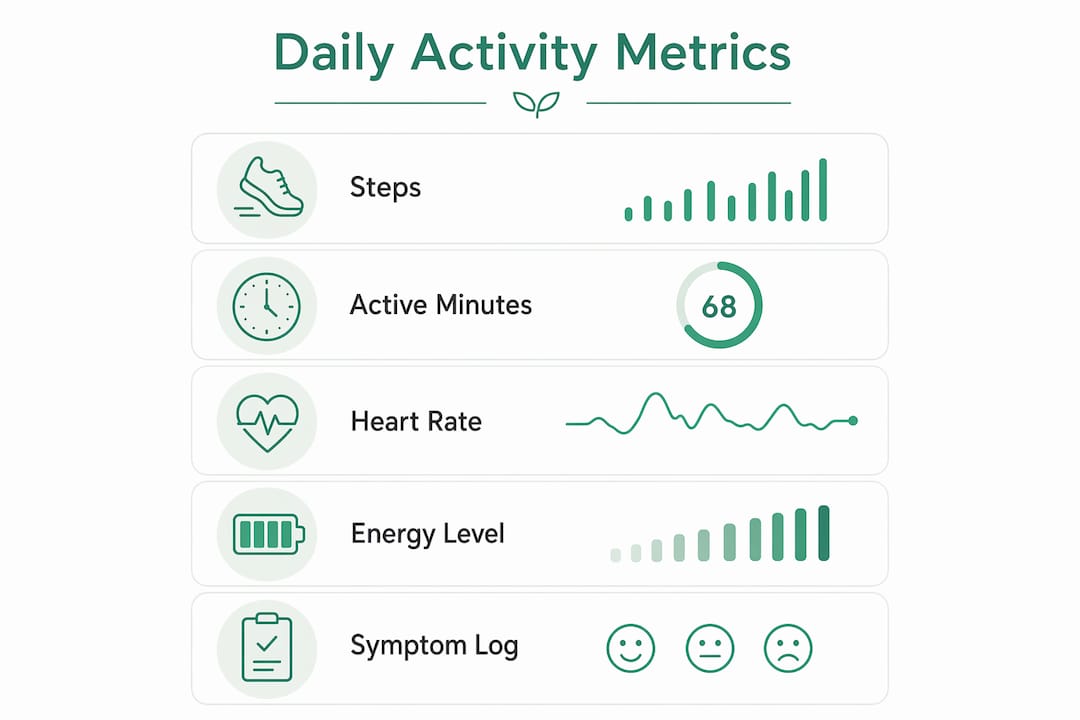
| Metric | What it measures | Best for | Benchmark / source |
|---|---|---|---|
| Steps | Total daily movement | General activity baseline | 6,000 steps as a starting point for beginners (Cleveland Clinic) |
| Active minutes | Time at moderate+ intensity | Cardio goal tracking | 150 min/week total (CDC) |
| Perceived exertion | Subjective effort (1–10 scale) | No-device days, symptom days | 5–6 out of 10 = moderate intensity |
| Symptom log | How you felt before, during, after | Chronic condition management | Daily entry; flag any new or worsening symptoms |
| Reps/sets | Strength work volume | Muscle-strengthening days | 2+ days/week (CDC) |
Combining symptom tracking with activity metrics is where the real safety value lives. Log energy level, pain, breathlessness, and mood alongside your step count. Over time, patterns emerge: maybe Tuesday mornings are consistently low-energy, or post-lunch walks feel easier. That data lets you plan smarter, and it gives Peacehealthai the context to suggest adjustments before a bad day becomes a skipped week.
How do you tailor activity goals when symptoms or chronic conditions are involved?
Safety comes before consistency. When symptoms appear, the goal shifts from performance to maintenance or recovery.
Modify your goal when you notice:
- Unusual fatigue that doesn't improve after 10 minutes of light movement
- Joint pain above a 4 out of 10
- Shortness of breath at rest or with minimal exertion
- Dizziness, nausea, or headache before or during activity
Stop immediately and seek care if you experience:
- Chest pain or pressure
- Sudden severe shortness of breath
- Fainting or near-fainting
- Heart palpitations that feel irregular or alarming
- Sudden severe pain in any joint or muscle
Daily symptom-check prompt (takes 60 seconds):
- Energy today: low / moderate / good?
- Any pain or discomfort? Where, and how intense (1–10)?
- Breathing at rest: normal or labored?
- Decision: proceed as planned / modify goal / rest today
The AHA and CDC both emphasize that some activity is better than none. On a symptomatic day, a 10-minute gentle walk still counts.
How and when should you revise your daily activity goals?
Revision is not failure. Practitioners in exercise science treat follow-up and revision as a core stage of the goal-setting process, not an afterthought. The four-stage cycle is: preparation, setting, planning, and follow-up. Most people skip the last stage and wonder why momentum stalls.
A practical review cadence:
- End-of-day (2 minutes): Did you hit the goal? Yes or no. If no, was it a barrier you can remove tomorrow, or a sign the goal needs adjusting?
- Weekly (5 minutes): How many days did you hit the target? If fewer than three out of five, lower the bar slightly. If you hit all five comfortably, raise it.
When increasing your target, use small increments. For steps, adding 500–1,000 steps per week is a sustainable pace. Jumping straight to 10,000 steps from a low baseline is a common burnout trigger. If a goal consistently feels impossible, reframe it as a learning goal: "I will identify one barrier to my 20-minute walk this week" rather than "I will walk 20 minutes every day."
Three ready-to-use daily goal templates
These are fully worded and copyable. Paste them into your planner, notes app, or Peacehealthai profile.
Beginner (low baseline):
- Goal: "Walk for 20 minutes at a comfortable pace after dinner, five days this week."
- Checklist: Log start time, end time, and how you felt (1–10 energy).
- Variant: Swap minutes for steps (aim for 4,000–6,000 steps/day to start).
Busy schedule (micro-burst approach):
- Goal: "Complete three 10-minute movement breaks today: one mid-morning, one at lunch, one mid-afternoon."
- Checklist: Check off each block as completed; note which one you skipped and why.
- Variant: Replace one block with a 10-minute stretching or bodyweight routine.
Symptom-aware (recovery/maintenance focus):
- Goal: "Do 15 minutes of gentle movement this morning, guided by how I feel at the daily symptom check."
- Checklist: Complete the 60-second symptom prompt first; log activity type and perceived exertion.
- Variant: On low-energy days, reduce to 10 minutes of slow walking or seated stretching.
Which tools help you set, track, and adapt daily activity goals?
The most useful tools share a few traits: they let you log quickly, remind you at the right moment, and surface patterns over time. A basic setup includes a time-blocking calendar (Google Calendar, Apple Calendar), a step or activity tracker (a phone's built-in health app works), and a symptom log (a notes app or a dedicated health platform).
Peacehealthai adds a layer that generic trackers miss. Its symptom checker connects your reported symptoms to your activity plan, flagging when a pattern suggests you should scale back or when you've been consistently under-target and might be ready to progress. The platform also provides daily AI-generated activity insights, goal-based coaching for outcomes like fat loss, muscle gain, or general wellness, and early alerts when repeated symptoms suggest a trend worth watching.
"Any activity is better than none. For people who can't find long blocks of time, short bouts of activity throughout the day can add up and have real health benefits." — Mayo Clinic
On privacy: Peacehealthai is built with secure data handling as a baseline. Your symptom history and activity logs are not shared without your consent. For full details on data protection, visit Peacehealthai's features page.
Three steps to lock in today's daily activity goal right now
- Choose one SMART outcome tied to your highest-priority health goal. Write it in the format: "I will [activity] for [duration/metric] at [time] today."
- Block a protected calendar slot and decide your tracking metric: steps, active minutes, or a symptom check before and after.
- End-of-day review: Did you complete it? Yes or no. Write one sentence about tomorrow's goal based on today's result.
That's the whole system. The research on daily goals consistently shows that a single primary goal with a protected time slot outperforms a list of competing intentions every time.
Key Takeaways
Setting one SMART daily activity goal, tied to the CDC's 150-minutes-per-week target and revised regularly, is the most reliable path to lasting physical activity habits.
| Point | Details |
|---|---|
| Start with one SMART goal | Write a single, measurable daily outcome before opening email or starting your day. |
| 150 min/week = small daily chunks | Break the CDC weekly target into 30-min sessions, 10-min bursts, or any combination that fits your schedule. |
| Symptom check before you move | A 60-second daily prompt protects you from pushing through warning signs that need rest or medical attention. |
| Revision is part of the process | End-of-day and weekly reviews are not optional; practitioners treat follow-up as the stage most people skip. |
| Peacehealthai personalizes your plan | Use Peacehealthai's symptom-aware coaching and daily AI insights to adjust goals in real time based on how you actually feel. |
Why small, revised goals beat ambitious ones every time
The conventional wisdom says to aim high and work backward. Set a big goal, break it into milestones, stay motivated. That framing works for some people. For most, especially those managing symptoms, chronic conditions, or unpredictable schedules, it produces a cycle of overreach and abandonment.
The more useful frame is this: a daily activity goal is not a performance standard. It's a daily decision about what you can do today, given today's energy, symptoms, and schedule. The goal that gets done consistently at 70% effort beats the perfect goal that gets skipped four days out of five.
What the research on goal revision actually shows is that people who revise their goals when life intervenes maintain their self-efficacy, the belief that they can succeed, far better than people who hold rigid targets and feel like failures when they miss. A revised goal is an active goal. A skipped goal is just a missed day.
The symptom-aware approach that Peacehealthai supports takes this further. When your activity plan responds to how you actually feel, rather than a fixed weekly schedule, you stop fighting your body and start working with it.
Peacehealthai helps you set, track, and adapt your daily activity goals
Most activity apps track what you did. Peacehealthai helps you decide what to do next, based on your symptoms, history, and goals. The difference matters when you're managing a health condition, recovering from a rough week, or simply trying to build a habit that sticks.
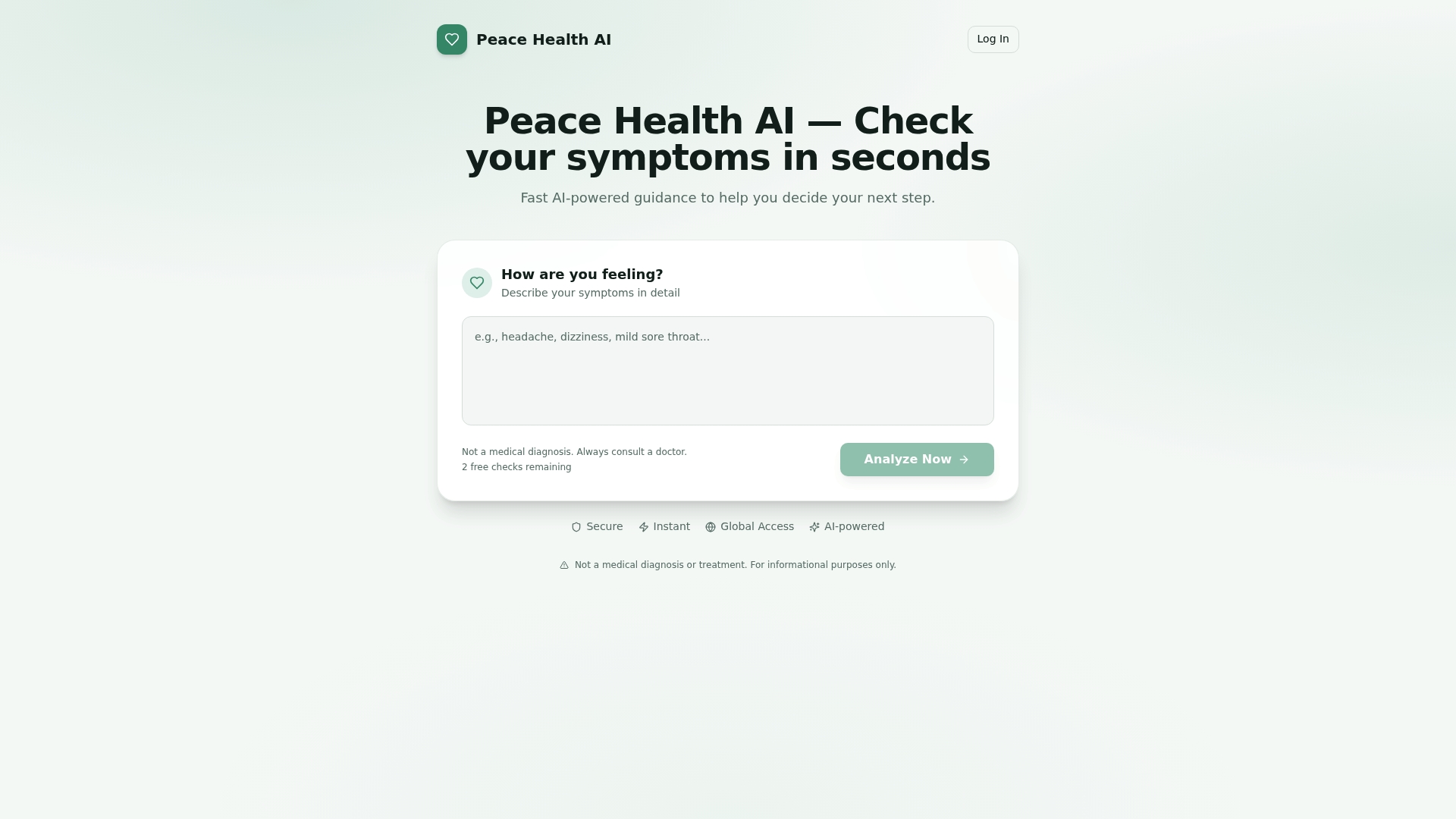
Four things Peacehealthai does that a step counter can't: it adjusts your daily goal suggestions based on reported symptoms, delivers AI-generated daily activity and nutrition insights, sends early alerts when repeated symptoms suggest a pattern worth addressing, and provides goal-based coaching for specific outcomes like fat loss, muscle gain, or general wellness. Your data stays private and secure throughout.
Plans range from a free tier to advanced subscriptions with priority response and full health analytics. Check pricing and plans to find the right fit, or go straight to the symptom checker to get a personalized starting point today.
Useful sources and further reading
| Source | What it covers | Relevance to this article |
|---|---|---|
| CDC Physical Activity Guidelines for Adults | 150 min/week moderate-intensity aerobic activity; muscle-strengthening 2+ days/week | Core weekly target used throughout for daily conversions |
| American Heart Association — Physical Activity Recommendations | Validates short activity bouts; notes low adherence rates among adults | Supports micro-burst strategy and safety framing |
| Cleveland Clinic — SMART Fitness Goals | SMART framework for fitness; beginner step baselines; gradual progression guidance | SMART templates, beginner goal examples, step increment advice |
| Mayo Clinic — How Much Exercise Per Day | Any activity is better than none; brief bouts add up | Supports micro-burst and symptom-day modification guidance |
| Springer / Exercise and Sports Science Australia — Goal Setting Expert Statement | Four-stage goal-setting cycle; revision as therapeutic practice | Revision cadence, follow-up as a strength, practitioner model |
| MedlinePlus — How Much Exercise Do I Need? | NIH-backed summary of activity guidelines for all ages | Secondary reference for weekly targets and chronic condition guidance |
This article is general health information, not medical advice. If you have a chronic condition, are pregnant, or are new to exercise, confirm your activity plan with your clinician before starting.