
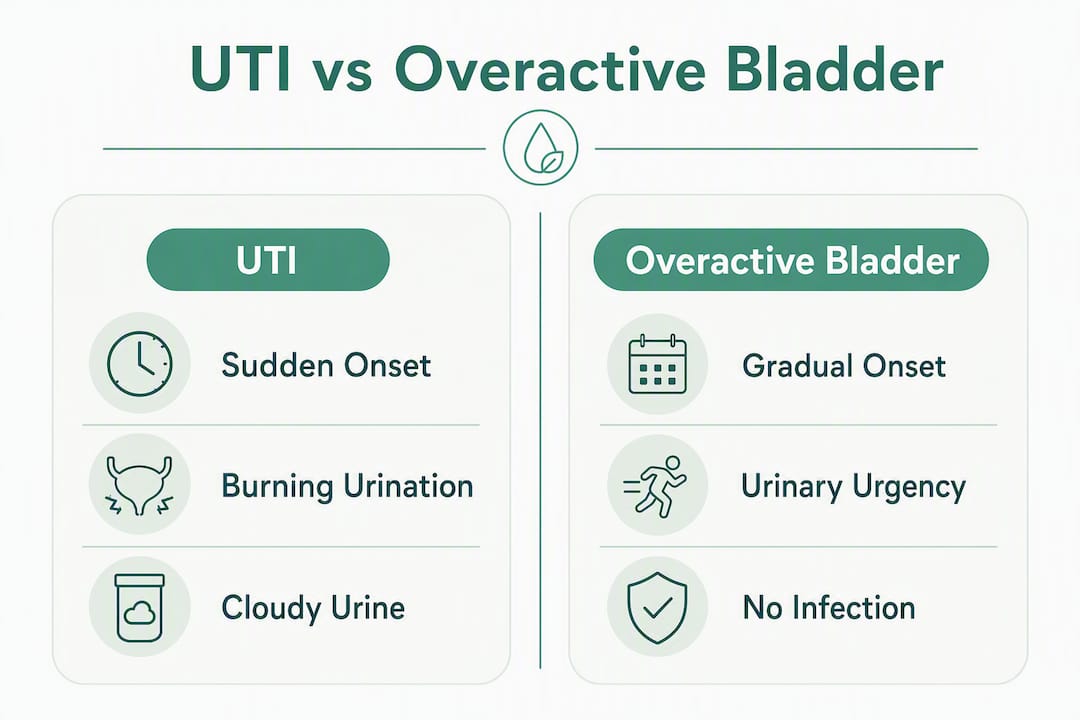
Burning when you urinate, sudden onset, cloudy or bloody urine, or a fever points strongly toward a urinary tract infection. Chronic urgency and frequency without any burning, normal-looking urine, and no fever suggests overactive bladder (OAB). These two conditions share enough symptoms to confuse anyone, but the distinctions are real and matter for treatment.
If you suspect a UTI: get a urinalysis and urine culture. Most UTIs improve within a few days of the right antibiotic.
If symptoms are chronic with no burning or abnormal urine: start a bladder diary and reduce known triggers (caffeine, alcohol) before your next clinician visit.
If you've had multiple negative urine cultures but urgency persists: that pattern is one of the strongest signals that OAB or pelvic floor dysfunction, not infection, is driving your symptoms.
Pro Tip: A negative urine culture combined with ongoing urgency is a key diagnostic pivot point. Log your symptoms for 3 days before your appointment — that data often changes what your clinician orders next.
Table of Contents
- How do UTI and overactive bladder symptoms actually differ?
- What causes UTI or OAB, and who is at higher risk?
- What tests will a clinician use to tell them apart?
- How is each condition treated, and how long does recovery take?
- When should you see a clinician urgently?
- Why do UTI and OAB sometimes look the same?
- How to keep a bladder diary and use a symptom checker effectively
- Key Takeaways
- The case for tracking before you treat
- Peacehealthai can help you document symptoms before your next appointment
- Useful sources and further reading
How do UTI and overactive bladder symptoms actually differ?
UTI symptoms arrive fast. OAB builds slowly. That single difference in timing is often the clearest early signal.

| Dimension | UTI | Overactive Bladder (OAB) |
|---|---|---|
| Onset / timing | Sudden, acute | Gradual, chronic |
| Pain / dysuria | Burning or pain with urination (hallmark) | Rarely present |
| Urine appearance | Cloudy, bloody, or strong-smelling | Usually normal |
| Systemic symptoms | Fever, chills, malaise possible | None |
| Urination pattern | Frequent, urgent, small volumes | Frequent, urgent, larger or normal volumes |
| Nocturia | Can occur during active infection | Common, often a primary complaint |
| Leakage | Uncommon | Urge incontinence common (leaking before reaching toilet) |
| Diagnosis | Urinalysis, urine culture | Bladder diary, exclusion of infection |
| Treatment / timeline | Antibiotics; symptoms ease in 2–3 days | Behavioral therapy, medications; weeks to months |
A few distinctions worth emphasizing:
- Dysuria is among the most frequent complaints in UTIs and is uncommon in OAB. If urination burns, infection is the more likely cause.
- Urge incontinence, losing urine before reaching the toilet, is more typical of OAB. UTIs more commonly cause passing only small amounts with each urge.
- Nocturia causes are not specific to either condition. Waking at night to urinate can stem from nocturnal polyuria, sleep disorders, or bladder storage problems, so nighttime frequency alone does not confirm either diagnosis.
- OAB does not resolve on its own the way a treated UTI does. Expect weeks to months of behavioral retraining before significant improvement.
What causes UTI or OAB, and who is at higher risk?
UTI risk factors
Bacteria, most often E. coli from the gut, enter the urethra and travel to the bladder. More than half of women will have at least one UTI in their lifetime, largely because the female urethra is shorter and closer to the rectum.
- Sexual activity increases bacterial exposure.
- Urinary retention (incomplete emptying) lets bacteria multiply in pooled urine.
- Catheter use is a major hospital-acquired risk.
- Postmenopause: lower estrogen changes vaginal flora and thins urethral tissue, raising UTI risk significantly.
- Anatomic abnormalities or kidney stones can trap bacteria.
OAB risk factors
OAB stems from detrusor overactivity, the bladder muscle contracting before it is full. The triggers are different from infection entirely.
- Neurologic conditions (stroke, multiple sclerosis, Parkinson's disease) disrupt the nerve signals that control voiding.
- Pelvic floor dysfunction, whether tight or weak muscles, alters bladder support and signaling.
- Age-related bladder changes reduce capacity and increase involuntary contractions.
- Bladder irritants: caffeine, alcohol, carbonated drinks, and spicy foods worsen urgency.
- Menopause contributes here too. Lower estrogen can alter bladder tissue and function, producing OAB-like symptoms independent of any infection.
When the two overlap
Incomplete bladder emptying predisposes to infection, so someone with OAB-related retention can develop recurrent UTIs. Menopause sits at the intersection of both conditions, which is why evaluations in postmenopausal women need to consider both possibilities rather than defaulting to antibiotics.
What tests will a clinician use to tell them apart?
Urinalysis and urine culture
These are the first-line tests for any urinary complaint. A urinalysis checks for white blood cells (pyuria) and bacteria; a urine culture identifies the specific organism and its antibiotic sensitivity. A positive culture confirms infection. A negative culture with persistent urgency, frequency, or leakage is strong evidence of a noninfectious cause, most often OAB or pelvic floor dysfunction.
Frequent misdiagnosis of OAB as UTI leads to unnecessary antibiotic courses that do nothing for the underlying problem and contribute to antibiotic resistance. If you have been treated multiple times for UTI without lasting relief, ask your clinician whether a culture was actually positive each time.
Bladder diary
The 24-hour voiding diary is the most practical tool for differentiating OAB from nocturnal polyuria and other storage problems. It records fluid intake, voiding times, urgency ratings, and leakage episodes. Clinicians use this data to see whether the problem is high fluid intake, small bladder capacity, or true detrusor overactivity.
Imaging and urodynamic testing
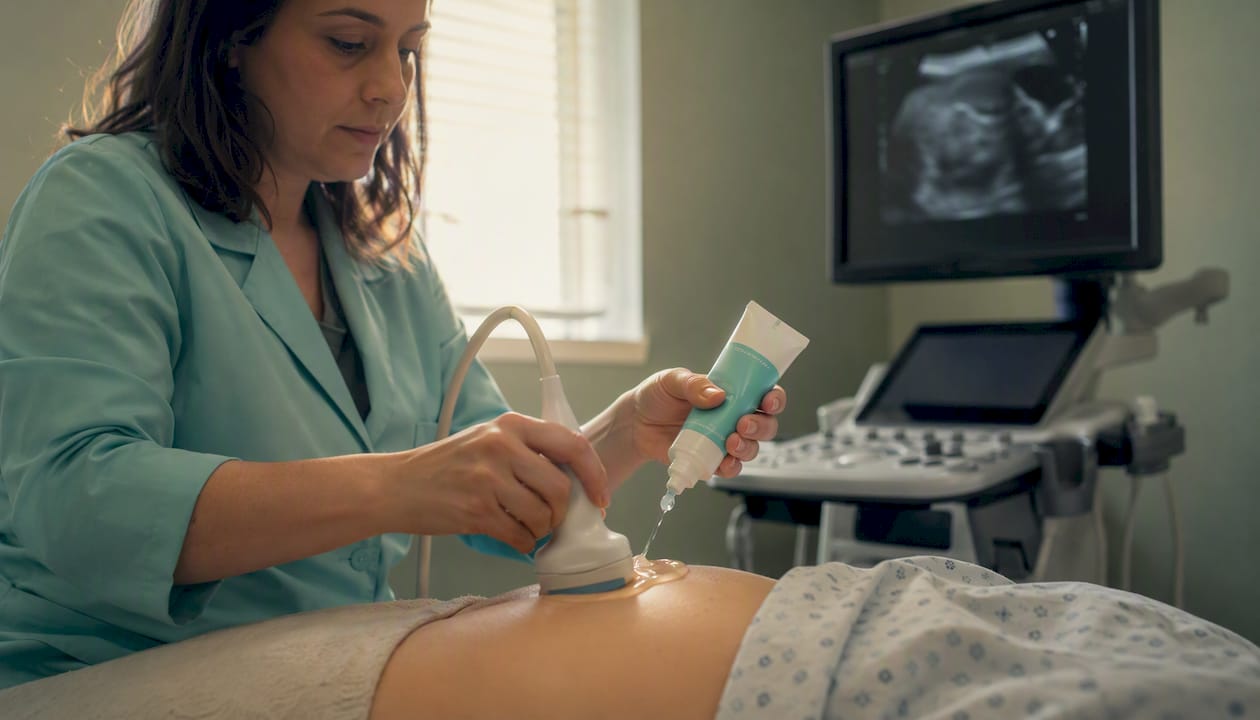
When symptoms are complex or do not respond to initial treatment, clinicians may order a bladder ultrasound to check post-void residual volume, or urodynamic testing to measure bladder pressure and confirm detrusor overactivity. These tests are not routine for a first UTI but become relevant for recurrent infections, suspected structural problems, or refractory OAB.
Pro Tip: Bring a completed 3-day bladder diary to your first appointment. Clinicians consistently find structured voiding data more useful than a verbal description of symptoms, and it often determines whether testing is needed at all.
How is each condition treated, and how long does recovery take?
UTI treatment
Short antibiotic courses, typically 3–7 days depending on the drug and infection location, clear most uncomplicated bladder infections. Symptoms usually improve within 48–72 hours. For pain relief during the first day or two, phenazopyridine (a urinary analgesic) reduces burning but does not treat the infection itself. Note: it turns urine bright orange.
For recurrent UTIs, preventive strategies include staying well hydrated, urinating after sex, and discussing low-dose prophylactic antibiotics or topical vaginal estrogen (for postmenopausal women) with your clinician.
OAB management
OAB treatment is layered and takes longer. The standard progression:
- Behavioral changes first: timed voiding, fluid management (not restricting water, but spacing intake), and eliminating bladder irritants.
- Pelvic floor physical therapy: a trained therapist addresses both weak and hypertonic (overly tight) pelvic floor muscles. This is often more effective than medication alone.
- Medications: anticholinergics (oxybutynin, tolterodine) and beta-3 agonists (mirabegron) relax the detrusor muscle. Both classes have side effects worth discussing with your clinician.
- Third-line options for refractory cases: sacral neuromodulation, posterior tibial nerve stimulation, or intradetrusor Botox injections.
Expect 6–12 weeks of behavioral retraining before judging whether it is working.
Pro Tip: Reducing caffeine by half for two weeks is one of the fastest OAB self-tests. If urgency drops noticeably, caffeine was a major driver. If nothing changes, the cause is likely structural or neurologic rather than dietary.
Shared self-care
Both conditions benefit from adequate hydration (concentrated urine irritates the bladder lining), avoiding alcohol and caffeine during flares, and not delaying urination to the point of urgency.
When should you see a clinician urgently?
Some symptoms cannot wait for a scheduled appointment. Go to urgent care or the emergency department if you have:
- Fever with flank or back pain: this combination suggests the infection has reached the kidneys (pyelonephritis), which requires prompt treatment and sometimes IV antibiotics.
- Inability to urinate: urinary retention is a medical emergency.
- Visible blood in urine: hematuria with systemic signs like fever or chills points toward infection or a more serious cause requiring urgent evaluation.
- Severe pelvic pain or pressure.
- Signs of sepsis: high fever, rapid heart rate, confusion, or feeling acutely unwell.
- Pregnancy: UTIs in pregnancy carry higher risk of kidney infection and preterm labor; any urinary symptoms warrant same-day evaluation.
Call your clinician (rather than going to the ER) if symptoms are uncomfortable but you have no fever, no flank pain, and you can still urinate. Older adults and immunocompromised individuals should use a lower threshold for in-person evaluation, since classic UTI symptoms are often blunted in these groups and infections can escalate faster.
Why do UTI and OAB sometimes look the same?
Both conditions cause urgency and frequency. That overlap is the core reason misdiagnosis happens, and it is not a failure of clinical judgment so much as a genuine ambiguity in the symptom pattern.
Comorbidities make it harder. Bladder stones, pelvic organ prolapse, and interstitial cystitis all produce urgency and pelvic discomfort. Menopause, as noted, raises risk for both UTI and OAB simultaneously, so a postmenopausal woman with urgency and frequency may have one, the other, or both.
Mixed presentations are real. Someone can have chronic OAB and develop an acute UTI on top of it. In that case, antibiotics will resolve the infection but urgency will persist afterward, which can be mistaken for treatment failure. The tell is whether urgency existed before the acute episode.
Prior antibiotic use complicates cultures. Antibiotics taken in the days before testing can suppress bacterial growth and produce a false-negative culture even when infection is present. If you took antibiotics recently and symptoms persist, tell your clinician before the culture is interpreted.
Partial response to antibiotics should prompt re-evaluation, not a second course of the same drug. A negative culture after treatment with ongoing symptoms is a signal to reconsider the diagnosis entirely.
How to keep a bladder diary and use a symptom checker effectively
A properly completed 24-hour bladder diary is often more informative than a verbal symptom history. Here is a simple template:
| Time | Fluid intake (type + amount) | Void time | Urgency (0–3) | Leakage? |
|---|---|---|---|---|
| — | Coffee, 8 oz | — | 2 | No |
| — | Water, 12 oz | — | 1 | No |
| — | Water, 8 oz | — | 0 | No |
| — | Tea, 8 oz | — | 3 | Yes |
| — | Water | — | 1 | No |
| — | Water, 6 oz | — | 2 | No |
| — | — | — | 2 | No |
Urgency scale: 0 = no urgency, 1 = mild, 2 = moderate, 3 = strong urgency or leakage.
Log at least 3 consecutive days for a useful pattern. Note what you drank before high-urgency episodes. Clinicians look for total daily voids (more than 8 in 24 hours suggests OAB or high fluid intake), nighttime voids, and whether urgency correlates with specific drinks or times of day.
A structured symptom tracker speeds triage by giving your clinician objective data rather than a memory-based account. When symptoms are new but not red-flag, logging them for 2–3 days before calling your clinician often determines whether you need a urine test, a referral, or simply a dietary change.
Pro Tip: Take a photo of your completed diary or enter it into a symptom-tracking app before your appointment. Clinicians report that patients who bring structured data get to a diagnosis faster than those who describe symptoms from memory.
Key Takeaways
UTI and overactive bladder share urgency and frequency, but burning urination, abnormal urine, or fever points to infection, while chronic urgency without those signs points to OAB.
| Point | Details |
|---|---|
| Onset tells you a lot | Sudden symptoms with burning suggest UTI; gradual, chronic urgency without burning suggests OAB. |
| Testing settles the question | A positive urine culture confirms infection; a negative culture with ongoing symptoms points to OAB or pelvic floor dysfunction. |
| Red flags need same-day care | Fever with flank pain, inability to urinate, or visible blood in urine requires urgent evaluation, not watchful waiting. |
| Avoid unnecessary antibiotics | OAB misdiagnosed as UTI leads to antibiotic courses that do not help and contribute to resistance. |
| Peacehealthai helps you document | Peacehealthai's symptom checker lets you log symptoms and urgency patterns before your appointment, giving clinicians structured data for faster triage. |
The case for tracking before you treat
Most people experiencing urinary symptoms do one of two things: they assume it is a UTI and ask for antibiotics, or they wait and hope it resolves. Both approaches have real costs.
The assumption-to-antibiotic path is understandable. UTIs are common, antibiotics work quickly, and the discomfort is real. But when the actual problem is OAB or pelvic floor dysfunction, antibiotics accomplish nothing except exposing you to side effects and contributing to resistance. The harder truth is that symptom-only judgment, even by experienced clinicians, is not reliable enough to prescribe antibiotics without a culture. A urine test takes a day. The cost of skipping it can be weeks of ineffective treatment.
The wait-and-see path fails differently. OAB does not resolve on its own, and untreated urgency incontinence affects sleep, work, and quality of life in ways that compound over time. Waiting six months to mention it to a clinician delays behavioral therapy that could have started much earlier.
What actually helps is structured data collected before the appointment. A 3-day bladder diary and a clear symptom log change the clinical conversation from "I've been having bladder issues" to "here is exactly what happens, when, and what seems to trigger it." That specificity drives better decisions faster.
Peacehealthai can help you document symptoms before your next appointment
When urinary symptoms are new, confusing, or recurring, the gap between "something feels wrong" and "I have a diagnosis" is where most people feel stuck. Peacehealthai's AI-powered symptom checker fills that gap by helping you describe symptoms in structured detail, flag patterns that suggest infection versus chronic bladder issues, and receive clear guidance on whether to seek care now or monitor first.
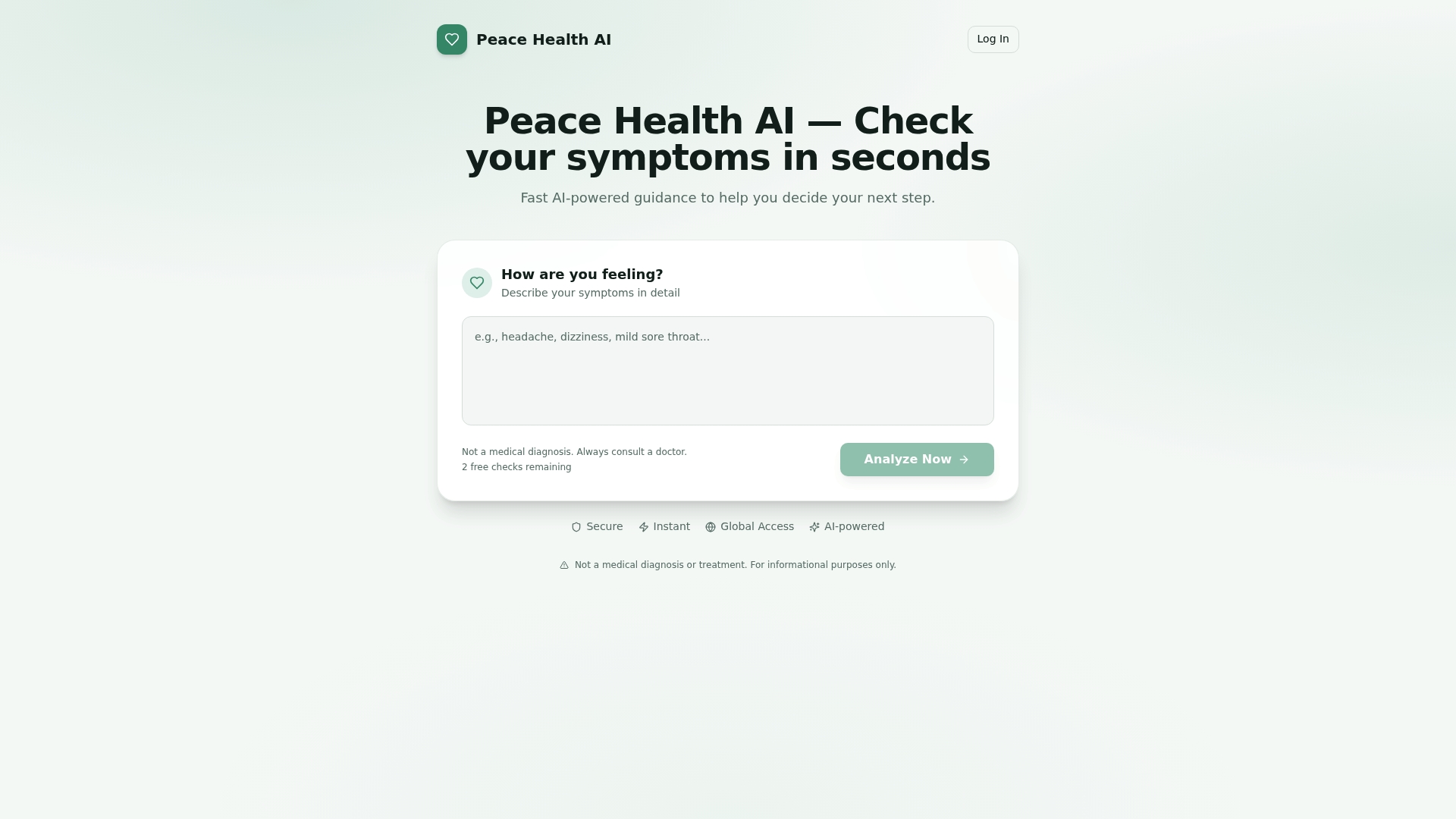
The tool is most useful before a clinician visit, when symptoms are uncomfortable but not emergency-level, or when you are tracking whether urgency and frequency are improving or worsening over time. Peacehealthai also stores your symptom history so you can share a timeline with your clinician rather than reconstructing it from memory. For anyone managing recurrent urinary symptoms, that history is exactly what speeds a correct diagnosis.
If you are unsure whether your symptoms point to a UTI, OAB, or something else, check your symptoms now and get structured next-step guidance in minutes.
Useful sources and further reading
The following sources informed this article and are recommended for readers who want more detail from clinician-trusted references.
"UTIs are common infections that happen when bacteria, often from the skin or rectum, enter the urethra and infect the urinary tract. Antibiotics treat UTIs. Your healthcare provider can determine if you have a UTI and what antibiotic you need." — CDC: Urinary Tract Infection Basics
- Urinary Tract Infections — womenshealth.gov: Covers UTI causes, symptoms, and treatment with a focus on women's health; includes statistics on lifetime prevalence.
- UTI Symptoms and Causes — Mayo Clinic: Detailed breakdown of UTI risk factors including postmenopause and catheter use.
- Overactive Bladder — MedlinePlus: Plain-language overview of OAB causes, diagnosis, and treatment options from the National Library of Medicine.
- Nocturia: Classification and Causes — NCBI: Clinical reference on nocturia causes, useful for understanding why nighttime urination is not diagnostic on its own.
- Nocturia and Bladder Diary Recommendations — AAFP: Evidence-based guidance on using voiding diaries for diagnosis; directly supports the diary template in this article.
- Bladder Infection (UTI) in Adults — NIDDK: National Institute of Diabetes and Digestive and Kidney Diseases overview of bladder infection facts and definitions.
- Symptom tracking guide — Peacehealthai blog: Practical methods and templates for recording symptom history before a clinician visit.
This article is general health information, not medical advice. Confirm current treatment guidelines and your individual situation with a qualified healthcare provider.