
When do symptoms require immediate action?
Some symptoms demand a response in minutes, not hours. Severe chest pain or pressure, sudden difficulty breathing, stroke signs (face drooping, arm weakness, slurred speech), loss of consciousness, uncontrolled heavy bleeding, and sudden severe abdominal pain all require calling 911 right now. These are not situations for a symptom checker or a call to your doctor's office.
While you wait for emergency services, keep the person still and calm, apply firm pressure to any bleeding wound, and do not give food or water. If someone has stopped breathing and you are trained in CPR, begin immediately. The goal is to stabilize, not treat.
The triage framework used across U.S. emergency medicine sorts situations into four levels: emergency, urgent, routine, and self-care. Knowing which level fits your situation determines where you go and how fast. If you are genuinely unsure, default to emergency care rather than waiting for certainty.
Symptoms that require calling 911 immediately:
- Chest pain or pressure spreading to the arm or jaw
- Sudden weakness or numbness on one side of the body
- Difficulty breathing or stopped breathing
- Seizures lasting more than one minute
- Sudden confusion or inability to speak, see, or walk
- Uncontrollable heavy bleeding
- Severe allergic reaction with throat swelling or hives
- High fever with a stiff neck and severe headache
- Loss of consciousness or fainting that does not resolve quickly
How to use symptom checkers safely and effectively
Symptom checkers perform triage, not diagnosis. They categorize urgency into levels (emergency, urgent, routine, self-care) and point you toward the right care setting. That distinction matters in practice: a checker that flags "emergency" is telling you to call 911, not to read more articles.
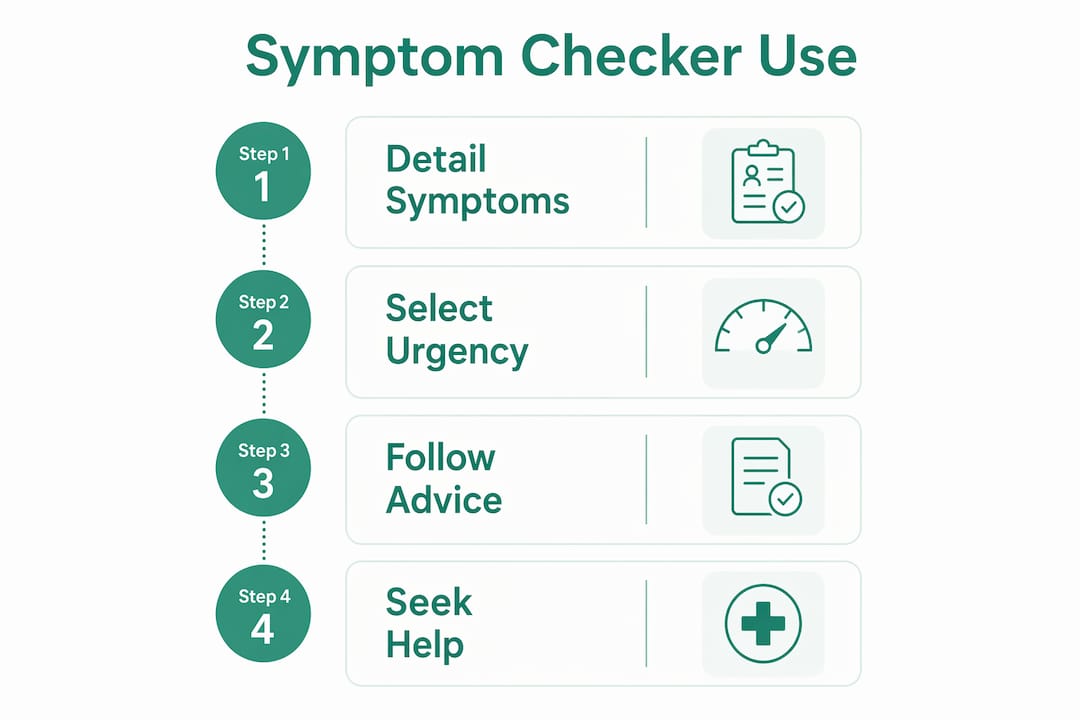
To get accurate results, describe your symptoms in as much detail as possible. Include when they started, how severe they feel on a scale of 1–10, whether they are getting worse, and any other symptoms present at the same time. Vague inputs produce vague outputs.

Read the triage category carefully when you get your result. "Urgent" means same-day evaluation, not next week. If your symptoms worsen at any point during or after using a checker, stop and call 911 or go to the nearest emergency department. A checker result does not override what your body is telling you.
Best practices for using symptom checkers:
- Be specific: include symptom duration, severity, and any triggers
- List all associated symptoms, even ones that seem unrelated
- Follow the triage category output, not just the symptom description
- Never use a checker as a substitute for care when symptoms are severe
- If the checker recommends emergency care, call 911 immediately without second-guessing
- People with chronic or complex conditions should follow their individual care plans and contact their provider directly rather than relying on generic checker advice
Which symptoms need emergency care versus monitoring?
Not every symptom is a crisis. Knowing the difference lets you act fast when it counts and avoid unnecessary emergency visits when it does not.
Emergency care now (call 911 or go to the ER):
- Chest pain, pressure, or pain radiating to the arm or jaw
- Sudden severe headache unlike any you have had before
- Stroke signs: face drooping, arm weakness, speech difficulty
- Coughing or vomiting blood
- Severe burns, deep wounds, or possible spinal injury
- Overdose or poisoning
Urgent care today (same-day evaluation needed):
- High fever that does not respond to medication
- Moderate injuries such as suspected fractures without bone breaking skin
- Sudden dizziness or weakness that does not resolve
- Sudden confusion or significant vision changes
- Severe allergic reaction without airway involvement
Monitor at home (self-care with safety-netting):
- Mild cold or flu symptoms in otherwise healthy adults
- Low-grade fever that responds to over-the-counter medication
- Minor cuts, sprains, or bruises
- Mild sore throat or earache without high fever
Key point: The American College of Emergency Physicians confirms that emergency departments are the right setting for life-threatening symptoms including chest pain, stroke signs, severe breathing difficulty, and unconsciousness. Urgent care centers handle non-emergencies that still need fast attention.
If you notice early warning signs of dementia such as sudden memory gaps, disorientation, or personality changes, treat these as urgent rather than routine. They often go unrecognized until the window for early intervention has narrowed.
Trusted symptom checker resources available in the United States
Three clinically reviewed tools are widely used and recommended for quick symptom assessment help in the U.S.
Mayo Clinic Symptom Checker draws on one of the most respected medical institutions in the country. It guides people through a structured set of questions and produces recommendations tied to Mayo's clinical standards. The output is clear and links directly to relevant health information.
Healthdirect Symptom Checker, developed by the Australian Government Department of Health, takes an average of six minutes to complete and advises whether you should see a doctor or manage symptoms at home. It cannot give a diagnosis and states this clearly upfront. While built for an Australian audience, it is publicly accessible and follows evidence-based clinical guidelines.
Patient.info Symptom Checker is a UK-based tool backed by clinically reviewed health information. It walks people through symptom inputs and produces triage-level guidance. Like the others, it is an educational tool, not a replacement for professional care.
All three tools integrate expert medical input and clinical evidence to support urgency decisions. None of them diagnose conditions.
Benefits shared across these resources:
- Structured symptom input with follow-up questions
- Clear triage output directing you to the right care level
- Accessible via web browser with no account required
- Backed by clinical review and medical expertise
- Free to use for basic symptom assessment
How AI-powered tools improve your symptom assessment
AI-powered symptom checkers go further than static question trees. They analyze detailed symptom descriptions, cross-reference patterns against clinical guidelines, and produce urgency recommendations in seconds. The American Medical Association recognizes AI-driven digital health tools as a meaningful category in modern health triage.
Peacehealthai offers both basic and advanced symptom analysis, with features including symptom history tracking, early alerts for repeated symptom patterns, a health score, and an AI health chat. Higher-tier plans add priority response speed and goal-based coaching for areas like fat loss, muscle gain, and general wellness. The design is clean and approachable, built for people who want a clear answer without wading through medical jargon.
Peacehealthai does not diagnose. If your assessment flags emergency-level symptoms, call 911. The tool's value is in the middle ground: helping you decide whether a symptom warrants urgent care today, a scheduled appointment, or watchful waiting at home.
Where AI symptom checkers add the most value:
- Rapid triage when you are unsure whether to go to the ER or urgent care
- Tracking recurring symptoms over time to spot patterns
- Providing context for symptoms that feel vague or hard to describe
- Reducing unnecessary emergency visits for non-critical concerns
- Offering 24/7 access when your doctor's office is closed
Pro Tip: When using any AI symptom checker, include every symptom you are experiencing, even ones that seem minor or unrelated. AI triage tools are only as accurate as the information you give them.
Special considerations for children, the elderly, and pregnant people
Vulnerable groups often present symptoms differently, and the thresholds for seeking care are lower across the board.
Children cannot always describe what they feel. Watch for behavioral cues: unusual lethargy, refusal to eat, inconsolable crying, or a fever in infants under three months. Any of these in a young child warrants same-day evaluation at minimum. A medical ID tag can help emergency responders quickly access a child's health history when seconds matter.
Older adults may not show classic symptoms. A heart attack in someone over 70 can present as fatigue or nausea rather than chest pain. Sudden falls, new confusion, or a change in baseline behavior should be treated as urgent, not dismissed as normal aging.

Pregnant people face a narrower safety margin. Severe headache, sudden swelling of the face or hands, decreased fetal movement, or vaginal bleeding at any stage requires immediate evaluation. Do not wait to see if it resolves.
Key Takeaways
Symptom checkers are triage tools, not diagnostic ones. When symptoms feel life-threatening, call 911 first and use a checker second.
| Point | Details |
|---|---|
| Emergency symptoms need 911 | Chest pain, stroke signs, seizures, and uncontrolled bleeding require calling 911, not a checker. |
| Checkers categorize, not diagnose | Symptom checkers assign urgency levels (emergency, urgent, routine, self-care) to guide your next step. |
| Uncertain? Default to emergency care | When urgency is unclear, seeking emergency care is always the safer choice. |
| Vulnerable groups need lower thresholds | Children, older adults, and pregnant people should seek care sooner than the general adult population. |
| AI tools improve triage decisions | Peacehealthai and similar AI-powered tools help identify symptom patterns and reduce unnecessary ER visits. |