
If your head pain is one-sided, throbbing, and comes with nausea or light sensitivity, you're likely dealing with a migraine, not a routine headache. A regular tension headache usually feels like a dull band of pressure on both sides of your head and rarely comes with the sensory sensitivities that define migraine attacks.
That single distinction changes almost everything about how you should respond.
- Pain quality and location: Migraine pain tends to be one-sided and pulsing; tension headaches feel like a tight, pressing band across both sides.
- Associated symptoms: Nausea, sensitivity to light or sound, and visual disturbances (aura) point strongly toward migraine, especially when two or more show up together.
- Duration: Untreated migraine attacks typically run 4 to 72 hours, while tension headaches can be shorter or drag on for days at a lower intensity.
Seek urgent care immediately if you experience a sudden "worst headache of your life," head pain with fever and neck stiffness, new severe headache after age 50, or any new weakness, confusion, or vision loss alongside the pain.
Key Takeaways
Migraine is a distinct neurological diagnosis marked by one-sided throbbing pain, nausea, and sensory sensitivity, while a routine headache is usually a milder, bilateral, pressure-type symptom.
| Point | Details |
|---|---|
| Check the symptom combo | Nausea plus light sensitivity plus real disability points strongly toward migraine, not a routine headache. |
| Know the duration difference | Migraine attacks typically run 4 to 72 hours untreated; tension headaches are often shorter but can drag on longer at lower intensity. |
| Watch the frequency threshold | Four or more headache days a month is a common trigger point to discuss preventive therapy with a doctor. |
| Avoid the overuse trap | Using simple painkillers over 14 days a month, or triptans over 9 days a month, risks medication overuse headache. |
| Track before you treat | Peace Health AI's symptom checker helps log attacks and spot patterns you can bring straight to a clinician. |
Table of Contents
- Why It Matters Whether You Have a Migraine or a Headache
- What Are the Most Common Types of Headaches?
- What Are the Phases and Symptoms of a Migraine Attack?
- Tension Headache or Migraine: How Do You Tell Them Apart?
- How Do Cluster, Sinus, and Overuse Headaches Differ From Migraine?
- What Triggers Migraines, and How Do You Test Your Own?
- How Are Migraines and Headaches Treated and Prevented?
- When Should You See a Doctor About a Headache?
- How Should You Track Your Symptoms for a Better Diagnosis?
- Our Take: The Gap Between Knowing and Tracking
- How Peace Health AI Helps You Track and Triage Symptoms
- Frequently Asked Questions
- Sources
Why It Matters Whether You Have a Migraine or a Headache
Here's the distinction most people miss: a headache is a symptom, but migraine is a neurological diagnosis. That's not a technicality. It changes what you take, when you take it, and how your doctor plans your care over the long term, according to NewYork-Presbyterian's health team.
A tension headache usually responds to ibuprofen and a nap. Migraine often doesn't. It can require attack-specific medications like triptans, targeted anti-nausea drugs, and, for frequent cases, daily preventive therapy. Get the label wrong and you end up treating a neurological condition with tools built for a much milder problem.
The stakes go beyond comfort:
- Migraine can be disabling enough to derail work, parenting, and social plans for a full day or more, and Cleveland Clinic notes it often needs both acute and preventive treatment strategies.
- Treating the wrong condition repeatedly with over-the-counter painkillers raises your risk of medication overuse headache, a self-perpetuating cycle covered in detail later in this article.
- Migraine with aura carries specific considerations around stroke risk that your doctor needs to know about, particularly if you smoke or take hormonal birth control.
Pro Tip: If you're having four or more headache days a month, that frequency alone is a widely used threshold for discussing preventive therapy with a doctor, even if each individual episode feels manageable.
What Are the Most Common Types of Headaches?
Before you can tell migraine apart from "just a headache," it helps to know what else is out there. Head pain isn't one thing. It's a category with several distinct members, each with its own fingerprint.
- Tension-type headache: Dull, pressing pain on both sides, often triggered by stress, poor posture, or eyestrain; usually responds to OTC medication and rest.
- Migraine: One-sided, throbbing pain, moderate to severe, frequently paired with nausea and light or sound sensitivity.
- Cluster headache: Excruciating, stabbing pain around one eye, arriving in short, repeated bursts with tearing or nasal congestion on the same side.
- Sinus headache: Pressure and pain around the cheeks, forehead, or bridge of the nose, usually tied to an actual sinus infection with thick nasal discharge.
- Medication overuse headache: A near-daily dull headache caused by taking pain relievers too often, which paradoxically keeps the pain cycle going.
- Secondary headache: Pain caused by an underlying issue, such as a head injury, high blood pressure, or in rare cases something more serious, rather than a headache disorder itself.
These categories aren't always tidy. Plenty of people have tension headaches most of the time and occasional migraine attacks layered on top, which is exactly why tracking your symptoms over time matters more than diagnosing a single bad day.
What Are the Phases and Symptoms of a Migraine Attack?
Migraine doesn't just show up as pain. It moves through a recognizable sequence, and learning to spot the early phases is one of the most useful things you can do for yourself.
- Prodrome: Starts hours to a day or two before the pain. Watch for mood changes, food cravings, neck stiffness, or unusual fatigue.
- Aura: Affects roughly a third of people with migraine. Common signs include flashing lights, zigzag lines in your vision, or tingling on one side of the face or hand.
- Attack: The main event. One-sided throbbing pain, often worsened by movement, light, or sound, typically lasting 4 to 72 hours if untreated.
- Postdrome: Sometimes called the "migraine hangover." Fatigue, mild confusion, or lingering sensitivity can last a day after the pain fades.
Recognizing these four phases matters because catching a migraine in the prodrome or early aura stage, before the pain peaks, generally means treatment works better and faster.
The cardinal features that separate a migraine attack from other head pain:
- Pain is one-sided (though it can switch sides between attacks or, less commonly, affect both).
- The quality is throbbing or pulsing, not a steady pressure.
- Intensity is moderate to severe, often severe enough to stop you mid-task.
- Physical activity, like climbing stairs, makes it noticeably worse.
- Light and sound become genuinely hard to tolerate.
- Nausea or vomiting frequently rides along with the pain.
Migraine is also a spectrum condition. Some people get aura without any headache pain at all, and others develop chronic migraine, defined as headache on 15 or more days a month. Both patterns change how a doctor approaches treatment.
Tension Headache or Migraine: How Do You Tell Them Apart?
When the pain hits, most people don't want a phase breakdown. They want a yes or no. Here's how the two stack up across the factors that actually matter for treatment decisions.
| Feature | Migraine | Tension-Type Headache |
|---|---|---|
| Pain quality | Throbbing or pulsing | Dull, pressing, or band-like |
| Typical location | One side of the head | Both sides, often like a tight band |
| Severity and impact | Moderate to severe; often stops normal activity | Mild to moderate; usually allows you to keep functioning |
| Associated symptoms | Nausea, light and sound sensitivity, sometimes aura | Rarely accompanied by nausea or sensory sensitivity |
| Typical duration | 4 to 72 hours untreated | several days, usually milder throughout |
| Common triggers | Hormones, sleep changes, certain foods, stress, weather | Stress, poor posture, eyestrain, muscle tension |
| First-line treatment | Migraine-specific meds (triptans), antiemetics, early dosing | OTC analgesics, rest, stretching, relaxation techniques |
A quick way to sort your own symptoms: if you've got nausea plus light sensitivity plus real disability, meaning the pain stopped you from working or doing normal tasks, that combination points strongly toward migraine. This lines up with the ID Migraine screening tool used in primary care, where two or more "yes" answers to those three questions suggests migraine.
- If your pain is bilateral, dull, and you can still push through your day, tension-type is the more likely answer.
- If symptoms overlap heavily, some nausea here, some pressure there, don't force a self-diagnosis. That's exactly the situation where a clinician's assessment earns its cost.
How Do Cluster, Sinus, and Overuse Headaches Differ From Migraine?
Migraine gets confused with several other conditions, and mixing them up means mistreating them. Each has a signature that, once you know it, is hard to miss.
Cluster headaches feel almost nothing like a typical migraine, despite both being severe. The pain is excruciating, strictly one-sided, centered around or behind one eye, and shows up in short, repeated bursts, sometimes several times a day for weeks at a stretch. It often comes with tearing, a drooping eyelid, or nasal congestion on the same side as the pain, a pattern migraine rarely produces.
Sinus headaches get blamed constantly, but true sinus headaches are less common than people assume. The giveaway is thick, discolored nasal discharge and other signs of an actual sinus infection, like fever or facial tenderness over the sinuses. Without those infection markers, what feels like "sinus pressure" is very often migraine misfiled under the wrong name.
Medication overuse headache is quieter but more insidious. It develops when you treat frequent head pain with painkillers so often that your body starts rebounding into more headaches between doses, a cycle that feeds itself.
Simple analgesics like NSAIDs or acetaminophen used more than roughly 14 days a month, or triptans used more than about 9 days a month, can tip you into this cycle. The headache that results often feels like a dull, constant ache that never fully resolves, and reaching for another pill only maintains it.
Secondary headaches deserve a category of their own because they're symptoms of something else entirely, a head injury, uncontrolled blood pressure, or rarely a more serious neurological event. Any headache paired with fever and stiff neck, sudden severe onset, or new neurological symptoms belongs in urgent care, not a home remedy.
What Triggers Migraines, and How Do You Test Your Own?
Triggers aren't universal. What sets off an attack for one person does nothing for another, which is why generic trigger lists only get you partway there.
The usual suspects show up again and again:
- Disrupted sleep, whether too little or, oddly, too much
- Hormonal shifts, especially around menstrual cycles
- Skipped meals or dehydration
- Specific foods: aged cheese, processed meats, artificial sweeteners for some people
- Alcohol, particularly red wine
- Sudden weather or barometric pressure changes
- Strong smells like perfume or cleaning products
- Emotional stress, or the drop in stress right after a tense period
- Big swings in caffeine intake, in either direction
Attacks rarely come from one trigger acting alone. More often, several minor factors stack up. A rough night of sleep plus a skipped lunch plus a stressful meeting might not do anything individually, but combined they can cross your personal threshold.
Pro Tip: To test whether something is really your trigger, remove just that one factor for two to three weeks while keeping everything else the same, then reintroduce it deliberately and log what happens over the following 24 hours. Changing five variables at once tells you nothing; changing one and tracking the result tells you almost everything.

How Are Migraines and Headaches Treated and Prevented?
Treatment splits into two jobs: stopping the attack you're having now, and reducing how often attacks show up in the first place. Get the timing right on the first one and the second becomes far less necessary.
For acute attacks, act fast:
- Take OTC pain relievers like acetaminophen or NSAIDs at the very first sign of an attack, not after the pain has fully built.
- If OTC medication isn't cutting it, ask a doctor about triptans, a class of medication built specifically for migraine, not general pain.
- Add an antiemetic if nausea is part of your pattern; treating the nausea often makes the whole attack more bearable.
- Rest in a dark, quiet room whenever possible. It sounds obvious, but reducing sensory input measurably shortens recovery for a lot of people.
For prevention, once frequency or severity crosses a line:
- Lifestyle basics matter more than most people expect: consistent sleep, regular meals, and steady hydration remove a surprising number of triggers before they start.
- Magnesium and riboflavin are commonly discussed supplement options, though they work better as an addition to other strategies than a standalone fix.
- Prescription preventives, including daily oral medications and newer CGRP-targeting treatments, are usually considered once attacks hit four or more days a month or are disabling enough to disrupt regular life.
The catch is that acute treatment carries its own risk if overused. Reaching for painkillers too often turns them from a solution into a problem, and the thresholds are specific: NSAIDs and acetaminophen beyond about 14 days a month, triptans beyond about 9 days a month. Staying under those limits, and talking to a doctor about prevention if you're bumping against them, is how you avoid trading one headache problem for a worse one.
When Should You See a Doctor About a Headache?
Most headaches don't need a medical visit. Some absolutely do, and knowing which is which can matter more than any treatment decision.
Get evaluated immediately if you notice any of these:
- A sudden, severe headache unlike anything you've had before, sometimes described as a "thunderclap"
- Headache with fever, stiff neck, confusion, or a rash
- New weakness, numbness, slurred speech, or vision loss alongside the pain
- A first severe headache appearing after age 50
- Headache that keeps getting progressively worse over days rather than settling
Outside of emergencies, it's worth booking a routine visit with a doctor or headache specialist if attacks are happening four or more times a month, if pain regularly stops you from working or caring for yourself, or if OTC treatment has stopped working. Clinicians sometimes apply a practical five-day rule, checking whether pain has prevented normal activity for at least one full day, to gauge whether an attack is disabling enough to justify a bigger treatment change.
At the visit, expect a detailed conversation about your headache history, timing, and family history, since migraine often runs in families. Imaging like an MRI or CT scan is only ordered when something in your history or exam raises a red flag, not as routine practice. Bring a symptom log if you have one. It tells the doctor more in five minutes than a verbal recap usually can, as discussed further here.
How Should You Track Your Symptoms for a Better Diagnosis?
A headache diary sounds tedious until you realize it's the single fastest way to turn "I get headaches sometimes" into a pattern a doctor can actually act on.

| Field to Log | What to Record |
|---|---|
| Date and time | When the pain started and, if possible, when it ended |
| Pain score | Rate for intensity |
| Location | One side, both sides, behind one eye, forehead |
| Pain quality | Throbbing, pressing, stabbing, dull |
| Associated symptoms | Nausea, light or sound sensitivity, aura, tearing |
| Possible trigger | Sleep, food, stress, hormones, weather |
| Duration | How long the episode lasted |
| Medication taken | What you took, dose, and timing relative to onset |
| Effect of treatment | Fully resolved, partially helped, no effect |
| Impact on activity | Worked through it, had to rest, missed obligations |
Keep this in a notes app, a spreadsheet, or a dedicated tracker. What matters is consistency, not the tool. After three or four attacks, patterns start jumping out that you'd never notice in the moment, like every attack showing up two days before your period, or always following a poor night's sleep.
An online symptom checker can help you organize this information and get a sense of whether your pattern leans toward migraine or another headache type, but treat its output as a starting point for a conversation, not a final answer. It works best when you feed it specific, dated symptoms rather than a vague "my head hurts a lot."
Pro Tip: Bring three things to your appointment: your symptom log, a list of every medication you've tried (including OTC), and a note on how each headache affected your ability to function that day. That combination gives a doctor more diagnostic information than most people provide in months of visits.
Our Take: The Gap Between Knowing and Tracking
Most people don't struggle to understand the difference between migraine and headache once someone lays it out clearly. The one-sided throbbing, the nausea, the light sensitivity, none of that is complicated. What trips people up is memory. By the time you're sitting in a doctor's office two weeks after your worst attack, the details have blurred into "I had a bad headache and felt sick."
That's the real gap, and it's more consequential than most headache advice admits. A doctor can't identify a four-day-a-month pattern that justifies preventive therapy if you can only describe your last episode. Diagnosis in this field runs on frequency and pattern, not on any single dramatic attack.
We'd also push back gently on the instinct to tough it out. Waiting until pain is unbearable before treating it is one of the most common reasons acute medication seems to "stop working." It's not that the drug failed. It's that migraine biology gets harder to interrupt the longer an attack has been building. Early treatment, right at the first hint of prodrome or aura, consistently performs better than treatment started an hour into a full attack.
If there's one habit worth building from this article, it's logging your symptoms the same day they happen, every time, even the mild ones. That record is what turns a vague sense of "I get headaches" into an actual diagnosis and a workable treatment plan.
How Peace Health AI Helps You Track and Triage Symptoms
Figuring out whether a headache is a one-off or part of a migraine pattern usually takes weeks of paying close attention, not a single symptom checklist. Peace Health AI is built for exactly that gap: describe what you're feeling in plain language, and the AI symptom checker helps you log the details, spot recurring patterns across attacks, and get a clearer sense of what your next step should be.
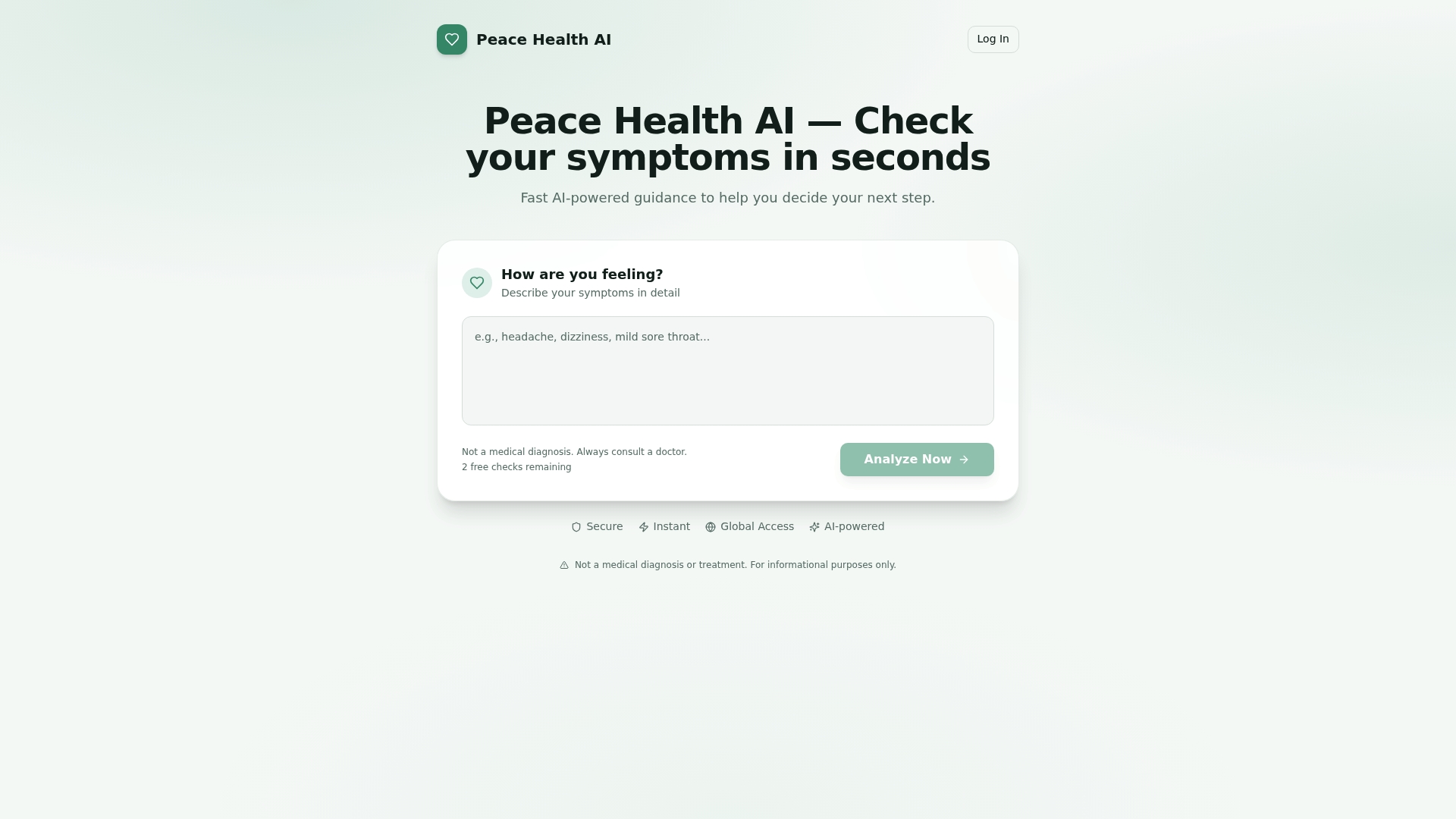
The tool's symptom history tracking does the remembering you'd otherwise lose to time, so when a pattern like "always after poor sleep" or "always one-sided with nausea" starts forming, you'll actually see it instead of forgetting it by your next appointment. Early alerts flag repeated symptoms before they become a bigger problem, and the AI health chat gives you a place to ask follow-up questions between attacks.
None of this replaces a clinician, especially if you're hitting red flags like sudden severe pain or neurological symptoms covered earlier in this article; those situations call for immediate medical evaluation, not an app. But for the day-to-day work of tracking patterns and deciding whether it's time to book that appointment, Peace Health AI's symptom checker gives you a running start. Head to Peacehealthai to log your first symptom entry and see how your pattern looks after a week.
Frequently Asked Questions
Can a headache turn into a migraine? A tension headache itself doesn't convert into a migraine attack, but some people experience both conditions and can have trouble telling which one is happening in the moment, especially if a tension headache is unusually severe.
Is it possible to have migraine symptoms without a headache? Yes. Some people experience aura, visual disturbances, tingling, or speech changes, without any accompanying head pain, a recognized pattern within the migraine spectrum.
Why do my headaches feel worse at certain times of the month? Hormonal fluctuations, particularly around menstruation, are a well-documented migraine trigger for many people, which is why tracking timing alongside symptoms often reveals a pattern.
How can I tell if my headache needs emergency care? Treat it as an emergency if the pain came on suddenly and severely, if you have fever with neck stiffness, or if you notice new weakness, confusion, or vision changes alongside the head pain.
Does caffeine help or worsen headaches? Both, depending on the person and the pattern. A small amount can ease some headaches, but withdrawal from regular heavy caffeine use is a common trigger, which is why sudden changes in intake in either direction are worth tracking.
This article is general information, not a substitute for advice from a qualified doctor. Consult a qualified healthcare professional about your own circumstances before acting on anything here.
Sources
- Symptoms and causes - Mayo Clinic
- Migraine and tension-type headache differences (PMC review)
- Migraine vs. Headache: How to Tell the Difference and When to Get Help | NYP Health Matters
- Migraine or Just a Bad Headache? How to Tell the Difference | University of Utah Health
- Migraine headaches overview | Cleveland Clinic