
The best NHS symptom checker alternatives right now are Peacehealthai, Ada Health, WebMD Symptom Checker, Mayo Clinic Symptom Checker, Your.MD, and Symptomate. If you want one clear recommendation, Peacehealthai stands out for its AI-powered triage, symptom history tracking, and privacy-first design that works whether you're in the UK or the US.
Here's a quick use-case breakdown:
- Peacehealthai — best for ongoing health monitoring, AI chat, and personalized triage with tiered plans including a free option
- Ada Health — best for detailed, question-by-question symptom exploration with a clinically reviewed engine
- WebMD Symptom Checker — best for quick, no-signup online symptom assessment backed by a major medical publisher
- Mayo Clinic Symptom Checker — best for users who want structured symptom selection from one of the most trusted medical institutions in the world
- Your.MD (now Healthily) — best for general wellness guidance alongside symptom checking
- Symptomate — best for a clean, fast online symptom assessment with clear triage outputs
Pro Tip: No symptom checker replaces a clinician. If you experience chest pain, sudden difficulty breathing, loss of consciousness, severe bleeding, or any symptom that feels life-threatening, call emergency services immediately — 999 in the UK, 911 in the US. Do not run a symptom check first.
Table of Contents
- How do the top NHS symptom checker alternatives compare?
- How do symptom checkers reach recommendations, and what are their limits?
- How do you pick the right symptom checker for your needs?
- Short profiles: what each tool does well
- When should you skip a symptom checker and get immediate care?
- Key Takeaways
- What Peacehealthai believes about clinical oversight and product intent
- Peacehealthai: what it offers and how to get started
- Useful sources and further reading
How do the top NHS symptom checker alternatives compare?
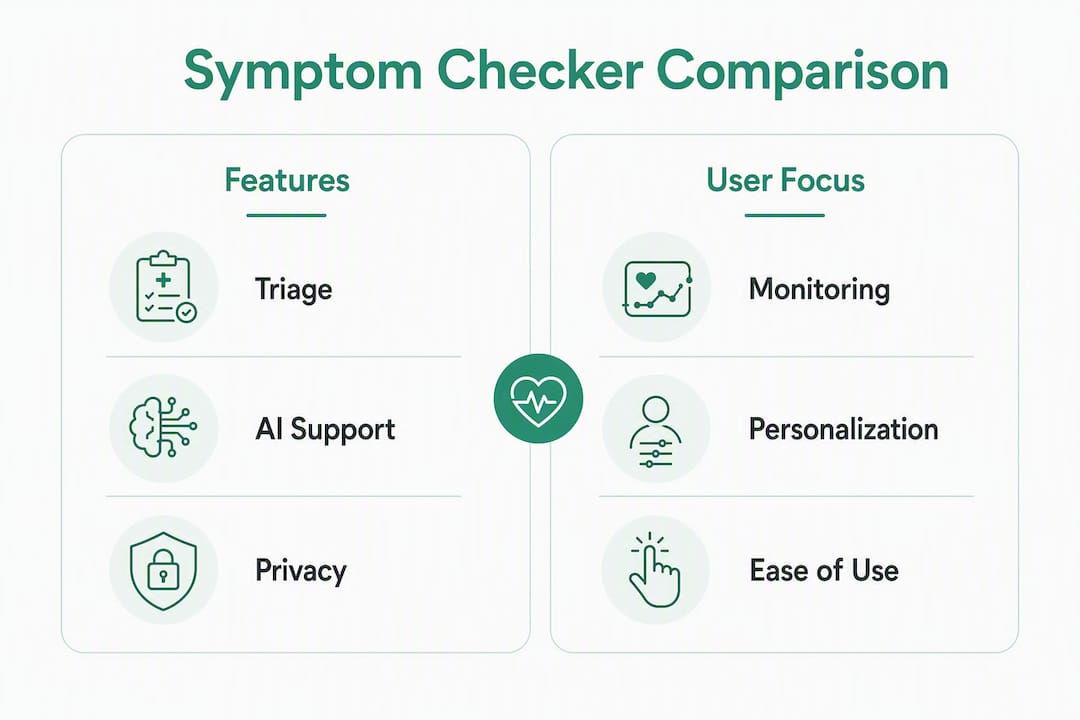
The table below covers the dimensions that actually matter when choosing between these tools.
| Tool | Best for | Platform | Cost | Clinical backing | Triage clarity | AI features | Privacy |
|---|---|---|---|---|---|---|---|
| Peacehealthai ⭐ | Ongoing monitoring + AI health chat | Web, iOS, Android | Free tier + paid plans | AI model with clinical oversight | Self-care / pharmacy / GP / urgent / emergency | Symptom history, AI chat, health score, coaching | Secure global access; transparent data policy |
| Ada Health | Deep symptom exploration | Web, iOS, Android | Free | Clinician-designed; CE-marked app | Clear next-step triage | Adaptive question flow | GDPR-compliant; data use stated |
| WebMD Symptom Checker | Fast, no-signup checks | Web | Free | Major medical publisher; editorial review | Probable causes + care level | Basic; no personalization | Standard publisher privacy policy |
| Mayo Clinic Symptom Checker | High-authority structured check | Web | Free | Mayo Clinic medical staff | Structured flow; not diagnostic | Minimal | Mayo Clinic privacy policy |
| Your.MD / Healthily | Wellness + symptom guidance | Web, iOS, Android | Free / freemium | Clinician-reviewed content | Next-step triage included | Moderate personalization | GDPR-compliant |
| Symptomate | Quick, clean online check | Web, iOS | Free | Medical team review | Self-care / GP / emergency outputs | Moderate | Privacy policy published |
Why Peacehealthai earns the recommended pick: It's the only tool on this list that combines real-time AI symptom analysis with symptom history tracking, daily nutrition and activity insights, early alerts for repeated symptoms, and goal-based coaching. The free tier gives you immediate access; paid plans add priority response speed, advanced personalization, and exportable health data you can bring to a clinician.
A few standout notes on the others:
- Ada's adaptive question flow is genuinely thorough. It asks follow-up questions based on your previous answers, which reduces the chance of missing an atypical presentation.
- WebMD's checker requires no account and loads fast, but it offers no personalization or history.
- Mayo Clinic's tool is backed by one of the most credible medical institutions in the world. It won't give a diagnosis and says so clearly.
- Symptomate's interface is clean and the triage outputs are unambiguous, though its AI personalization is limited compared to Peacehealthai.
How do symptom checkers reach recommendations, and what are their limits?
Symptom checkers are triage tools, not diagnostic tools — they analyze what you enter and suggest probable causes alongside a recommended level of care, not a confirmed medical conclusion.
Most tools use one or more of these methods:
- Decision trees — branching logic that routes you based on yes/no or severity answers
- Bayesian inference — probabilistic models that weight symptom combinations against population-level data
- Clinical rule sets — structured protocols derived from clinical guidelines (similar to what a triage nurse uses)
- AI inference models — machine learning trained on symptom-condition datasets to surface probable matches and flag urgency
Typical outputs include a short list of probable causes ranked by likelihood, plus a triage recommendation: treat at home, visit a pharmacy, see a GP, go to urgent care, or call emergency services. Clinician-designed tools make these care-level distinctions explicit, which is what makes them genuinely useful.
The limits are real, though. Accuracy depends heavily on how precisely you describe your symptoms. Atypical presentations — symptoms that don't follow the textbook pattern — are where these tools most often miss. They also have no access to your full medical history, current medications, or recent lab results, all of which a clinician uses to narrow a differential. A BMJ analysis found that the triage recommendation (the "what to do next" output) is more clinically valuable than the probable-cause list, because it reduces unnecessary urgent visits and helps direct appropriate care.
Pro Tip: You'll get a more useful output by entering specific, time-based details: when symptoms started, how severe they are on a 1–10 scale, whether anything makes them better or worse, and any relevant context like recent travel or new medications. Vague inputs produce vague results.
Here's a brief example of how this plays out. A user enters: "headache, started 2 days ago, 6/10 severity, worse in the morning, no fever, no visual changes, no neck stiffness." A well-designed checker routes that through its logic and returns: probable tension headache or migraine, recommended action — self-care with OTC pain relief, see a GP if it persists beyond 5 days or worsens suddenly. That's a useful, actionable output. The same user entering just "headache" gets a much broader, less useful list.
Treating checker results as preparatory material for a clinician visit is the smartest approach. Generating a summary report before your appointment means you won't forget key details during a short consultation.
How do you pick the right symptom checker for your needs?
The single most important criterion is clear triage guidance backed by clinical oversight. A tool that tells you "possible causes include X, Y, Z" without telling you what to do next is only half useful. The highest-value output is an unambiguous next-step recommendation.
Beyond that, here's what to look for:
- Clinical review: Is the tool designed or reviewed by clinicians? Look for a named medical advisory board, a CE mark (for EU/UK-regulated apps), or explicit statements about clinical oversight.
- Transparent accuracy or validation studies: Does the provider publish any data on how the tool performs? Absence of this doesn't disqualify a tool, but presence of it is a strong trust signal.
- Clear triage outcomes: Can you see a spectrum of recommended actions — self-care, pharmacy, GP, urgent care, emergency — rather than just a list of conditions?
- Privacy policy: Where is your health data stored? Is it sold to third parties? Clinically sensitive data deserves a clear, specific answer.
- Exportable visit summaries: Can you download or share a report of your session? This matters if you want to bring your symptom history to a clinician.
Before you subscribe to a paid tier, ask three questions: Does it show triage steps clearly? Is there named clinician oversight? How long is data retained and who can access it?
Red flags to avoid: no privacy policy, overconfident language like "you have X condition," no triage outcome beyond a list of conditions, and no way to contact support or escalate a concern.

On pricing, free tiers across most of these tools give you basic symptom assessment and triage outputs. Paid tiers typically add symptom history tracking, exportable reports, priority response speed, advanced AI personalization, and in Peacehealthai's case, daily nutrition and activity insights plus goal-based coaching. If you're using a checker regularly or managing a chronic condition, the paid tier's history and export features are worth it.
Short profiles: what each tool does well
Peacehealthai
Peacehealthai is built for people who want more than a one-off symptom check. You enter your symptoms, get an instant AI-powered triage recommendation, and the platform tracks your history over time so patterns don't get lost between visits.
Why choose it:
- AI health chat for follow-up questions after your initial assessment
- Symptom history tracking and early alerts for repeated symptoms
- Daily AI-generated nutrition and activity insights
- Health score analytics and goal-based coaching (fat loss, muscle gain, wellness)
- Free tier available; paid plans add priority response and advanced personalization
Notable limits: As with all symptom checkers, it's an informational triage tool, not a diagnostic service. It works best as preparation for a clinician visit, not a replacement.
Best for: Anyone who wants ongoing health monitoring alongside triage, not just a single-use check. The features page covers the full capability set.
Ada Health
Ada's strength is its depth. The app walks you through a structured, adaptive interview — each answer shapes the next question — which makes it better than most at surfacing atypical presentations. Its Google Play listing notes 24/7 access, exportable assessment reports, and a CE-marked device classification for certain markets. Ada explicitly states it cannot replace professional medical advice.
Why choose it:
- Thorough adaptive question flow
- Exportable assessment reports
- Available on web, iOS, and Android
Notable limits: No ongoing health monitoring or coaching features. The free model is comprehensive but personalization is limited compared to subscription tools.
Best for: Users who want a detailed, one-session symptom exploration.
WebMD Symptom Checker
WebMD's checker is the fastest no-friction option on this list. No account required, loads in seconds, and is backed by WebMD's editorial medical review process. It returns a list of probable conditions and a suggested care level.
Why choose it:
- No signup needed
- Backed by a major medical publisher
- Fast and accessible on any browser
Notable limits: No personalization, no history, no exportable reports. The probable-cause list can feel broad.
Best for: A quick, anonymous first check when you don't want to create an account.
Mayo Clinic Symptom Checker
Mayo Clinic's tool carries the weight of one of the most respected medical institutions in the US. It uses a structured symptom-selection flow and makes clear it won't provide a diagnosis. The outputs are conservative and clinically grounded.
Why choose it:
- Institutional credibility is unmatched
- Structured, methodical symptom flow
- Free, no account required
Notable limits: Minimal AI personalization. Not designed for ongoing monitoring.
Best for: Users who prioritize institutional authority over feature depth.
Your.MD / Healthily
Healthily (formerly Your.MD) combines symptom checking with broader wellness content. It's clinician-reviewed and available on web, iOS, and Android, with a freemium model that adds features at higher tiers.
Why choose it:
- Wellness content alongside triage
- Clinician-reviewed
- Cross-platform
Notable limits: The wellness content can dilute the triage focus for users who want a clean clinical output.
Best for: Users who want health education alongside symptom guidance.
Symptomate
Symptomate is clean, fast, and medically reviewed. It produces clear triage outputs (self-care, GP, emergency) without clutter. Available on web and iOS.
Why choose it:
- Unambiguous triage outputs
- Clean, fast interface
- Medical team review
Notable limits: Limited personalization and no history tracking.
Best for: Users who want a no-fuss, quick online symptom assessment.

Some commercial tools also offer downloadable assessment reports and telehealth integration, which can be useful for connecting your symptom check directly to a follow-up consultation.
When should you skip a symptom checker and get immediate care?
Bypass any online tool entirely and call emergency services if you or someone near you experiences any of the following:
- Chest pain or pressure, especially with shortness of breath, sweating, or arm/jaw pain
- Sudden severe difficulty breathing
- Loss of consciousness or unresponsiveness
- Sudden severe headache unlike any you've had before
- Signs of stroke: face drooping, arm weakness, speech difficulty (think FAST)
- Severe bleeding that won't stop
- Suspected poisoning or overdose
- Severe allergic reaction (throat swelling, difficulty swallowing, hives with breathing changes)
- Sudden confusion or disorientation in an otherwise healthy person
- Major trauma, burns, or injury
In the UK, call 999. In the US, call 911. Do not wait for a symptom checker result before making that call.
Pro Tip: Save your local emergency number, your GP's out-of-hours line, and your nearest urgent care address in your phone contacts now, before you need them. If you use Peacehealthai or Ada, export a symptom summary before heading to an appointment — it gives your clinician a clear picture in the first 60 seconds.
Key Takeaways
The most important thing to understand about any symptom checker is this: triage guidance, not a list of probable conditions, is what makes a tool clinically useful and worth your time.
| Point | Details |
|---|---|
| Triage, not diagnosis | Symptom checkers suggest probable causes and care levels; they never confirm a diagnosis. |
| Triage clarity is the key signal | Prioritize tools that give unambiguous next steps: self-care, pharmacy, GP, urgent care, or emergency. |
| Peacehealthai is the recommended pick | It combines AI triage, symptom history, health coaching, and a free tier — more than a one-off checker. |
| Emergency symptoms bypass all tools | Chest pain, stroke signs, severe breathing difficulty, and major trauma require an immediate 999 or 911 call. |
| Export your report | Bringing a symptom summary to a clinician improves appointment efficiency and reduces missed details. |
What Peacehealthai believes about clinical oversight and product intent
Peacehealthai was built on a straightforward premise: people deserve fast, clear guidance about their symptoms without having to wait hours for an appointment or wade through generic search results. The tool is designed to help you understand what your symptoms might mean and what to do next — not to replace the clinician who will examine you, review your history, and make a real diagnosis.
Our commitment to users includes:
- Clinical oversight: The AI model is designed with clinical triage logic at its core, not just pattern matching.
- Data security: Health data is handled with strict privacy standards; we do not sell personal health information.
- Transparent pricing: A free tier is available with no hidden costs; paid plans are clearly listed on the plans page.
- User education: Every output includes a reminder that the result is informational and that a clinician should be consulted for any ongoing or serious concern.
Peacehealthai: what it offers and how to get started
Most symptom checkers give you a list and leave you to figure out the rest. Peacehealthai gives you a triage recommendation, tracks your symptoms over time, flags patterns before they become problems, and connects that health data to daily coaching on nutrition and activity. That's a meaningfully different product from a one-off web checker.
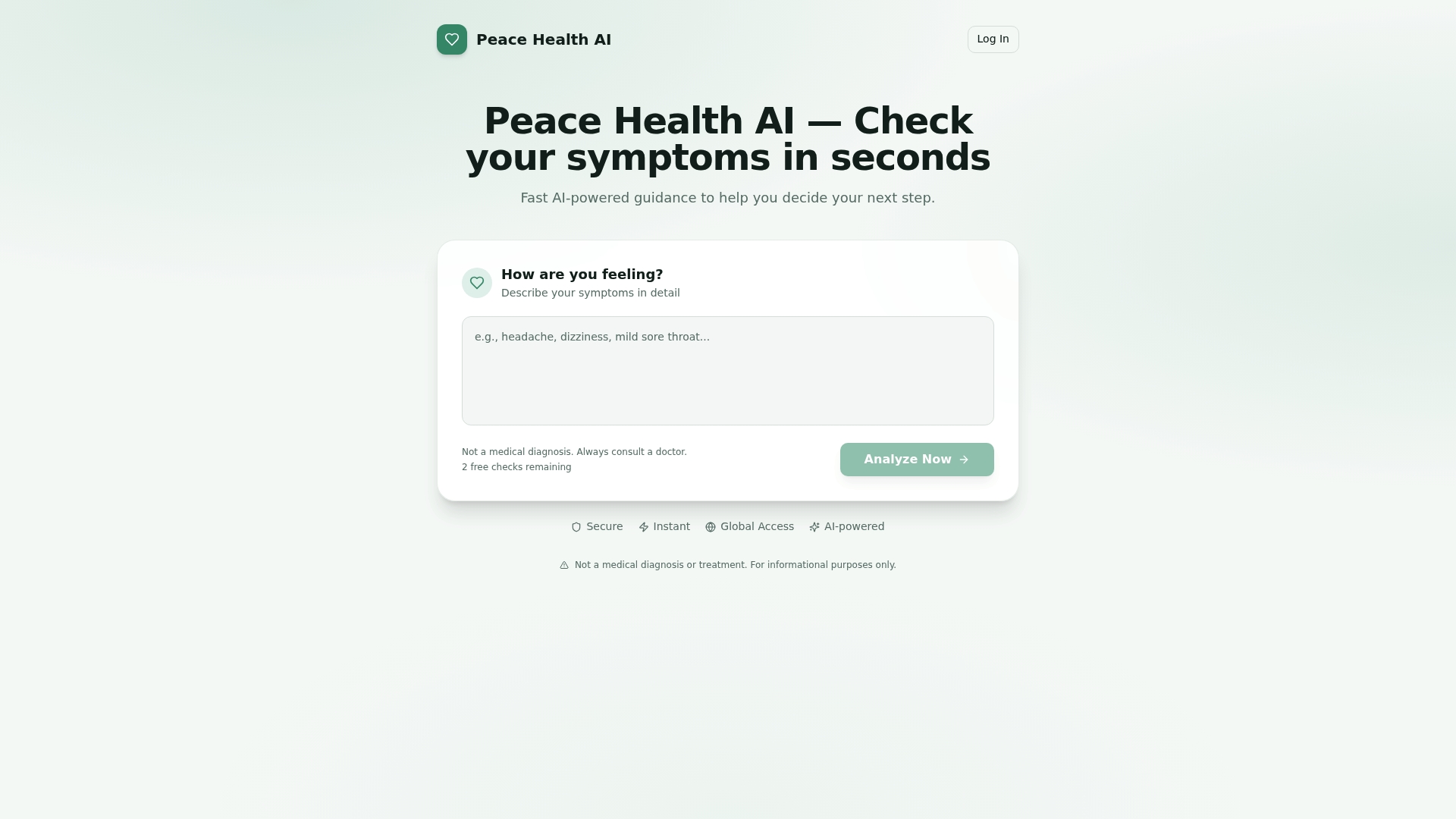
The free tier covers core symptom assessment and basic triage guidance. Paid plans add symptom history, early alerts for repeated symptoms, priority AI response speed, advanced personalization, health score analytics, and goal-based coaching. If you're managing a chronic condition or simply want to stay ahead of your health rather than react to it, the paid tier pays for itself in appointment preparation alone.
Privacy is built in: your health data is stored securely and never sold to third parties. Clinical oversight is embedded in the AI model's triage logic, not bolted on as a disclaimer.
Try the free tier at peacehealthai.org/check, or review the full feature set and plan options at peacehealthai.org before you decide.
Useful sources and further reading
The claims in this article draw from the following authoritative sources. Each is worth bookmarking for your own health research.
| Source | Why it's trustworthy |
|---|---|
| — | The UK's official non-emergency health service; sets the standard for triage guidance and emergency escalation. |
| Mayo Clinic Symptom Checker | One of the most respected medical institutions in the US; structured, conservative, and clinician-backed. |
| BMJ — Symptom Checker Analysis | Peer-reviewed analysis of symptom checker utility; the source for the finding on triage value over probable-cause lists. |
| Ada Health — Google Play | Official app listing with feature details, CE-mark information, and usage cautions. |
| Peacehealthai | The recommended tool in this article; the landing page covers features, privacy, and plan options. |
A few important reminders before you use any of these tools:
- No symptom checker is a substitute for professional medical advice, diagnosis, or treatment. Use these tools to prepare for clinician visits, not to avoid them.
- For emergencies, call 999 (UK) or 911 (US) immediately. Do not run a symptom check first.
- Consult your GP or a qualified clinician for any symptom that persists, worsens, or concerns you.
This article is general health information, not medical advice. Always confirm your situation with a qualified healthcare professional or the relevant primary source.