
AI in healthcare is conditionally safe. When a system has been clinically validated, deployed with human oversight, and regulated under recognized frameworks like the FDA's device clearance pathway or the NIST AI Risk Management Framework, the evidence supports meaningful patient-safety benefits. When those conditions are absent, the same technology can produce biased diagnoses, hallucinated drug advice, or privacy breaches. The honest answer is: it depends entirely on the specific application, how rigorously it was tested, and who is watching it after deployment.
When AI in healthcare tends to be reasonably safe:
- FDA-cleared or FDA-approved diagnostic imaging tools with prospective clinical validation
- Clinical decision support systems integrated with physician review and override capability
- Administrative automation tools (scheduling, coding) with low direct patient-safety stakes
- Symptom checkers used as informational triage aids, not as diagnostic replacements
When AI in healthcare carries higher risk:
- Consumer-facing large language model (LLM) chatbots with no clinical validation or regulatory clearance
- Autonomous treatment recommendation systems without clinician-in-the-loop design
- AI tools trained on narrow or demographically skewed datasets applied to broader populations
- Any system deployed without post-market monitoring or incident reporting
A physician-led red-teaming study found that publicly available LLM chatbots produced unsafe responses in a notable minority of cases across many primary-care questions. That figure sounds small until you consider the scale of consumer AI health queries.
Pro Tip: Before trusting any AI health tool, search for its FDA clearance number or ask the vendor directly. If they cannot produce one, treat the output as general information only, not clinical guidance.
Key Takeaways
AI in healthcare is safe when it is clinically validated, deployed with human oversight, and governed under recognized frameworks like FDA clearance and the NIST AI Risk Management Framework.
| Point | Details |
|---|---|
| Safety is conditional | AI safety depends on the specific application, validation rigor, and ongoing governance, not the technology alone. |
| LLM chatbots carry measurable risk | A physician-led study found unsafe responses in 5–13% of cases across 222 primary-care questions from publicly available chatbots. |
| FDA clearance is a key signal | Patients and clinicians should verify FDA clearance status before relying on any AI tool for clinical guidance. |
| Bias and drift require active monitoring | Models trained on skewed data can worsen health disparities; post-market bias audits and drift detection are required safeguards. |
| AI supports clinicians, it does not replace them | Use AI outputs as inputs to a clinician conversation; override AI recommendations when clinical judgment conflicts. |
Table of Contents
- What AI actually does in healthcare today
- The main safety risks you need to understand
- How U.S. regulation and evidence shape AI safety in medicine
- How developers and health systems actually validate AI for safety
- Why generative AI hallucinates and what can be done about it
- What patients and clinicians should do right now
- Real cases where AI failed in healthcare
- Where AI safety in healthcare is headed
- Peace Health AI's perspective on what safety actually requires
- Sources
What AI actually does in healthcare today
AI in medicine covers a wide range of applications with very different safety profiles. Grouping them together is where most public confusion starts.
Diagnostic imaging analysis uses computer vision models to flag abnormalities in radiology scans, pathology slides, and retinal images. Several FDA-cleared tools in this category have demonstrated sensitivity and specificity comparable to specialist radiologists in controlled studies. Safety concerns center on false negatives (missed findings) and on whether the model was validated on a population similar to the one it is now reading.
Clinical decision support (CDS) tools surface drug interaction alerts, sepsis risk scores, and care pathway recommendations inside electronic health records. The safety risk here is less about the AI being wrong and more about alert fatigue: when a system fires too many low-priority warnings, clinicians start dismissing them, including the ones that matter. The AHRQ specifically flags alert fatigue as a common implementation failure.
Risk prediction models estimate which patients are likely to deteriorate, readmit, or develop a complication. These tools can improve outcomes when they route high-risk patients to earlier intervention. The danger is when a model trained on historically biased data systematically underestimates risk for certain demographic groups.
Symptom checkers and health chatbots let patients describe their symptoms and receive triage guidance. Safety stakes vary: a tool that tells someone with chest pain to "monitor at home" instead of calling 911 is a life-safety failure. A tool that correctly routes a patient to urgent care is a genuine benefit.
Remote monitoring and biometric AI analyzes continuous data from wearables and implanted devices to detect arrhythmias, glucose trends, or deterioration signals. Real-time monitoring creates real-time risk if the alert logic misfires or if connectivity fails.
Workflow and administrative automation handles scheduling, prior authorization, and clinical documentation. Direct patient-safety stakes are lower here, though errors in documentation can propagate into clinical records.
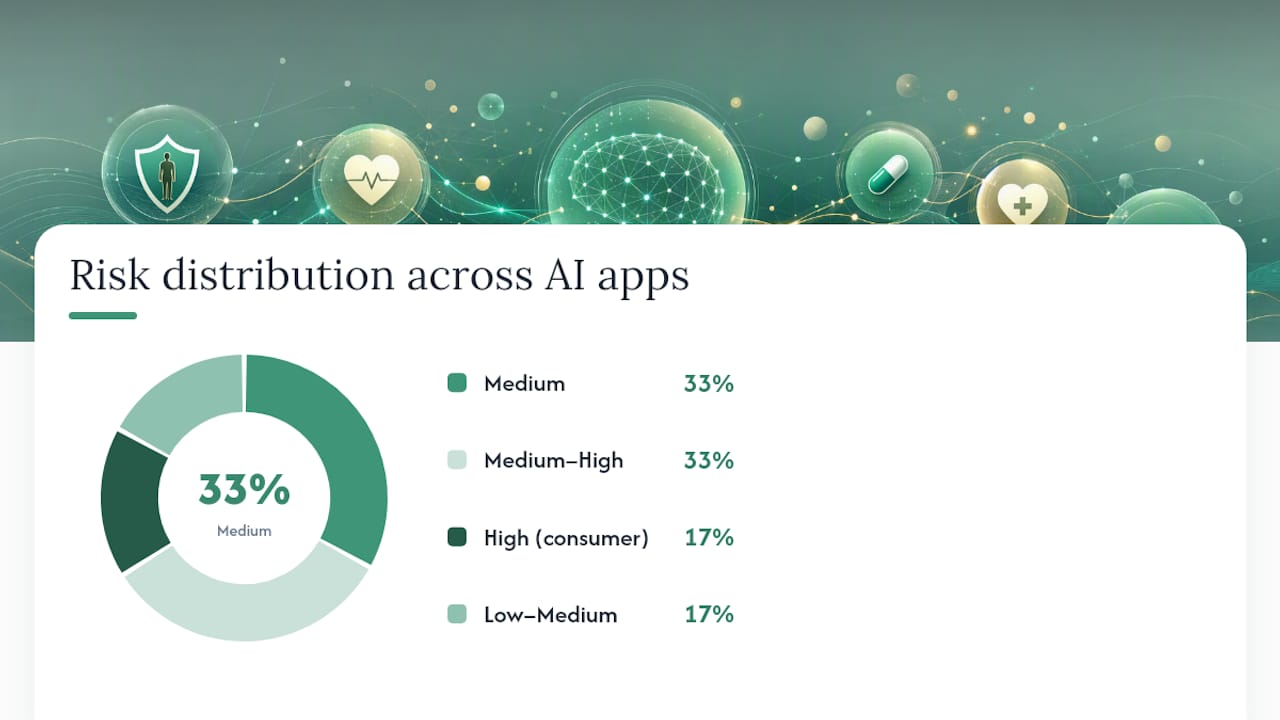
| Application | Primary safety concern | Relative risk level |
|---|---|---|
| Diagnostic imaging AI | False negatives, population mismatch | Medium |
| Clinical decision support | Alert fatigue, workflow mismatch | Medium |
| Risk prediction models | Demographic bias, miscalibration | Medium–High |
| Symptom checkers / chatbots | Hallucinations, no EHR access | High (consumer-facing) |
| Remote monitoring | Real-time alert errors, connectivity | Medium–High |
| Administrative automation | Documentation errors | Low–Medium |
Pro Tip: When evaluating any AI health tool, ask specifically which patient population it was validated on. A model trained predominantly on data from academic medical centers may perform differently in community or rural settings.
The main safety risks you need to understand
Bias and health equity
AI models learn from historical data, and historical healthcare data reflects decades of unequal treatment. A model trained on records that underrepresent Black patients, women, or rural populations will reproduce those gaps in its predictions. Researchers writing in PMC warn that biased training data can amplify existing health disparities at scale, and that governance frameworks with dedicated oversight institutions are needed to enforce transparency. The equity implication is direct: a risk-prediction tool that systematically underestimates severity for certain groups will route those patients to lower levels of care.

Data privacy and security
Healthcare AI systems process protected health information (PHI), and generative AI introduces a specific new risk: outputs fed back into a model during training or fine-tuning can inadvertently expose patient data. The NCBI review of generative AI risks identifies privacy leaks from poorly isolated data flows as a primary concern and recommends strict data-handling safeguards at every stage of model development and deployment.

Hallucinations and incorrect outputs
LLMs generate plausible-sounding text by predicting likely word sequences. They do not "know" medicine; they pattern-match. When the pattern leads somewhere wrong, the model produces a confident, fluent, incorrect answer. Mayo Clinic experts note that chatbots lack access to a patient's full medical record, cannot perform a physical exam, and are prone to exactly this kind of hallucination. A patient reading a hallucinated drug dosage recommendation has no obvious signal that anything is wrong.
Algorithmic brittleness and drift
A model validated on 2022 data may perform differently in 2026 because patient populations shift, disease patterns change, and clinical workflows evolve. This is called model drift. Brittleness refers to a related problem: small changes in input (a different imaging scanner, a slightly different lab reference range) can degrade performance significantly. Neither problem is visible to end users unless the deploying institution actively monitors for it.
Lack of explainability
Many high-performing AI models, particularly deep learning systems, cannot explain why they reached a conclusion. A radiologist can point to the specific shadow on a scan. A neural network often cannot. This "black box" problem makes it harder for clinicians to catch errors, harder for patients to give informed consent, and harder for regulators to audit.
Alert fatigue and workflow harms
Poorly calibrated CDS tools that fire alerts too frequently train clinicians to ignore them. Studies have documented cases where critical alerts were dismissed because the system had cried wolf too many times. This is a systems-integration failure as much as an AI failure, but it is a real patient-safety risk.
Clinician overreliance
When AI outputs are presented with high confidence scores, clinicians sometimes defer to them even when their own judgment would have caught an error. This automation bias is well-documented in aviation and is increasingly studied in medicine.

A physician-led evaluation of 888 chatbot responses across 222 primary-care questions found a significant proportion of problematic and unsafe responses, with rates varying depending on the model tested.
How U.S. regulation and evidence shape AI safety in medicine
FDA pathways for medical AI
The FDA regulates AI-based medical tools as Software as a Medical Device (SaMD). A tool that diagnoses disease or guides treatment decisions typically requires either 510(k) clearance (demonstrating substantial equivalence to a predicate device) or De Novo classification for novel low-to-moderate risk tools. High-risk autonomous AI may require Premarket Approval (PMA). Tools that only support administrative functions or provide general wellness information generally fall outside FDA jurisdiction. The practical implication: FDA clearance is a meaningful safety signal, but its absence does not automatically mean a tool is dangerous. It means the tool has not been independently reviewed for clinical safety claims.
HIPAA and data privacy
Any AI tool handling PHI must comply with HIPAA's Security Rule, which requires administrative, physical, and technical safeguards. For AI specifically, this means encrypted data pipelines, access controls, audit logs, and business associate agreements with any third-party model provider. The NCBI generative AI review highlights that GenAI feedback loops create novel HIPAA exposure if patient data is used to retrain models without proper de-identification.
NIST AI Risk Management Framework
The NIST AI RMF, published in 2023, provides a voluntary but widely adopted structure for managing AI risk across four functions: Govern, Map, Measure, and Manage. Health systems using it can systematically identify where their AI deployments carry the most risk and build monitoring processes around those points. The White House Executive Order on AI (October 2023) directed federal agencies to align with NIST guidance and established safety testing requirements for high-risk AI systems.
State of clinical evidence
The evidence base for healthcare AI is uneven. Diagnostic imaging AI has the strongest prospective trial record. Risk prediction models have more mixed evidence, with several high-profile tools showing degraded performance when deployed outside their original training environment. Consumer-facing chatbots have almost no prospective clinical safety evidence. The AHRQ is direct about this: much deployment is outpacing peer-reviewed validation, and implementation failures are common.
Regulatory checklist for evaluating an AI health tool:
- Does the tool have FDA clearance, approval, or De Novo classification? (Search the FDA's 510(k) database)
- Is the validation study published in a peer-reviewed journal with a sample population similar to yours?
- Does the vendor have a HIPAA Business Associate Agreement and documented data security practices?
- Is there a post-market monitoring plan with defined performance thresholds?
- Does the tool include explainability features or confidence intervals on its outputs?
- Is there a human clinician review step before the AI output affects a care decision?
How developers and health systems actually validate AI for safety
Pre-deployment validation is where most safety work happens, and where most shortcuts are taken.
Retrospective testing runs the model against historical data to measure baseline performance. It is necessary but not sufficient. A model can score well on a curated retrospective dataset and still fail in live deployment because real-world data is messier, more diverse, and arrives in different formats.
External validation tests the model on data from a different institution or population than the one used for training. This is the step that most often exposes brittleness. A sepsis prediction model that performs well at a large urban academic center may underperform at a rural critical-access hospital with different patient demographics and documentation practices.
Prospective pilots run the model in a live clinical environment, usually with a shadow mode where outputs are logged but not acted on. This reveals workflow integration problems, alert fatigue patterns, and edge cases that retrospective testing missed.
Post-market monitoring is the ongoing work after deployment. Key practices include:
- Performance dashboards tracking sensitivity, specificity, and calibration over time
- Drift detection algorithms that flag when input data distributions shift
- Incident reporting channels for clinicians to flag suspicious or harmful outputs
- Periodic bias audits comparing performance across demographic subgroups
- Regular retraining or recalibration schedules
The FUTURE-AI international consensus guideline frames clinical validation as a continuous process, not a one-time gate. A tool validated in 2022 needs re-evaluation when the clinical context changes.
Pro Tip: Ask any AI vendor for their model card or validation report. A legitimate clinical AI tool should be able to tell you the training dataset size, demographic breakdown, validation methodology, and current performance metrics. If they cannot, that is a red flag.
Key validation metrics worth knowing:
- Sensitivity (recall): the proportion of true positives correctly identified. Critical for screening tools where missing a case is the primary risk.
- Specificity: the proportion of true negatives correctly identified. Critical for tools where false alarms cause harm (alert fatigue, unnecessary procedures).
- Calibration: whether the model's confidence scores match actual outcome rates. A model that says "90% probability" should be right about 90% of the time.
- Fairness metrics: performance parity across demographic subgroups (age, sex, race/ethnicity, insurance status).
Why generative AI hallucinates and what can be done about it
LLMs do not retrieve facts from a database. They generate text by predicting the next most probable token given everything that came before it. In a medical context, this means the model can produce a fluent, authoritative-sounding answer that is factually wrong because "wrong but plausible" is sometimes statistically likely given the training data. There is no internal fact-checker; the model does not know what it does not know.
Brittleness and drift in generative AI arise from the same root cause. The model learned patterns from a fixed training corpus. When the real world diverges from those patterns, whether because of a new disease variant, a new drug interaction, or simply a user who phrases a question unusually, performance degrades. Prompt sensitivity compounds this: research shows that minor typos or vague symptom descriptions can substantially worsen model outputs, which disproportionately affects users with lower health or technical literacy.
Proven mitigation strategies:
- Retrieval-augmented generation (RAG): instead of relying solely on training data, the model retrieves relevant passages from a curated, up-to-date medical knowledge base before generating a response. This grounds outputs in verified content.
- Dual-model cross-checks: a second model reviews the primary model's output for factual consistency or flags responses that exceed a confidence threshold.
- Fact-checking layers: rule-based filters that catch specific high-risk outputs (e.g., drug dosages outside safe ranges, advice to stop prescribed medications).
- Prompt engineering safeguards: system-level instructions that constrain the model's scope, require it to recommend clinician follow-up, and prevent it from making definitive diagnoses.
- Continual monitoring and bias detection: automated pipelines that flag output drift and demographic performance gaps in near real-time.
- User-facing disclaimers that are actually read: research indicates users often ignore boilerplate disclaimers. Contextual, specific warnings ("this answer is based on general information and does not account for your medical history") are more likely to influence behavior.
A concrete example: a consumer chatbot asked about a drug interaction between two common medications produced a confident, incorrect answer because the interaction was underrepresented in its training data. A RAG-based system with access to a current drug interaction database would have retrieved the correct contraindication before generating a response.
Pro Tip: When using any AI health tool, describe your symptoms specifically and completely. Vague inputs like "I feel bad" produce less reliable outputs than "I have had a sharp pain in my lower right abdomen for 12 hours, rated 7/10, with nausea." Specificity is a safety feature.
What patients and clinicians should do right now
For patients
The most important thing to understand is what AI health tools cannot do. Mayo Clinic is explicit: chatbots have no access to your full medical record, cannot examine you, and cannot order tests. Use them to generate questions for your doctor, not to replace the appointment.
Patient checklist:
- Never share your full name, date of birth, Social Security number, or insurance details with a consumer AI health tool.
- Treat AI output as a starting point for a clinician conversation, not a diagnosis.
- If a tool recommends stopping a prescribed medication or avoiding emergency care, ignore that recommendation and call your provider.
- For symptoms that could indicate a medical emergency (chest pain, difficulty breathing, sudden severe headache, signs of stroke), call 911. Do not consult an AI tool first.
- Check whether the tool has FDA clearance and a published privacy policy before entering any health information.
- Use tools that explicitly recommend clinician follow-up rather than ones that present conclusions as final.
For practical guidance on asking AI health questions safely, the framing of your query matters as much as the tool you use.
Red flags vs. trust signals:
| Red flag | Trust signal |
|---|---|
| No FDA clearance and claims to diagnose | FDA-cleared with published validation study |
| No privacy policy or HIPAA disclosure | HIPAA-compliant with BAA documentation |
| Confident answers with no caveats | Outputs include confidence ranges and recommend clinician review |
| No information about training data | Transparent about training population and limitations |
| No mechanism to report errors | Clear incident reporting or feedback channel |
For clinicians
Questions to ask any AI vendor before deployment:
- What was the training dataset size, demographic composition, and data source?
- Has the tool been externally validated on a population similar to ours?
- What is the FDA regulatory status, and what claims does that clearance cover?
- What post-market monitoring does the vendor provide, and what are the performance thresholds for intervention?
- How does the tool handle edge cases and out-of-distribution inputs?
- What explainability features are available to support clinical override decisions?
Integrate AI outputs as one input among several, not as a final answer. The FUTURE-AI consensus guideline is clear that AI must support, not replace, the clinician-patient relationship. When an AI recommendation conflicts with your clinical judgment, your judgment takes precedence. Document that override decision.
For immediate symptom triage guidance that complements AI-assisted workflows, clear escalation protocols remain the safety backstop.
Real cases where AI failed in healthcare
These cases illustrate failure modes that are not hypothetical. They are drawn from documented incidents and published analyses.
Biased risk scoring: A widely deployed hospital risk-prediction algorithm was found to systematically underestimate illness severity in Black patients compared to white patients with similar clinical presentations. The root cause was that the algorithm used healthcare cost as a proxy for health need, and historical spending disparities meant Black patients were assigned lower risk scores. The lesson: proxy variables that correlate with race or socioeconomic status can introduce bias even when race is not an explicit input variable.
Chatbot hallucination leading to misinformation: Clinical researchers documented cases where consumer LLM chatbots provided incorrect medication dosage information and contraindicated drug combinations when patients described their symptoms and current medications. The Duke University School of Medicine reported on clinical examples where context-blind chatbot answers could lead patients toward harmful self-treatment decisions. The lesson: consumer chatbots need grounding to verified drug databases and mandatory escalation language for medication questions.
Privacy breach via model feedback loop: In documented cases, AI systems that allowed users to input free-text health descriptions and then used that data for model improvement inadvertently exposed PHI when outputs were not properly isolated. The lesson: any AI tool that learns from user inputs needs explicit de-identification protocols and user consent before that data enters a training pipeline.
Alert fatigue contributing to missed diagnosis: A hospital CDS system generating high volumes of low-specificity sepsis alerts was associated with clinician desensitization. When a genuine sepsis case arrived, the alert was dismissed along with the routine noise. The lesson: alert thresholds need continuous calibration, and alert volume itself is a patient-safety metric.
The absence of a mandatory AI incident reporting system in U.S. healthcare means most failures stay invisible. The FDA's Medical Device Reporting (MDR) system covers cleared devices, but consumer AI health tools largely fall outside it.
Where AI safety in healthcare is headed
The near-term trajectory is toward more structure, not less. The FDA has signaled intent to expand its oversight of AI-enabled software, including tools that update autonomously after deployment. NIST is developing sector-specific AI risk management guidance. Several major health systems have established internal AI governance committees that require prospective validation before any new AI tool touches a clinical workflow.
Three trends worth watching:
- Mandatory post-market surveillance: the FDA's proposed framework for predetermined change control plans would require developers to specify in advance how their models can change and what monitoring will detect unsafe drift.
- Stronger equity requirements: federal guidance is increasingly requiring that AI validation studies demonstrate performance parity across demographic subgroups, not just aggregate accuracy.
- International alignment: the FUTURE-AI consensus guideline and similar international frameworks are converging on shared standards for clinical validation, transparency, and governance, which will likely influence U.S. regulatory expectations.
The bottom-line verdict holds: AI in healthcare is safe when it is validated, governed, and monitored. The gap between that standard and current practice is where most of the risk lives. For patients, the practical next step is simple. Before relying on any AI health tool, verify its FDA status, read its privacy policy, and treat its output as the start of a conversation with a clinician, not the end of one.
For a broader look at how consumer AI health tools compare on safety features, evaluating wellness apps by their validation and transparency practices is a useful starting point.
Peace Health AI's perspective on what safety actually requires
The debate around AI safety in healthcare often gets framed as a binary: either AI is dangerous or it is transformative. Both framings miss the point. Safety is an engineering and governance problem, not a property of the technology itself.
What concerns us most is not the AI tools that are obviously unfit for clinical use. Those are easy to identify. The harder problem is the tools that look credible, carry confident outputs, and have never been tested on a population that resembles the person using them. That gap between apparent credibility and actual validation is where patients get hurt.
At Peacehealthai, the design commitment is to keep the tool in its lane. A symptom checker should help you understand what your symptoms might mean and what questions to bring to a clinician. It should not tell you what you have, what to take, or whether to skip the doctor. That boundary is not a limitation; it is the safety feature. Every output from the Peacehealthai symptom checker is framed as informational guidance, not diagnosis, and every session is designed to route users toward appropriate care rather than away from it.
The ethical commitments that follow from this are straightforward: transparent data handling under HIPAA-aligned practices, no use of user health inputs for model retraining without explicit consent, continuous monitoring of output quality, and a design that assumes the clinician is the decision-maker. AI's job is to help patients arrive at that conversation better prepared.
Sources
- RISKS OF GENERATIVE ARTIFICIAL INTELLIGENCE IN HEALTH AND MEDICINE - Generative Artificial Intelligence in Health and Medicine - NCBI Bookshelf
- Potential for near-term AI risks to evolve into existential threats in healthcare - PMC
- Can you trust AI for health advice? - Mayo Clinic
- Artificial intelligence and patient safety: Promise and challenges
This article is general information, not a substitute for advice from a qualified doctor. Consult a qualified healthcare professional about your own circumstances before acting on anything here.