Body fat percentage, paired with waist circumference, tends to tell you more about your actual metabolic risk than BMI does. BMI still earns its place as a fast, free screening tool for tracking populations or flagging a starting point. But if you want to know what's really going on with your health, body fat percentage and waist measurement get you closer to the truth.
Here's why that verdict holds up:
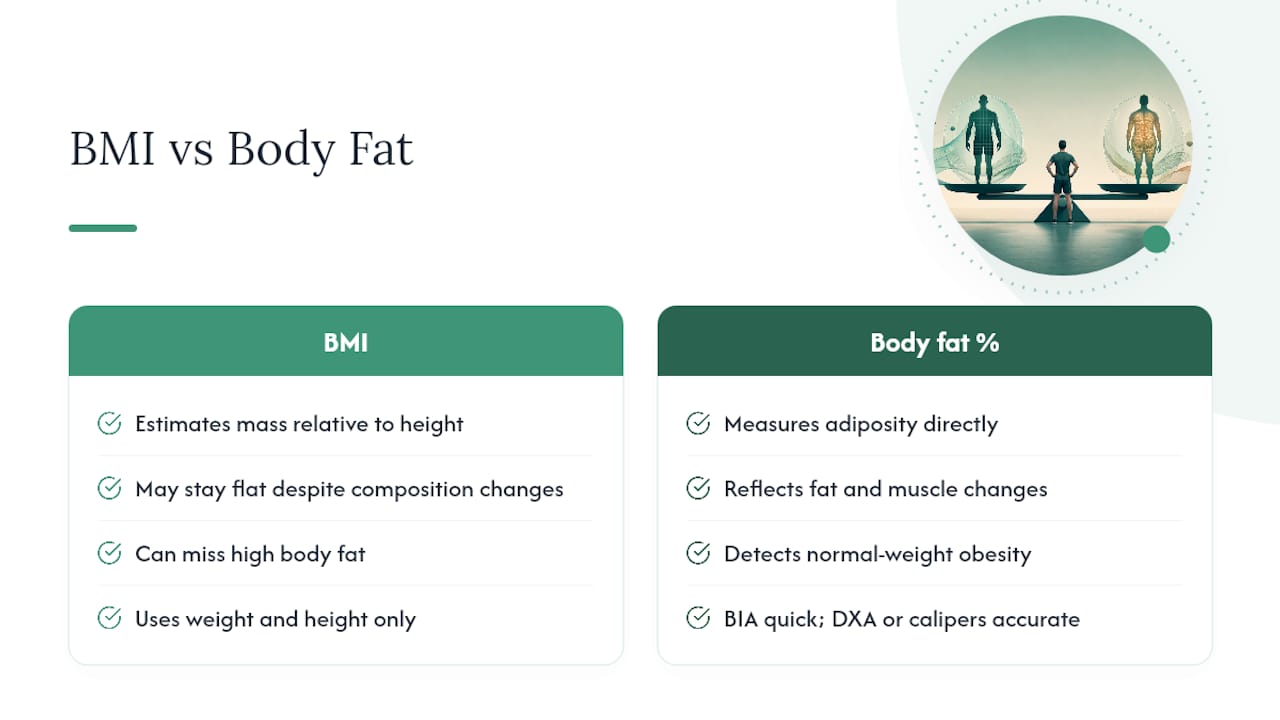
- BMI measures mass relative to height. It says nothing about how much of that mass is fat, muscle, or bone.
- Body fat percentage measures adiposity directly, which is what actually drives metabolic risk.
- A large cohort study found body fat percentage and waist circumference predicted 15-year mortality better than BMI did, and in that analysis BMI showed no statistically significant link to all-cause mortality once other factors were adjusted.
Use BMI as your first pass. If the number is borderline, if you're heavily muscled, or if a clinical decision hangs on the result, get body fat percentage or waist circumference measured before you act on it.
Key Takeaways
Body fat percentage and waist circumference generally predict individual health risk more reliably than BMI, but BMI still works well for fast screening and population tracking.
| Point | Details |
|---|---|
| BMI is a screening tool, not a diagnosis | It measures mass relative to height and can't tell fat from muscle. |
| Body fat percentage tracks risk more closely | A 15-year cohort found stronger mortality links for body fat percentage and waist circumference than BMI. |
| Waist circumference is your cheapest tiebreaker | Above 40 inches for men or 35 inches for women signals elevated abdominal risk. |
| Method choice affects your number | DXA, BIA, and calipers can each give different body fat readings for the same person. |
| Pair metrics with metabolic labs | Blood pressure, glucose, and cholesterol resolve most cases where BMI and body fat percentage disagree. |
Table of Contents
- BMI vs Body Fat Percentage: What Each One Actually Measures
- What Body Fat Percentage Tells You That BMI Can't
- Does Body Fat Percentage Predict Mortality Better Than BMI?
- How Is Body Fat Percentage Actually Measured?
- When Should You Trust BMI vs Get a Body Fat Test?
- Quick Self-Checks You Can Do This Week
- Where AI Health Tools Fit Into This Picture
- Reading Your Numbers Without Overreacting to Them
- Frequently Asked Questions
- Sources
BMI vs Body Fat Percentage: What Each One Actually Measures
BMI is weight in kilograms divided by height in meters squared. That's it. It's a ratio of mass to height, not a measure of fat, and the CDC is explicit that it does not distinguish muscle, fat, or bone.
NHLBI's standard categories break down like this:
- Underweight: below 18.5
- Healthy weight: 18.5 to 24.9
- Overweight: 25 to 29.9
- Obese: 30 and above
A 5-foot-9 person weighing 160 pounds comes out to roughly 23.6, squarely in the healthy range. That's the appeal of BMI: cheap, instant, and reproducible across a doctor's office, a research study, or a phone app.
The catch is what it can't see. A 200-pound bodybuilder with 12% body fat can land in the "obese" category right next to someone carrying the same weight in fat around their midsection. BMI also shifts in meaning across age, sex, and ethnicity, a limitation documented in the clinical literature on BMI's blind spots.
What Body Fat Percentage Tells You That BMI Can't
Body fat percentage is the share of your total body mass that's actual fat tissue, as opposed to muscle, bone, organs, and water. WebMD frames this as body composition giving a more detailed health picture than weight alone, and that's the core reason it matters more for individual risk assessment.
Healthy ranges differ by sex and shift with age:
- Men: roughly 6 to 13% is athletic, 14 to 17% is fitness level, 18 to 24% is average, and above 25% is considered elevated.
- Women: roughly 14 to 20% is athletic, 21 to 24% is fitness level, 25 to 31% is average, and above 32% is considered elevated.
- These ranges creep upward with age even at a stable weight, since lean mass declines over time.
Where you carry that fat matters as much as how much you have. Visceral fat, packed around your organs, drives inflammation and insulin resistance far more than subcutaneous fat sitting under the skin. Two people with identical body fat percentages can carry very different risk profiles depending on that distribution.
This is also how "normal-weight obesity" slips past a BMI screening: someone with a BMI of 22 can still carry 30% body fat, mostly visceral, and get waved through as healthy. Body fat percentage catches what BMI misses in exactly that scenario.
Does Body Fat Percentage Predict Mortality Better Than BMI?
The mortality data settles a lot of this argument. In a nationally representative cohort followed for 15 years, researchers found that body fat percentage carried an unadjusted hazard ratio of 2.01 for all-cause mortality, dropping only modestly to 1.78 after adjustment. BMI, run through the same model, showed no statistically significant association with all-cause mortality at all.
That gap matters because BMI and body fat percentage frequently disagree about who's actually at risk. Someone can post a "healthy" BMI while carrying elevated body fat, or a "high" BMI built almost entirely from muscle. Population data out of Singapore found body fat based obesity rates far exceeding BMI-based estimates in the same cohort, driven by ethnic differences in fat storage at any given BMI.
Here's how the two stack up side by side:
- What it measures: BMI captures total mass relative to height; body fat percentage captures direct adiposity.
- Accuracy for individuals: BMI is unreliable for muscular or older adults; body fat percentage is more individually accurate but method-dependent.
- Cost and accessibility: BMI needs only a scale and a tape measure; body fat percentage testing ranges from a $30 home scale to a $150 DXA scan.
- Use case: BMI suits population screening and tracking; body fat percentage suits individualized risk stratification.
- Mortality and cardiovascular association: body fat percentage and waist circumference showed stronger links in the cohort above; BMI's link disappeared after adjustment.
The cohort's central finding: body fat percentage and waist circumference held meaningful associations with 15-year all-cause and heart-disease mortality, while BMI's relationship with all-cause mortality was not statistically significant once other factors were controlled.
Pro Tip: If your BMI and body fat percentage point in different directions, don't split the difference and assume you're fine. Check your waist circumference and ask for basic metabolic labs, blood pressure, fasting glucose, and cholesterol, since pairing composition metrics with lab work resolves most discordant cases.
How Is Body Fat Percentage Actually Measured?
Testing options range from a $20 caliper to a $150,000 scanner, and accuracy tracks almost exactly with that price gap.
- DXA (dual-energy X-ray absorptiometry): the closest thing to a reference standard, giving regional and total fat breakdowns, though cost and limited access keep it out of routine primary care.
- Bioelectrical impedance analysis (BIA): fast, clinic-friendly, and increasingly accurate when the device is validated, though hydration status can swing a reading by several points.
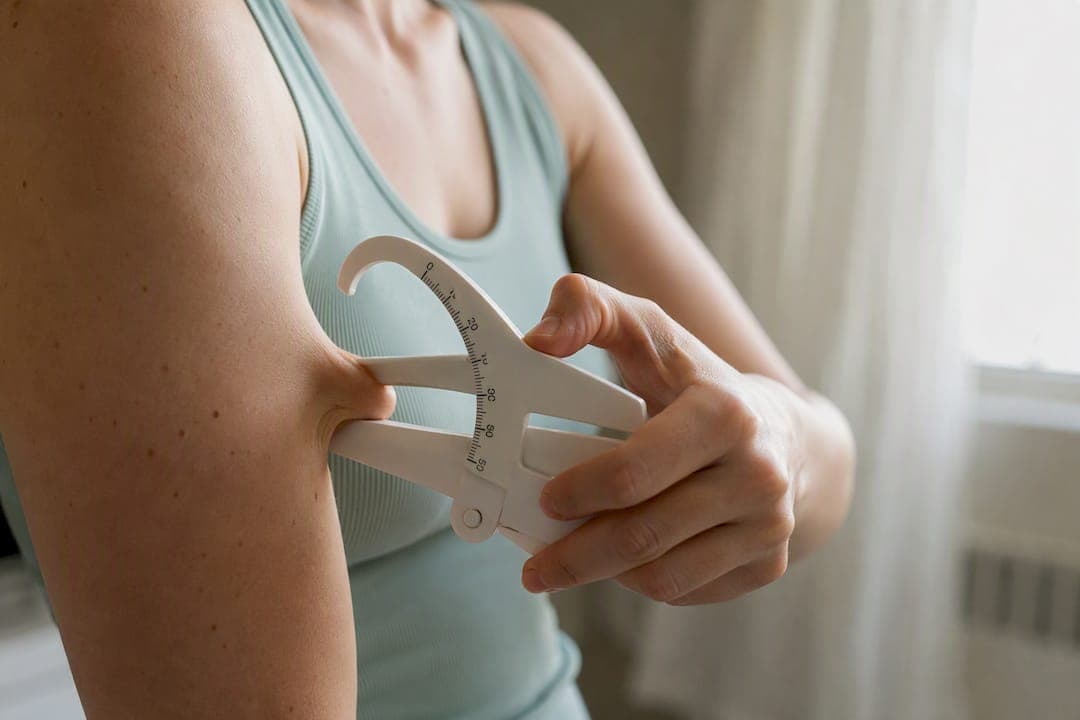
- Skinfold calipers: cheap and portable, but results depend heavily on the technician's skill and consistency.
- Air-displacement plethysmography (Bod Pod): research-grade accuracy without DXA's radiation exposure, though it requires specialized equipment.
- Hydrostatic weighing: historically the gold standard, now less common because it requires full water submersion.
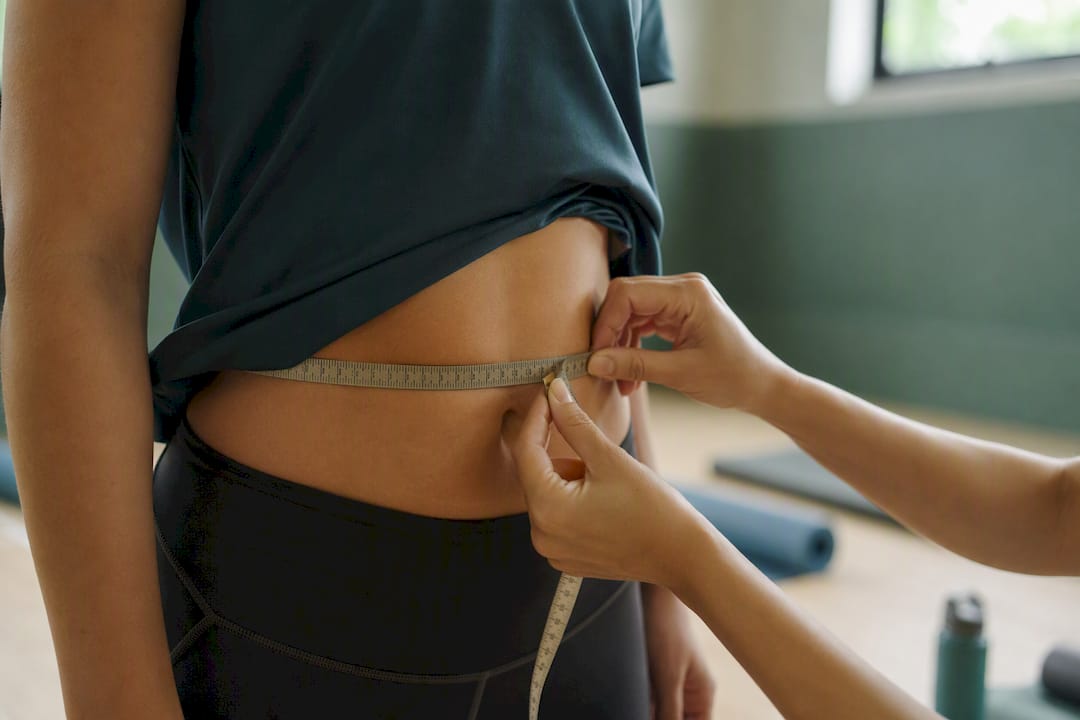
- Waist circumference: not a body fat method exactly, but a fast, free proxy for central adiposity that correlates strongly with metabolic risk.
Every method has an error source worth knowing: BIA shifts with hydration, calipers shift with operator skill, and even DXA carries some day-to-day variability. Track trends over single readings.
Pro Tip: For most people, a validated BIA scale or a clinic DXA scan, paired with waist circumference and standard metabolic labs, gives a realistic and affordable picture without chasing lab-grade precision you don't need.
When Should You Trust BMI vs Get a Body Fat Test?
- Use BMI for a quick screen, tracking weight trends over time, or population-level health reporting.
- Get body fat percentage or waist circumference measured when your BMI sits in the overweight or obese range but you're highly muscled, when your BMI looks normal but you have metabolic symptoms, or when a clinical decision (medication, surgery eligibility) depends on the answer.
- Ask your clinician or lab which body fat method they use, since BIA, DXA, and calipers can produce meaningfully different numbers for the same person.
- Confirm your waist was measured correctly, at the navel, standing, at the end of a normal exhale.
Demographics change how you should read these numbers. Older adults naturally carry more body fat at a given BMI as lean mass declines. Many Asian populations show elevated body fat and metabolic risk at BMI levels the standard chart still labels "normal," which is why some clinical guidelines lower the action threshold for those groups.
Before your next appointment, bring three things: your recent weight trend, a waist measurement, and any body fat readings you've taken. That gives your clinician a trend to interpret instead of a single isolated number.
Quick Self-Checks You Can Do This Week
- Calculate your BMI: weight (kg) ÷ height (m)² — a 70 kg person at 1.75 m comes to 22.9.
- Measure your waist: wrap a tape measure around your navel, standing relaxed. Above 40 inches for men or 35 inches for women signals elevated abdominal risk, though thresholds run lower for some ethnic groups.
- Estimate body fat at home: a BIA scale or a Deurenberg-style calculator gives a rough number, but these regression estimates skew off for athletes, older adults, and pregnant people.
- Log repeat measures, same method, same time of day, rather than reacting to one reading. Track it the way you'd track any daily health check-in.
If your waist measurement is elevated but your BMI looks normal, or you're noticing symptoms alongside these numbers, that combination is worth a conversation with a clinician and a request for metabolic labs.
Where AI Health Tools Fit Into This Picture
Peace Health AI builds tools that help people make sense of confusing health signals, and body composition numbers are a textbook example of data that's easy to misread alone. When your BMI, body fat percentage, and how you're feeling don't line up, that's exactly the kind of pattern worth flagging rather than ignoring.
Our AI-powered symptom checker isn't a diagnostic tool and doesn't replace a clinician, but it can help you sort out what to prioritize before you book an appointment, especially when your numbers are sending mixed signals.
Reading Your Numbers Without Overreacting to Them
The instinct with any health metric is to treat it as a verdict. Both are inputs, not conclusions, and the research backs that caution: body composition metrics work best paired with metabolic markers, not read in isolation.
What gets underestimated is how often these two numbers should disagree. A powerlifter with a BMI of 29 and 14% body fat isn't a data error. A slim-looking person with a BMI of 21 and 29% body fat isn't either. Both scenarios are common, and both would get mishandled by an approach that treats BMI as the final word.
The uncomfortable middle ground is this: waist circumference is often the more honest tiebreaker than either number alone, because it captures the fat distribution that actually predicts trouble. It doesn't require special equipment, and unlike BMI or even a lot of body fat estimates, it responds fast to real changes in visceral fat. If you only track one extra number beyond your weight, make it your waist.
Frequently Asked Questions
Is body fat percentage more accurate than BMI? For assessing individual health risk, yes. Body fat percentage measures adiposity directly, while BMI only estimates mass relative to height and can't tell fat from muscle.
What's a healthy body fat percentage for my age?
Can I have a normal BMI but high body fat? Yes, this is called normal-weight obesity, and it's one of the clearest gaps between the two metrics. It happens more often in older adults and people who've lost muscle mass over time.
How do I measure body fat at home? A BIA scale gives a fast estimate, though hydration affects the reading. For more accuracy, ask your doctor about DXA scanning or professional caliper testing.
Should I use BMI or body fat percentage to track my fitness progress? Body fat percentage is generally more useful for fitness tracking since it reflects actual changes in fat and muscle, while BMI can stay flat even as your body composition shifts significantly.
This article is general information, not a substitute for advice from a qualified doctor. Consult a qualified healthcare professional about your own circumstances before acting on anything here.
Sources
- About adult BMI | CDC
- Body Mass Index vs Body Fat Percentage as a Predictor of Mortality in Adults Aged 20-49 Years | PMC
- Body fat percentage vs. BMI - Which is important? | Baylor College of Medicine
- Calculate your BMI | NHLBI