
What are the top WebMD alternatives worth using right now?
The best alternatives to WebMD are platforms that go beyond static medical encyclopedias to offer AI-driven symptom analysis, personalized health guidance, and real triage logic. Here are the ones worth your time:
- Peacehealthai — AI-powered symptom checker with detailed health score analytics, daily coaching, symptom history tracking, and early alerts for repeated symptoms. Combines clinical data with personalized wellness guidance across free and paid tiers.
- Ada Health — Conversational AI symptom checker developed with clinical input, known for methodical branching questions and solid triage recommendations.
- Isabel DDx — Built originally for physicians, Isabel uses a large differential diagnosis database and is one of the more clinically rigorous public-facing tools available.
- Buoy Health — Guides users through symptom questions with a chat-style interface and connects them to appropriate care options, including telehealth.
- Symptomate — A clean, medically reviewed symptom checker that covers a wide range of conditions and delivers clear triage advice without requiring registration.
- Docus AI — Combines AI symptom analysis with access to medical expert consultations, positioning itself as a bridge between self-assessment and professional review.
- WebMD — Still the most-trafficked health information site in the US, with a broad condition library and basic symptom checker, though it lacks the personalization of newer AI-first platforms.
The core difference between WebMD and these alternatives comes down to interactivity. WebMD remains a reference library. The platforms above, particularly Peacehealthai, function more like a responsive health advisor that adapts to what you tell it.
| Platform | Diagnostic Approach | AI Personalization | Free Access |
|---|---|---|---|
| Peacehealthai | AI symptom analysis + coaching | Yes, with health score and coaching | Yes (basic tier) |
| Ada Health | Conversational AI triage | Moderate | Yes |
| Isabel DDx | Differential diagnosis database | Low | Limited |
| Buoy Health | Chat-style symptom flow | Moderate | Yes |
| Symptomate | Medically reviewed algorithm | Low | Yes |
| Docus AI | AI + expert consultation | Moderate | Limited |
| WebMD | Static library + basic checker | None | Yes |

Table of Contents
- How do these platforms compare on accuracy, features, and cost?
- How do you choose the right symptom checker for your needs?
- What is a symptom checker, and why do so many people use them?
- What makes Peacehealthai different from other symptom checkers?
- Common questions people have about online symptom checkers
- Key Takeaways
- The future of symptom checkers is not what most people expect
- Peacehealthai gives you more than a symptom lookup
How do these platforms compare on accuracy, features, and cost?
Diagnostic accuracy across popular symptom checkers is reported in published medical journal studies as moderate, with user input quality being one of the strongest variables affecting that figure. That figure matters when you are deciding how much weight to put on any platform's output.

Diagnostic accuracy and clinical validation
Ada Health and Isabel DDx sit toward the higher end of the accuracy range among consumer-facing tools. Isabel was built on a differential diagnosis engine originally designed for clinicians, which gives it a depth that most consumer apps do not match. Buoy Health and Symptomate perform reliably for common conditions but may be less precise with rare or overlapping symptom profiles. Peacehealthai combines peer-reviewed medical data with adaptive AI, and its symptom history tracking means the system gets more useful the longer you use it, not just on a single session.
Features, privacy, and platform availability
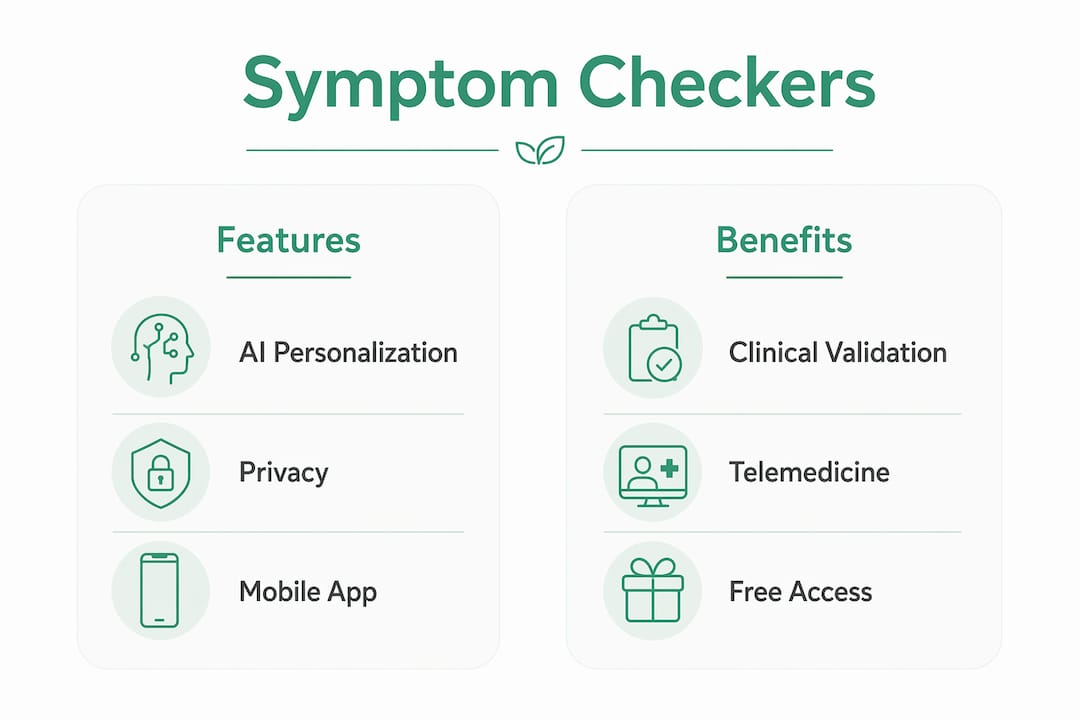
Privacy and data security policies differ meaningfully across these platforms, and that gap matters when you are entering sensitive health information. Symptomate and Ada Health are both GDPR-compliant, which sets a reasonable baseline. Peacehealthai offers secure global access and does not require sharing data with third-party advertisers, a contrast worth noting given WebMD's ad-supported model.
Mobile app availability varies widely. Ada Health has a well-rated mobile app. Buoy Health is primarily web-based. Peacehealthai works across devices with a clean, accessible interface. Symptomate and Docus AI are both accessible via web browser without requiring a download.
Pricing and registration
Subscription structures range from fully free access to tiered paid plans with advanced features. Here is how the main platforms break down:
- Peacehealthai: Free basic tier; paid plans unlock advanced symptom analysis, priority response, AI health chat, health score analytics, and goal-based coaching (fat loss, muscle gain, wellness).
- Ada Health: Free to use with no registration required for basic symptom checks.
- Isabel DDx: Free public access is limited; fuller features are gated behind professional or paid tiers.
- Buoy Health: Free to use; no subscription required.
- Symptomate: Free, no registration required.
- Docus AI: Limited free access; expert consultation features require payment.
- WebMD: Free, ad-supported.
Telemedicine integration
Telemedicine connections triggered by symptom assessment outcomes are still an emerging feature across the category, but Buoy Health and Docus AI have moved furthest in this direction. Buoy actively routes users toward care options based on triage results. Docus AI's model is built around connecting AI assessment with real physician review. Peacehealthai is developing integrations in this space, with its current strength lying in the coaching and analytics layer that sits between symptom checking and clinical care.
Key comparison points:
- Published studies report the diagnostic accuracy of popular symptom checkers averages around 59%, with input quality as the strongest variable influencing results.
- Only a few platforms offer genuine AI personalization beyond a single session.
- Ad-supported models like WebMD create privacy trade-offs that newer platforms avoid.
- Mobile app support is inconsistent; check before committing to a platform.
- Telemedicine integration is growing but not yet standard across all tools.
How do you choose the right symptom checker for your needs?
Not every symptom checker fits every situation. The right choice depends on what you actually need from the tool, and a few criteria separate genuinely useful platforms from ones that just look credible.
Clinical validation is the first filter. A platform built on peer-reviewed medical data or developed with clinical input will give you more reliable triage guidance than one assembled from general web content. Ask whether the platform cites its medical sources or has published accuracy data.
Personalization matters more than most people expect. A tool that remembers your symptom history, tracks patterns over time, and adjusts recommendations based on your health profile is categorically more useful than one that treats every session as a blank slate. Peacehealthai's health score analytics and early alerts for repeated symptoms are a direct example of this.
User interface and accessibility affect whether you will actually use the tool when you need it. A cluttered or confusing interface is a real barrier when you are not feeling well. Platforms with clean, mobile-friendly designs and plain-language outputs earn their keep.
Cost and feature trade-offs require honest evaluation. Free tiers are useful for occasional checks, but if you want symptom history, AI coaching, or priority response, a paid plan is the only way to get there. Weigh what you will actually use against what you will pay.
Data privacy is non-negotiable for health information. Understand whether a platform sells or shares your data, whether it complies with HIPAA or GDPR standards, and whether it uses your inputs to serve advertising.
Telemedicine integration is worth considering if you want a platform that can route you toward professional care when the AI flags something serious.
Pro Tip: Spend at least 5–7 minutes answering a symptom checker's follow-up questions carefully. Rushing through or skipping prompts is the single most common reason people get vague or unhelpful results. The AI can only work with what you give it.
What is a symptom checker, and why do so many people use them?
A symptom checker is an interactive digital tool that asks you structured questions about how you feel, then uses that input to suggest possible conditions, triage urgency, and recommend next steps. They are not diagnostic tools in the clinical sense, but they serve a real function: helping people decide whether to wait and monitor, call a doctor, or go to an emergency room.
The appeal is straightforward. You can use one at midnight without waiting on hold, without a copay, and without the anxiety of not knowing whether something is serious. For the millions of Americans who rely on digital health resources as a first stop before calling a provider, a good symptom checker can mean the difference between appropriate early action and unnecessary delay.
The best platforms do more than list possible conditions. They use:
- Branching symptom questions that adapt based on your answers, narrowing the differential as you go.
- Triage scoring that tells you whether to seek care now, schedule an appointment, or manage at home.
- Health analytics that track patterns across multiple sessions.
- Condition awareness that flags when symptoms could indicate something requiring urgent attention.
The limitation worth keeping in mind: effective symptom checkers guide appropriate next steps without causing alarm, but they are not a substitute for clinical evaluation. A published 59% average diagnostic accuracy rate means these tools are a starting point, not a final answer. Use them to orient yourself, not to replace your doctor.
What makes Peacehealthai different from other symptom checkers?
Most symptom checkers answer one question: what might be causing this? Peacehealthai answers a second one that most platforms ignore: what should you actually do about your health over time?
The platform combines peer-reviewed clinical data with adaptive AI to deliver personalized insights that go beyond a single symptom session. That distinction shows up in features that other tools in this category simply do not offer at the same depth:
- Symptom history tracking that builds a picture of your health over time, not just today's complaint.
- Health score analytics that give you a running measure of your overall wellness, not just a one-off triage result.
- Daily AI-generated nutrition and activity insights tailored to your health profile.
- Early alerts for repeated symptoms, so patterns get flagged before they become serious.
- AI health chat for ongoing questions between formal symptom checks.
- Goal-based coaching covering fat loss, muscle gain, and general wellness, integrated into the same platform as your symptom data.
Industry experts highlight the balance between clinical authority and AI-driven personalization as the key advantage of newer platforms over established encyclopedic sources. Peacehealthai sits at that intersection more fully than any other consumer-facing tool currently available in the US.
The free tier gives you access to basic symptom analysis. Upgrading unlocks advanced analysis, priority response speed, and the full coaching and analytics suite. For anyone who wants a health platform rather than just a symptom lookup tool, the difference between tiers is substantial.
Common questions people have about online symptom checkers
Are symptom checkers accurate enough to trust? They are useful for orientation, not diagnosis. Published studies put average diagnostic accuracy at around 59% across the category, with significant variation by platform and by how carefully users answer the questions. Treat results as a starting point for a conversation with a provider, not a final answer.
Is my health data safe on these platforms? It depends on the platform. Ad-supported sites like WebMD use your data to serve targeted advertising. Newer platforms, including Peacehealthai, are built around secure access without third-party data sharing. Always check a platform's privacy policy before entering personal health information, particularly anything related to chronic conditions or medications.
Do I need to pay to use a symptom checker? Most platforms offer a free tier. Ada Health, Buoy Health, and Symptomate are entirely free. Peacehealthai offers a free basic tier, with paid plans for advanced features like health score analytics, AI coaching, and symptom history. Docus AI and Isabel DDx gate their more powerful features behind payment.
Can a symptom checker replace a doctor's visit? No. These tools are designed to help you decide whether and how urgently to seek care, not to replace clinical evaluation. When a symptom checker flags something serious, treat that as a prompt to call your provider or seek care, not as a reason to wait.
Which platform is best for ongoing health management, not just one-off checks? Peacehealthai is the clearest answer here. Its symptom history tracking, health score analytics, and daily coaching make it a platform for ongoing health engagement, not just reactive symptom lookup.
Key Takeaways
Across the category, AI personalization and clinical validation are what separate genuinely useful symptom checkers from digital encyclopedias with a search bar attached.
| Point | Details |
|---|---|
| Diagnostic accuracy of popular symptom checkers averages 59% | Published studies report this figure; input quality strongly influences the result. |
| AI personalization changes the value proposition | Platforms with symptom history, health score tracking, and coaching deliver more than one-off triage tools. |
| Privacy policies vary significantly | Ad-supported models share data; newer platforms like Peacehealthai are built around secure, private access. |
| Free tiers exist but have real limits | Basic checks are free on most platforms; advanced analytics and coaching require a paid plan. |
| Peacehealthai covers symptom checking and wellness | It combines clinical AI triage with daily coaching, health score analytics, and early symptom alerts in one platform. |
The future of symptom checkers is not what most people expect
The conventional wisdom about online health tools goes something like this: they are useful for basic lookups, dangerous if taken too seriously, and fundamentally limited by the gap between consumer AI and clinical medicine. That framing is increasingly outdated.
The real shift happening in digital health is not about accuracy percentages. It is about the move from reactive to continuous. WebMD and its first-generation peers were built around a single question: "What is this condition?" The platforms gaining ground now are built around a different model entirely, one where your health data accumulates, patterns get flagged early, and the platform becomes more useful the longer you use it.
That model has real implications. Early alerts for repeated symptoms, health score trends over weeks rather than a single session, AI coaching that connects your daily habits to your symptom patterns: these are not incremental improvements on WebMD. They represent a different category of tool.
The telemedicine integration piece is still catching up. Most platforms are not yet able to route a flagged symptom directly to a same-day provider appointment, but that capability is coming. When it arrives, the distinction between "symptom checker" and "digital health platform" will collapse entirely.
Platforms like Peacehealthai are already positioned at that intersection, combining the clinical authority that makes triage trustworthy with the personalization that makes daily engagement worthwhile. The static medical library had its moment. What comes next is a health platform that knows you.
Peacehealthai gives you more than a symptom lookup
Every platform in this comparison does something useful. But if you came here because you want a tool that actually tracks your health over time, not just answers a one-off question, Peacehealthai is built for that.
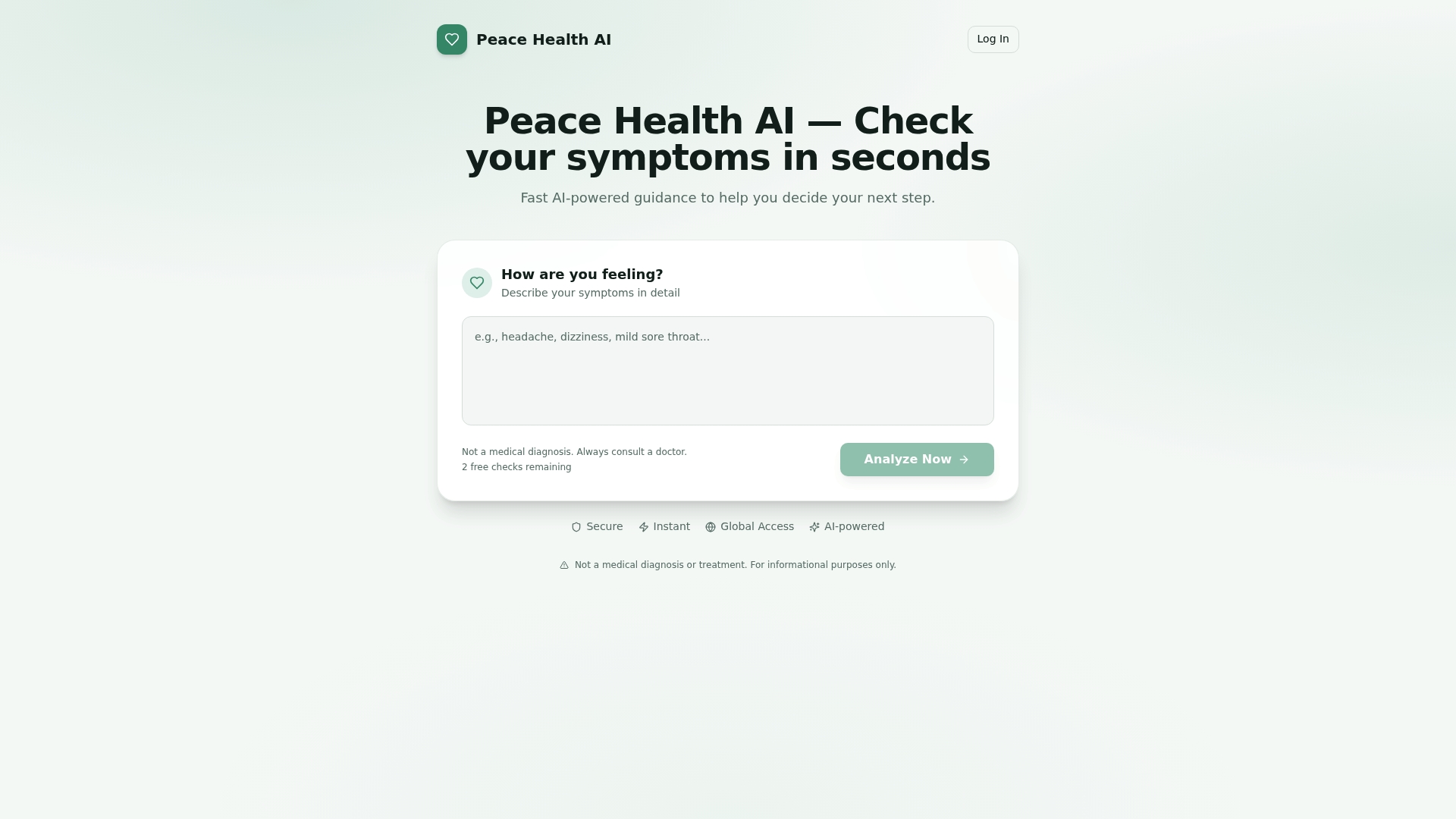
The free tier gets you immediate AI-powered symptom analysis with clear next-step guidance. Upgrading adds symptom history tracking, health score analytics, daily nutrition and activity coaching, early alerts for repeated symptoms, and goal-based wellness programs covering fat loss, muscle gain, and general health. It is the only platform in this comparison that functions as both a symptom checker and a daily health management tool in one place.
No lengthy intake forms, no waiting room, no ad-driven results. You describe what you are experiencing, and Peacehealthai gives you a clear, personalized response based on clinical data. Check the full feature list or explore the plans to see which tier fits your needs, then start your first symptom check at peacehealthai.org.