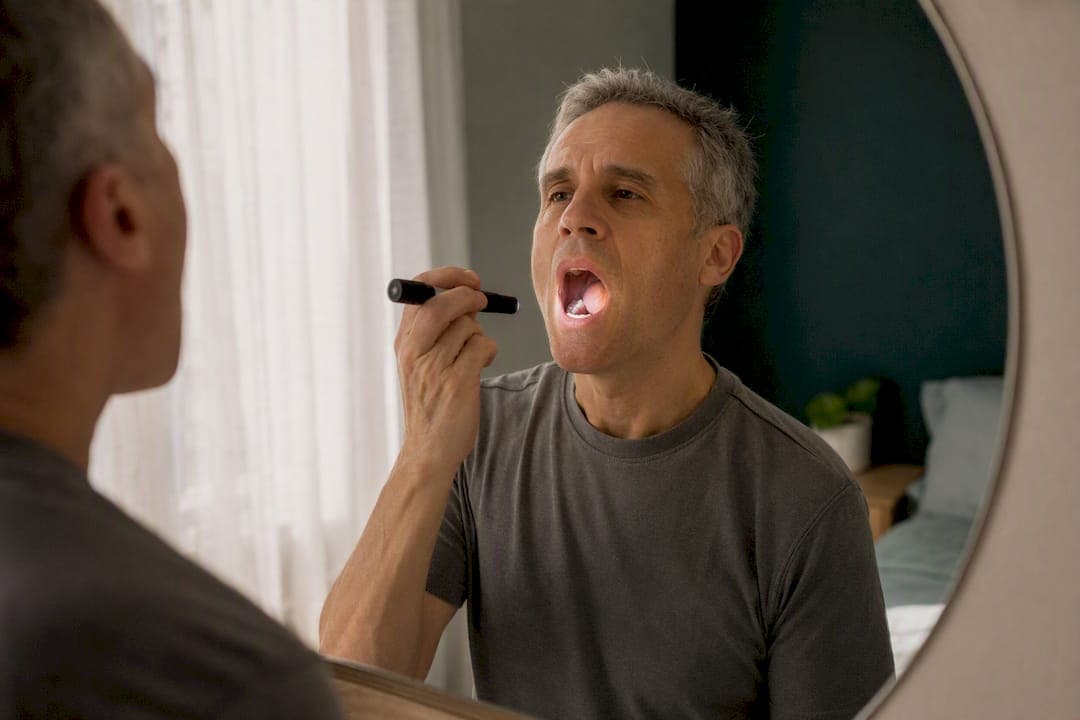
Most sore throats are viral and clear up on their own within a week. Strep throat is the bacterial exception, and it needs a different response: testing and often antibiotics.
Here's the quick read on which one you're likely dealing with:
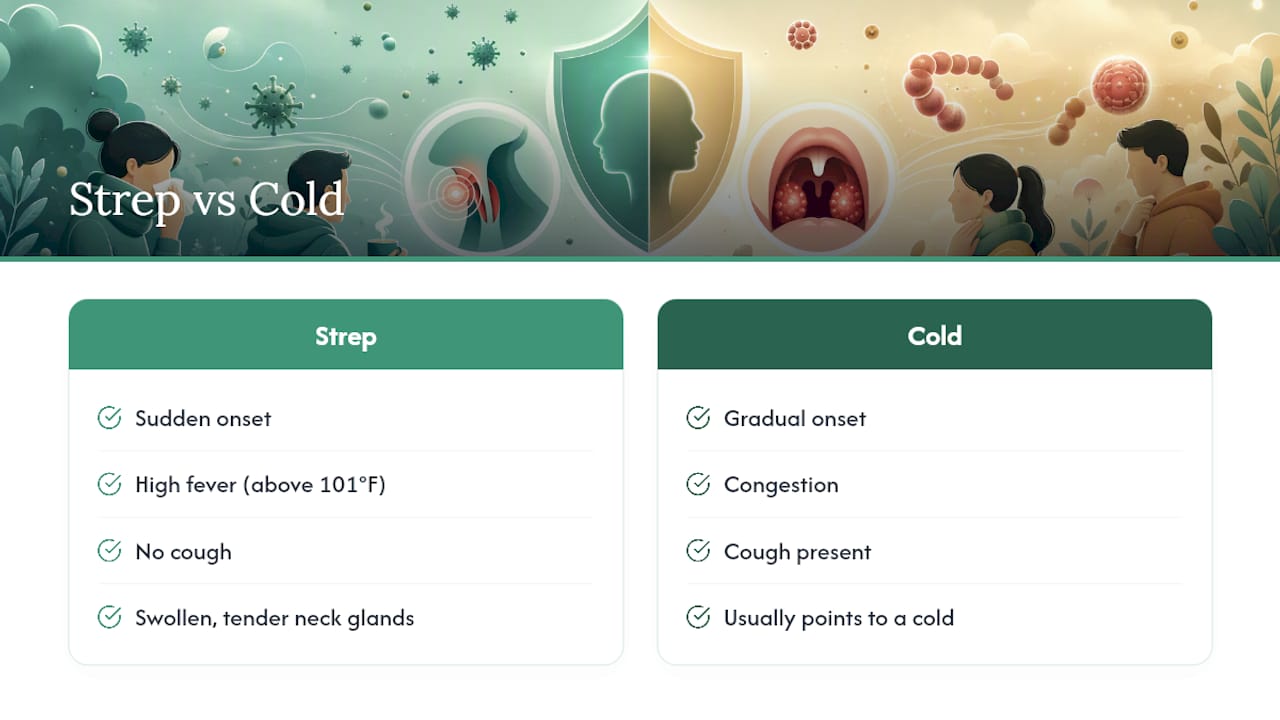
- Points to viral: gradual onset, cough, runny nose, hoarseness, watery eyes
- Points to strep: sudden onset, fever over 101°F, no cough, swollen tender neck glands, white patches on the tonsils
Strep accounts for roughly 10% of adult sore throat cases and about 30% of cases in children. If your symptoms lean toward the strep column, the next move is a rapid strep test rather than waiting it out.
Key Takeaways
Distinguishing sore throat vs strep comes down to three signals: sudden onset, high fever, and absence of cough, confirmed only by a rapid test or throat culture.
| Point | Details |
|---|---|
| Symptoms guide suspicion, not certainty | Sudden onset, fever over 101°F, and no cough point toward strep, but testing confirms it. |
| Strep is the minority cause | It explains about 10% of adult sore throats and about 30% in children. |
| Testing follows clinical scoring | Centor or McIsaac criteria help decide who needs a rapid antigen test or throat culture. |
| Antibiotics only help confirmed strep | Penicillin or amoxicillin for a full 10 days; viral sore throats need supportive care instead. |
| Peacehealthai supports the decision, not the diagnosis | Its symptom checker helps you triage and organize symptoms before or instead of an urgent clinic visit. |
Table of Contents
- Sore Throat vs Strep Symptoms: What to Check First
- What Usually Causes a Sore Throat, and How Common Is Strep?
- When to Test for Strep and How Diagnosis Works
- How Strep Throat Is Treated Differently From a Viral Sore Throat
- When to See a Clinician for a Sore Throat
- How Contagious Is Strep and How Long Does It Last?
- What Happens If Strep Throat Goes Untreated?
- Can a Symptom Checker Help You Figure Out Strep vs a Sore Throat?
- Frequently Asked Questions
- Sources
Sore Throat vs Strep Symptoms: What to Check First
Strep throat tends to hit fast. Someone feels fine at breakfast and miserable by lunch, with a fever that climbs past 101°F and pain sharp enough to make swallowing water unpleasant. The CDC's clinical guidance lists the classic markers: sudden onset, that higher fever, red and swollen tonsils sometimes streaked with white exudate, tender lumps on the sides of the neck, and small red spots (petechiae) on the roof of the mouth. One thing is usually missing: a cough.
Viral sore throats build more slowly and travel with a supporting cast. Think runny nose, congestion, watery eyes, a scratchy cough, maybe some hoarseness. If your throat pain showed up alongside sniffles and a mild cough that's been building for two days, that pattern reads viral, not strep.

| Signal | Leans strep | Leans viral |
|---|---|---|
| Onset | Sudden | Gradual |
| Fever | Often above 101°F | Low grade or none |
| Cough | Usually absent | Common |
| Neck glands | Swollen, tender | Mild or normal |
| Tonsils | Red, white patches | Red, sometimes mild swelling |
Pro Tip: White patches on the tonsils aren't proof of strep. Mononucleosis causes the same look, sometimes worse. If the exudate is heavy and paired with extreme fatigue or a swollen spleen area, that's a reason to get tested rather than guess.
What Usually Causes a Sore Throat, and How Common Is Strep?
Viruses cause the large majority of sore throats: rhinovirus, influenza, COVID-19, and adenovirus all top the list, along with allergies and mononucleosis (caused by Epstein-Barr virus). Group A strep is the main bacterial culprit, and it shows up in about 10% of adult cases and closer to 30% in children.
Age matters here. Strep throat is most common in children between 5 and 15, and it peaks in winter and early spring, though it can turn up any month of the year. Adults get it too, just less often, which is one reason a fast sore throat with a high fever in a school-age kid deserves more suspicion than the same symptoms in a 40-year-old.
When to Test for Strep and How Diagnosis Works
Clinicians don't test everyone with a sore throat. Many use the Centor or McIsaac clinical scoring criteria to decide who actually needs a swab, which cuts down on unnecessary antibiotic use. The four criteria people ask about are:
- Fever over 100.4°F
- No cough
- Swollen, tender front neck lymph nodes
- Tonsillar swelling or exudate
Score more of those and your odds of strep go up; a clinician may skip testing altogether if you score very low, since a negative result is nearly certain.
When testing is warranted, the flow usually looks like this:
- A rapid antigen detection test (RADT) is swabbed in the office, with results in minutes.
- If the RADT is positive, that's typically enough to start antibiotics.
- If it's negative in a child or teen but symptoms still strongly suggest strep, a throat culture follows to catch false negatives, since RADTs are highly specific but not perfectly sensitive.
- Culture results take one to two days but remain the gold standard for confirming or ruling out strep.
Pro Tip: If your rapid test comes back negative but you still feel worse by the day, don't assume you're in the clear. Call your clinician about a follow-up culture, especially for kids, rather than waiting out symptoms that don't fit a typical viral course.
How Strep Throat Is Treated Differently From a Viral Sore Throat
Confirmed strep gets antibiotics. Everything else gets supportive care while your body clears the virus on its own.
For strep, penicillin or amoxicillin are the standard choices, usually prescribed as a 10-day course. Most people start feeling noticeably better within 24 to 48 hours of the first dose.
Pro Tip: Finish every day of that 10-day course even after you feel fine on day three. Stopping early lets bacteria survive and raises the odds of relapse or, rarely, complications like rheumatic fever.
If your sore throat is viral, there's no antibiotic that will speed things along. What actually helps:
- Fluids, warm or cold, whatever goes down easier
- A humidifier to cut the dryness that makes swallowing worse at night
- Warm saltwater gargles a few times a day
- OTC pain relievers like acetaminophen or ibuprofen for fever and throat pain
When to See a Clinician for a Sore Throat
See someone the same day if your fever is high and climbing, swallowing is genuinely difficult, or symptoms have stretched past 48 hours without improvement. Certain signs mean don't wait at all.
Head to urgent care or a same-day appointment for:
- A fever that won't come down or lasts several days
- Severe throat pain out of proportion to a typical cold
- Swollen, tender lymph nodes that keep getting worse
- Symptoms lingering more than two days with no sign of improvement
Go to the emergency department for trouble breathing, drooling because swallowing has become impossible, a muffled "hot potato" voice, neck stiffness, or blood in your saliva. Those point to airway involvement or a spreading infection, not a routine sore throat.
How Contagious Is Strep and How Long Does It Last?
Strep throat has an incubation period of about two to five days from exposure to symptoms. Once you start antibiotics, you're generally considered non-contagious after about 24 hours, and most people feel noticeably better within a day or two.
Simple habits limit spread:
- Stay home until you've been on antibiotics for at least a full day.
- Wash hands often, especially after coughing or touching your face.
- Avoid sharing cups, utensils, or straws.
- Cover coughs and sneezes, and wipe down shared surfaces.
One wrinkle worth knowing: 15 to 20% of school-age kids carry group A strep in their throats without any symptoms at all. That's exactly why testing is reserved for people who are actually sick, not random contacts, since a positive result in a symptom-free carrier doesn't mean they need treatment.
What Happens If Strep Throat Goes Untreated?
Left untreated, group A strep can occasionally lead to rheumatic fever, kidney inflammation, scarlet fever, or a peritonsillar abscess. These complications are rare in the US today, largely because antibiotics work well and treat the infection early.
Complications to know about:
- Rheumatic fever (can affect the heart)
- Poststreptococcal glomerulonephritis (kidney inflammation)
- Peritonsillar abscess (pus pocket near the tonsils)
- Scarlet fever (strep with a distinctive rash)
If your sore throat is severe or drags on, getting checked out is the simplest way to avoid these outcomes entirely.
Can a Symptom Checker Help You Figure Out Strep vs a Sore Throat?
A symptom checker can point you toward a next step. It cannot diagnose strep throat, because that requires an actual test.
Where a tool like Peacehealthai's AI symptom checker earns its place is in the moments before you decide what to do:
- Rapid triage on whether your symptom pattern leans urgent or watch-and-wait
- A suggested urgency level based on what you report
- Prompts for details worth mentioning to a clinician, like fever duration or absence of cough
- A running history of your symptoms if this keeps happening
None of that replaces a throat swab or a clinician's exam. Think of it as a way to organize what you're feeling before you walk into an appointment, or before you decide an appointment is even needed.
Pro Tip: Run your symptoms through the checker the morning your throat starts hurting, then bring that summary to your clinician if things haven't improved in a day or two. It saves you from trying to remember details under pressure in an exam room.
A Note From Peace Health AI
We built this guide because too many people either dose themselves with leftover antibiotics or ignore a sore throat that needed attention. Good triage starts with reliable information and ends with the right kind of care at the right time.
Try Peace Health AI Before Your Next Appointment
Trying to remember every symptom detail during a rushed doctor visit rarely works in your favor. Peacehealthai's AI-powered symptom checker lets you describe what you're feeling, fever, throat pain, swollen glands, whether you have a cough, and get instant guidance on your likely next step, whether that's home care, a same-day visit, or urgent testing.
It also keeps a running history of your symptoms, so if sore throats keep recurring, you'll have a clear record to share with your provider instead of a foggy memory. This is informational guidance only, not a diagnosis. Try the Peace Health AI symptom checker the next time your throat starts acting up, and use what it flags to decide whether today's the day you call a clinician.
Frequently Asked Questions
Is my sore throat strep or just a cold? If it came on suddenly with a high fever and no cough, strep is more likely. A gradual onset with congestion and cough usually points to a cold.
How to diagnose strep throat accurately? A rapid antigen test confirms most cases in minutes; a throat culture backs it up when the rapid test is negative but suspicion remains high.
What are the clearest strep throat indications? Sudden onset, fever above 101°F, no cough, swollen tender neck glands, and white patches on the tonsils.
Can you have strep without a fever? It's possible but less typical. Fever is one of the four Centor criteria clinicians use to estimate strep likelihood.
How long is strep contagious after starting antibiotics? Most people stop being contagious about 24 hours after starting antibiotics, though full symptom relief usually takes another day or two.
This article is general information, not a substitute for advice from a qualified doctor. Consult a qualified healthcare professional about your own circumstances before acting on anything here.
Sources
- Group A strep: About strep throat | CDC
- Tonsillitis - StatPearls - NCBI Bookshelf
- Strep throat - Symptoms & causes - Mayo Clinic
Always confirm your specific situation with a clinician rather than relying on symptoms alone.