
For pure weight loss, a calorie deficit is the primary driver. For body composition — keeping muscle while losing fat — macros, especially protein, matter more. Most people need both eventually, but you don't have to start with both.
Who should start with calories only:
- You're new to tracking and want to build a simple habit first
- Your main goal is scale weight, not muscle retention
- You find detailed logging overwhelming and want a sustainable entry point
Who should start with macros (or at least protein):
- You lift weights or do resistance training regularly
- You've already been in a calorie deficit but aren't seeing body composition changes
- You want to protect lean mass while losing fat
When to add a protein target without going full macro:
- After 2–4 weeks of consistent calorie logging, add a daily protein goal. That single addition captures most of the body-composition benefit of full macro tracking with a fraction of the complexity.
When full macro tracking is worth it:
- You're an athlete, you're cutting for a specific physique goal, or you've plateaued and need tighter control over carbs and fat.
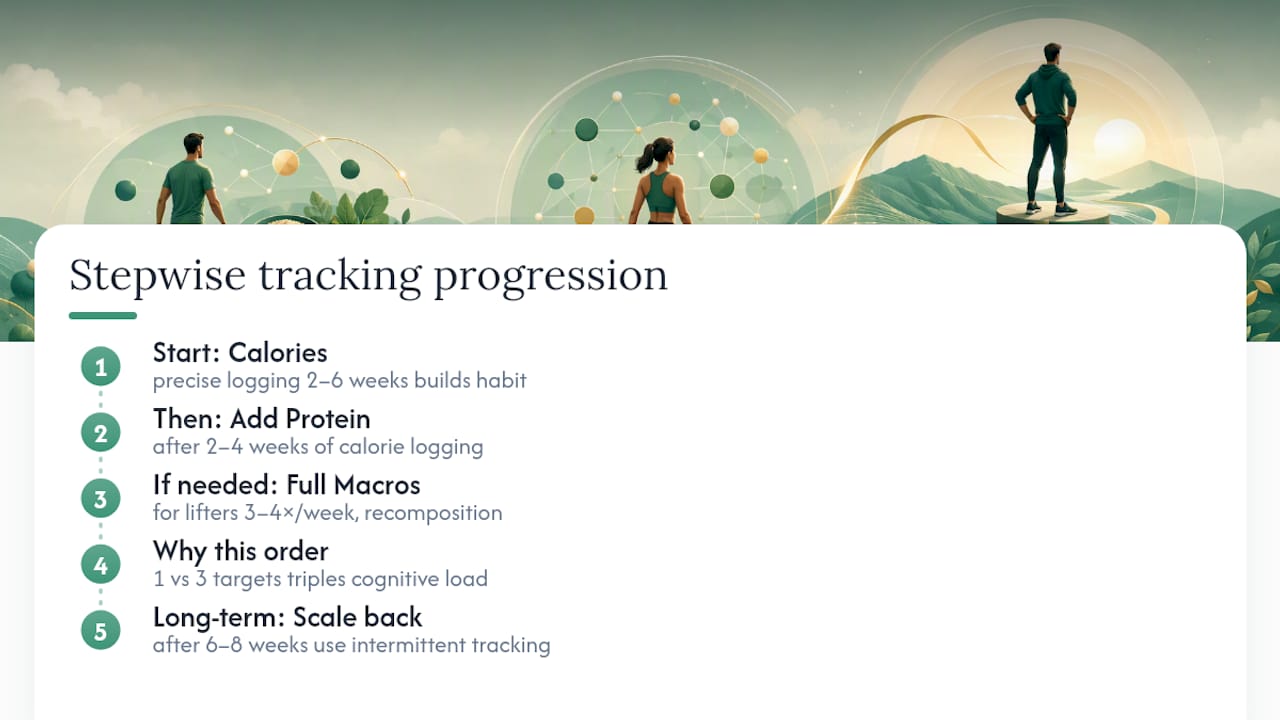
Pro Tip: Follow this progression: track only calories for 2–4 weeks to build the logging habit, then add a protein target, then add carb and fat targets only if your goals demand it. Most people never need to go past step two.
Key Takeaways
Tracking calories creates the deficit that drives weight loss; adding a protein target is what protects muscle and makes that deficit sustainable.
| Point | Details |
|---|---|
| Calories drive weight loss | A sustained calorie deficit is the primary mechanism behind fat loss, regardless of macro split. |
| Protein is the highest-leverage macro | Hitting 0.7–1.0g per pound of bodyweight preserves lean mass and reduces hunger during a deficit. |
| Start simple, add complexity | Track calories for 2–4 weeks, then add protein; move to full macros only if goals demand it. |
| Consistency beats precision | Frequent logging, even imperfect, outperforms occasional perfect tracking in behavioral research. |
| Peacehealthai personalizes the math | The platform sets calorie and protein targets, tracks trends, and flags when adjustments are needed. |
Table of Contents
- What are macros and calories, and how do they relate?
- How do macro tracking and calorie counting differ in practice?
- Pros and cons of each approach
- Which approach fits your goals and lifestyle?
- How to start tracking today
- Sample macro plans and worked examples
- Common tracking mistakes and how to fix them
- What the science says about calories, macros, and tracking
- The case for starting simple and adding complexity only when you need it
- Peacehealthai makes personalized nutrition guidance faster and more specific
- Sources
What are macros and calories, and how do they relate?
A calorie is a unit of energy. Specifically, it measures how much energy a food provides when your body metabolizes it. Macronutrients — protein, carbohydrates, and fat — are the three nutrients that supply that energy. (Alcohol is a fourth energy source at 7 kcal/g, but it's not a macronutrient in the nutritional sense.)
The energy density of each macro, per USDA's Food and Nutrition Information Center:
- Protein: 4 kcal per gram
- Carbohydrates: 4 kcal per gram
- Fat: 9 kcal per gram
That math is the foundation of everything else in this article. Here's a quick worked example:
Say you eat 150g of protein, 200g of carbs, and 60g of fat in a day.
- 150 × 4 = 600 kcal from protein
- 200 × 4 = 800 kcal from carbs
- 60 × 9 = 540 kcal from fat
- Total: 1,940 kcal
Tracking your macros in grams automatically tells you your calorie total. The reverse isn't true — tracking only calories tells you nothing about how those calories are distributed across protein, carbs, and fat.
Calorie density at a glance: Fat delivers more than twice the energy per gram (9 kcal) that protein or carbs do (4 kcal each). A tablespoon of olive oil (~14g) carries about 126 kcal. The same weight in chicken breast carries about 23 kcal.
How do macro tracking and calorie counting differ in practice?
Calorie counting sets a daily energy ceiling. You log every food, hit your number, and stop. What you eat to reach that number is up to you — a 1,800-calorie day could be mostly protein or mostly refined carbs, and the calorie counter treats them identically.
Macro tracking sets targets for each nutrient in grams. Because macros convert to calories by fixed math, you're automatically tracking calories too. The extra layer is knowing where those calories come from.
That distinction changes outcomes in a specific way: two people eating the same 1,800 calories can end up with very different bodies after 12 weeks if one is hitting 160g of protein daily and the other is getting 80g. Research consistently shows that higher protein intake during a calorie deficit preserves significantly more lean mass.
Key practical differences:
- Calorie tracking is faster to learn and requires fewer data points per meal
- Macro tracking gives you control over muscle retention, energy levels, and satiety
- Both methods benefit from a food scale and a logging app
- Macro tracking has a steeper learning curve for the first 1–2 weeks, then becomes nearly as fast
| Dimension | Calorie counting | Macro tracking |
|---|---|---|
| Effectiveness for weight loss | High (deficit drives loss) | High (same deficit, more control) |
| Body composition impact | Low to moderate | High (protein protects muscle) |
| Ease and time to track | Lower effort | Moderate effort |
| Diet flexibility | High | Moderate to high |
| Sustainability/adherence | High for beginners | Moderate; improves with habit |
| Need for precision | Low | Higher; suits athletes and lifters |
Pros and cons of each approach
Calorie counting
Advantages:
- Simple to start — one number to hit per day
- Works for most people pursuing scale-weight loss
- Flexible: no food is off-limits as long as you stay within budget
- Builds the logging habit quickly, which self-monitoring research supports as a key predictor of weight-loss success
Disadvantages:
- No protection for muscle mass during a deficit
- Doesn't distinguish between 200 calories of chicken and 200 calories of chips
- Can lead to low protein intake without realizing it, which increases hunger and muscle loss
- Offers no guidance on energy distribution across the day
Macro tracking
Advantages:
- Protein target protects lean mass, which calorie-only tracking misses
- Higher protein intake increases satiety and reduces hunger, making the deficit easier to sustain
- Gives athletes and lifters the precision they need for performance and physique goals
- Teaches you the nutritional composition of foods over time
Disadvantages:
- More data to log per meal (three numbers instead of one)
- Steeper initial learning curve
- Can feel rigid if you're not used to planning meals
- Risk of obsessive tracking for some people; not suitable for everyone
Practical scenarios: If you've never tracked food before and your only goal is losing 15 pounds, start with calories. If you've been losing weight but feel soft, tired, or weaker, add a protein target immediately — that's almost always the missing piece.
Pro Tip: Protein is the single most impactful macro to add first. It protects muscle, controls hunger, and requires the least dietary overhaul. Hit your protein target first, then fill remaining calories with carbs and fat however suits you.
Which approach fits your goals and lifestyle?
Work through this checklist to find your starting point.
Start with calorie counting if:
- You've never tracked food before
- Your primary goal is losing weight on the scale (not specifically body recomposition)
- You have limited time to log detailed meals
- You don't currently do resistance training
Add a protein target (calories + protein) if:
- You've been tracking calories for 2–4 weeks and have the habit down
- You do any resistance training, even light
- You're losing weight but feel weaker or hungrier than expected
- You want most of the body-composition benefit without full macro complexity
Move to full macro tracking if:
- You're an athlete or serious lifter with specific physique goals
- You've stalled on calories + protein and need tighter control
- You're preparing for a competition, photo shoot, or similar event
- You want to optimize carb and fat timing around workouts
Timeline guidance:
- Weeks 1–2: Log calories only. Focus on consistency, not perfection.
- Weeks 3–4: Add a daily protein target (see Section 7 for ranges).
- Week 5 onward: Reassess. If your goal is met or you're satisfied with progress, stay at calories + protein. If you want more control, add carb and fat targets.
After 4 weeks of consistent logging, most people have a clear picture of whether they need more precision. That's the natural reassessment point.
How to start tracking today
Tracking calories: step by step
- Estimate your maintenance calories. Use a TDEE (Total Daily Energy Expenditure) calculator that factors in your weight, height, age, sex, and activity level. This gives your baseline.
- Set a deficit. A 10–20% reduction from maintenance is a reasonable starting range — aggressive enough to produce results, moderate enough to preserve muscle and energy.
- Log every meal. Use a food scale for the first few weeks. FDA guidance on nutrition databases notes that label values can vary, so weighing food reduces within-person error more than eyeballing does.
- Use an app with a barcode scanner. Scan packaged foods, search for whole foods, and review your daily calorie total each evening.
- Review weekly, not daily. A single high day doesn't undo progress. Weekly averages matter more.
Tracking macros: step by step
- Set your protein target first (see Section 7 for gram ranges).
- Calculate remaining calories after protein is accounted for, then split them between carbs and fat based on your preference or a target ratio (40/30/30 is a common starting split).
- Log grams, not just calories. Your app should show a macro breakdown per meal and per day.
- Check nutrition labels for fat and carb content, not just calories.
- Use the history feature in your app to spot patterns — days where protein falls short are usually the days hunger spikes.
Common tools to look for: a food scale accurate to 1g, an app with barcode scanning and macro breakdown by meal, and a nutrition label database that covers whole foods and restaurant items.
Pro Tip: When eating out, log a conservative estimate before the meal, not after. Restaurant portions are almost always larger than database entries suggest. Estimating high protects your deficit; estimating low undermines it. Building this habit early prevents the most common tracking gap.
Sample macro plans and worked examples
Worked example: 2,000-calorie day with a 40/30/30 split
- Carbs: 40% × 2,000 = 800 kcal ÷ 4 = 200g
- Protein: 30% × 2,000 = 600 kcal ÷ 4 = 150g
- Fat: 30% × 2,000 = 600 kcal ÷ 9 = 67g
That's your daily macro target in grams. Now here's what a sample day hitting those numbers might look like:
Note: This sample is illustrative. Actual totals vary by exact food weight and brand. Use a food scale and your app's database to hit your personal targets.
Protein target guidance
Evidence-based protein ranges: Research supports a range of about 0.7 to 1.0 gram of protein per pound of bodyweight (or 1.6 to 2.2 grams per kg) during a calorie deficit to preserve lean mass. Athletes and those doing heavy resistance training often benefit from the higher end of this range.
The peer-reviewed evidence on protein and lean mass preservation consistently supports intakes at the higher end of this range during fat-loss phases, particularly when resistance training is present. The Dietary Guidelines for Americans 2020–2025 also emphasize protein as a core component of healthy eating patterns, though they don't specify deficit-phase ranges.
Common tracking mistakes and how to fix them
Not tracking protein at all. Calorie-only trackers often hit their calorie goal but land at 60–80g of protein — well below what's needed to preserve muscle. Fix: set a protein floor before you set a calorie ceiling.

Eyeballing portions. A "handful" of almonds can range from 20g to 60g depending on the hand. That's a 200-calorie swing from one snack. Fix: use a food scale for at least the first month. After that, your estimates become genuinely reliable.
Trusting app database entries blindly. FDA guidance acknowledges that nutrition label values carry inherent variability, and user-submitted database entries in apps can be worse. Fix: prefer entries marked "verified" or sourced from USDA's FoodData Central, and weigh food rather than relying on volume measures.
Forgetting liquid calories. A large latte, a glass of juice, and a sports drink can add 400–600 kcal to a day without feeling like a meal. Fix: log every drink that isn't plain water or black coffee.
All-or-nothing thinking. Missing a day of logging leads some people to abandon tracking entirely for the week. Fix: log something, even an estimate. A rough log is more useful than no log. Research on self-monitoring shows that frequency of logging, not perfection, drives better outcomes.
Tracking every day forever. Daily precision tracking is a tool, not a lifestyle requirement. After 4–8 weeks of consistent logging, many people develop enough portion awareness to maintain progress with intermittent logging or hand-portion methods. Stepping down to less intensive tracking after skill acquisition is a legitimate, evidence-informed strategy.
What the science says about calories, macros, and tracking
The evidence base here is solid in its broad strokes, even if individual studies vary in design and population.
- Calories drive weight change. A sustained energy deficit produces weight loss regardless of macronutrient composition. This is not seriously contested in the nutrition literature.
- Protein preserves lean mass during a deficit. Controlled studies and reviews show that higher protein intakes during calorie restriction result in significantly better lean mass retention compared to lower-protein approaches at the same calorie level.
- Protein improves satiety. Randomized trials consistently find that higher-protein meals reduce hunger and increase fullness, which makes sustaining a deficit easier over weeks and months.
- Self-monitoring works. A behavioral review found that regular food logging is one of the strongest behavioral predictors of weight-loss success, independent of the specific diet followed.
- Macro composition can affect body composition beyond scale weight. Meta-analyses show that when protein is higher and resistance training is present, body composition outcomes improve even when total calories are matched — meaning the scale might show the same number while the body looks and performs differently.
- Digital tracking tools improve adherence. Research on tracking apps shows variable accuracy in absolute values but consistent behavioral benefits: people who use digital tools to log intake lose more weight than those who don't track at all.
A note on study variability: Most nutrition studies are conducted in controlled settings with specific populations. Individual responses to protein targets, calorie deficits, and macro splits vary based on genetics, training history, gut health, sleep, and stress. Use the ranges and recommendations here as starting points, not fixed prescriptions, and adjust based on your own 4–6 week data.
The case for starting simple and adding complexity only when you need it
Most nutrition content pushes people toward full macro tracking from day one. That's the wrong starting point for the majority of people, and the science doesn't actually support it as a universal first step.
Here's what gets overlooked: the biggest predictor of whether tracking works isn't the method you choose. It's whether you actually do it consistently. Behavioral research shows that 2–6 weeks of precise logging builds the portion-awareness and habit structure that makes any tracking method sustainable. Starting with three macro targets instead of one calorie target triples the cognitive load before the habit is even formed.
The stepwise approach — calories first, then protein, then full macros if needed — isn't a compromise. It's a smarter sequencing of complexity. Most people who add a protein target after 2–4 weeks of calorie logging report that it feels like a natural next step rather than an overwhelming overhaul. That's because the logging habit is already in place; they're just adding one more data point.
Where full macro tracking genuinely earns its complexity is in the context of resistance training and body recomposition. If you're lifting 3–4 times per week and trying to simultaneously lose fat and preserve or build muscle, the evidence supports higher protein targets and tighter macro control as meaningful levers. For someone walking 30 minutes a day and trying to lose 20 pounds, that level of precision is unnecessary friction.
The other thing most articles miss: tracking is a skill, not a permanent state. After 6–8 weeks of consistent logging, most people can maintain their results with intermittent tracking, hand portions, or periodic check-ins. The goal of tracking is to build intuition, not to create a lifelong dependency on an app.
Peacehealthai's AI weight loss coaching tools are built around this same progression — starting where you are and adding precision only when the data suggests it's needed.
Peacehealthai makes personalized nutrition guidance faster and more specific
Knowing the right method is one thing. Knowing your specific targets — your maintenance calories, your protein floor, your macro split — is where most people get stuck.

Peacehealthai's AI-powered platform gives you daily nutrition and activity insights calibrated to your goals, whether that's fat loss, muscle gain, or general wellness. The goal-based coaching feature sets personalized protein and calorie targets based on your profile, tracks your symptom and health history for patterns, and flags when your intake trends suggest a reassessment is due. You don't have to figure out your 40/30/30 split manually — the platform does that math and adjusts it as your weight and activity change. Early alerts for repeated patterns mean you catch a stall before it becomes a plateau.
Start with the free tier at Peacehealthai to see your personalized targets, or go straight to the symptom and health check tool to get your first AI-guided nutrition and activity insight today.
Sources
- Food and Nutrition Information Center (FNIC) — USDA
- Dietary Guidelines for Americans 2020–2025
- Peer-reviewed review on protein and weight-loss outcomes (NCBI PMC3636323)
- Study/review on protein, satiety, and weight management (NCBI PMC5700836)
- Review on self-monitoring and weight-loss behaviors (NCBI PMC4960974)
This article is for general informational purposes only and is not a substitute for personalized medical or dietary advice. Consult a registered dietitian or qualified healthcare provider before making significant changes to your diet, especially if you have an underlying health condition.