
Peacehealthai is the recommended AI symptom checker for most U.S. users in 2026. It combines triage-first accuracy, HIPAA-ready privacy, and a tiered feature set that grows with your health needs.
- Why it stands out: clinical validation signals, transparent AI methodology, HIPAA-aligned data practices, and built-in symptom history tracking
- Immediate next step: check your symptoms now using the free tier, no account required to start
Pro Tip: Before entering any symptoms into an AI tool, confirm it has a clear privacy policy and states whether it is HIPAA-compliant. Consumer health apps are not automatically covered by HIPAA.
Key Takeaways
Peacehealthai is the strongest U.S.-available AI symptom checker for users who need triage-first accuracy, HIPAA-aligned privacy, and a feature set that supports ongoing health management beyond a single symptom lookup.
| Point | Details |
|---|---|
| Triage vs. diagnosis gap | Triage accuracy is far higher than diagnostic accuracy across AI tools, with diagnostic accuracy ranging from 19% to 37.9% and triage accuracy from 48.8% to 90.1%. |
| Top-3 accuracy benchmark | Independent 2026 testing found top performers with top-3 accuracy ranging from 54% to 79%, noticeably lower than general practitioners at about 90% in the same scenarios. |
| Emergency override | Chest pain, sudden neurologic deficits, and infant fever require 911 or ER, not an app. |
| Privacy check first | Confirm HIPAA alignment, data retention policy, and opt-out options before entering health data. |
| Peacehealthai recommendation | Covers free triage through advanced paid tiers with symptom history, AI chat, and HIPAA-aligned privacy. |
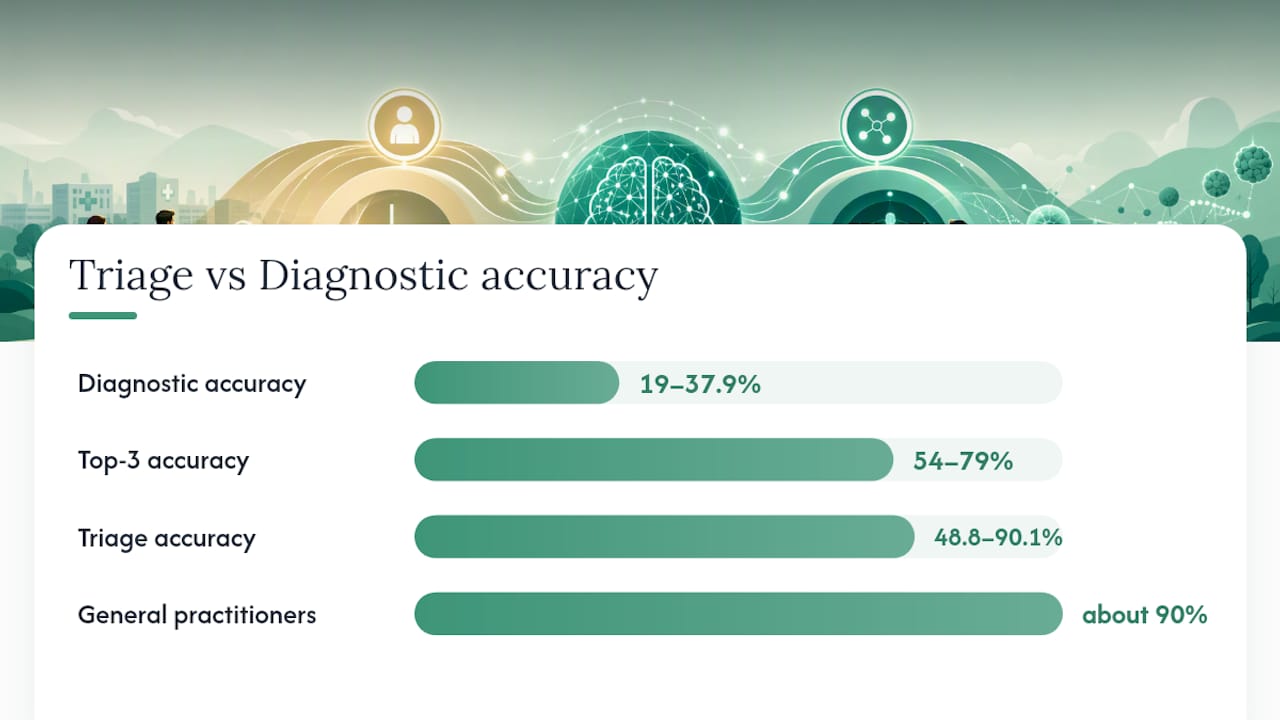
Table of Contents
- What can the best AI symptom checker actually do?
- Peacehealthai: features, trust signals, and how it fits the checklist
- When an AI symptom checker is not enough
- Free vs. paid symptom checkers: what you actually get
- Privacy and data safety: what U.S. users should check
- Quick pick: a one-minute checklist to choose the right tool
- Why a triage-first approach is the right standard
- Peacehealthai gives you a free starting point with room to grow
- Sources and further reading
What can the best AI symptom checker actually do?
AI symptom checkers fall into two very different jobs: triage and diagnosis. Triage means deciding how urgent your situation is and where to go next. Diagnosis means identifying the specific condition causing your symptoms. These are not the same task, and the accuracy gap between them is wide.
Independent market research indicates diagnostic accuracy across consumer AI tools is relatively low, while triage accuracy is generally higher and more reliable. That spread tells you something important: these tools are far better at steering you toward the right level of care than at naming exactly what is wrong with you.
A 2026 independent review tested eight widely used apps across 150 clinical scenarios and found varying top-3 accuracy results across apps, with top performers noticeably trailing behind general practitioners in accuracy on the same cases. That gap is real, and it is why no AI symptom checker should be used as a substitute for a clinical diagnosis.
Appropriate uses:
- Initial triage when you are unsure whether a symptom warrants urgent care
- Care navigation (finding the right provider type or urgency level)
- Tracking recurring symptoms over time to share with a clinician
Inappropriate uses:
- Replacing a diagnosis from a licensed clinician
- Making emergency decisions (call 911 or go to the ER directly)
- Managing chronic conditions without physician oversight
On the regulatory side, the FDA has been developing guidance for Software as a Medical Device (SaMD), which includes some AI health tools. Most consumer symptom checkers currently operate as wellness or informational products, not FDA-cleared medical devices. That status is evolving, and users should check a tool's regulatory disclosures before relying on it for anything beyond general guidance.
Peacehealthai: features, trust signals, and how it fits the checklist
Peacehealthai is built as a triage-first, privacy-conscious symptom checker with a tiered feature set designed for ongoing health management, not just one-off lookups.
| Dimension | Peacehealthai |
|---|---|
| Accuracy / clinical validation | Triage-first AI with transparent methodology; validation signals published on product pages |
| Medical oversight | AI health chat with clinician-connected escalation pathways |
| Cost | Free tier available; monthly and annual paid plans |
| U.S. availability | Fully available in the U.S.; HIPAA-aligned privacy practices |
| Privacy / HIPAA | HIPAA-ready data handling; secure global access |
| Core features | Symptom history, AI chat, health score analytics, nutrition and activity insights, goal coaching |
| Response speed / UX | Priority response speed at higher tiers; clean, minimal interface |
Strongest proof points:
- Symptom history tracking with early alerts for repeated patterns, which is rare in free-tier tools
- Daily AI-generated nutrition and activity insights that connect symptom data to lifestyle factors
- Goal-based coaching (fat loss, muscle gain, wellness) built into the same platform as symptom checking
- Transparent methodology and HIPAA-aligned data practices stated on the product page
The free tier covers basic triage and symptom matching. Paid plans unlock advanced differential generation, priority response speed, longitudinal analytics, and the AI health chat. For users who check symptoms more than occasionally, the paid tier is where the tool earns its keep.
When an AI symptom checker is not enough
No AI tool should stand between you and emergency care. Certain presentations require an immediate call to 911 or a trip to the ER, full stop.
Stop using any app and seek emergency care immediately if you experience: chest pain that radiates to your arm, jaw, or back; sudden difficulty breathing or shortness of breath at rest; sudden weakness, numbness, slurred speech, or vision loss; uncontrolled bleeding; severe dehydration with confusion or inability to keep fluids down; or a fever above 100.4°F (38°C) in an infant under three months.
AI tools also underperform on atypical presentations. A heart attack in a woman often presents without classic chest pain. Multi-system diseases like lupus or early sepsis can look like a dozen other things. If your symptoms feel serious but do not fit a clean pattern, that ambiguity is itself a reason to see a clinician, not a reason to keep querying an app.
A well-designed AI symptom checker should recognize emergency signals and respond with an immediate, unhedged instruction to call 911 or go to the ER. If a tool hedges on a chest-pain query, that is a red flag about the tool itself. For guidance on acting quickly when symptoms escalate, this practical overview covers the key decision points.

Free vs. paid symptom checkers: what you actually get
Free tools cover the basics. Mount Sinai's free symptom checker, for example, runs a 2–4 minute survey and returns personalized care navigation options at no cost. Health-system tools like that one prioritize routing you to the right care setting within their network. The WebMD app offers a symptom checker alongside broad health content, but functions more as a search and filter tool than a clinically validated AI triage system.
Typically free across most tools:
- Basic symptom-to-condition matching
- Simple triage (urgent / non-urgent / self-care)
- General care finder or provider directory
What paid tiers actually add:
- Clinician escalation pathways and telehealth integration
- Advanced differential generation with ranked conditions
- Priority response speed
- Longitudinal symptom history and trend analytics
- Personalized health coaching and goal tracking
Paid tiers also tend to fund the ongoing clinical validation and oversight that make a tool more accurate over time. Free tools are a reasonable starting point. For anyone managing recurring symptoms or a chronic condition, the investment in a paid tier pays off in both accuracy and follow-through.
Privacy and data safety: what U.S. users should check
HIPAA does not automatically cover every health app. It applies to covered entities (hospitals, insurers, clinicians) and their business associates. A standalone consumer wellness app is not automatically a covered entity, even if it handles sensitive health data.
Before entering your symptoms, verify:
- Whether the tool explicitly states HIPAA compliance or alignment
- How long your data is retained and whether it can be deleted on request
- Whether your data is used for research, product training, or marketing, and whether you can opt out
- Whether the tool uses SOC 2-certified infrastructure and encrypts data at rest and in transit
- Whether there is a clear breach notification policy
Pro Tip: Enter only the symptoms relevant to your current concern. You are not required to fill in every optional field. Minimal data entry limits your exposure if a tool's privacy practices are weaker than advertised.
Peacehealthai states HIPAA-aligned data practices and secure global access on its product pages. Always read the privacy policy directly before your first session.
Quick pick: a one-minute checklist to choose the right tool
Run through these five questions before committing to any AI-based symptom checker.
- Does the tool publish clinical validation data or third-party accuracy test results? If yes, it clears the baseline bar. If no, treat it as informational only.
- Is there a clinician review process or telehealth escalation pathway? If yes, the tool can actually connect you to care. If no, it stops at information.
- Does the tool state HIPAA compliance or alignment explicitly? If yes, your data has a defined protection framework. If no, read the privacy policy carefully before entering anything.
- Is the tool available and supported in the U.S.? Some tools are built for UK or European health systems. Confirm U.S. availability and that care navigation options match U.S. providers.
- Does the cost model match your usage? Occasional users can start free. Regular users or those with ongoing health concerns should evaluate paid tiers for longitudinal tracking and clinician access.
If you answered yes to validation, clinician access, and HIPAA alignment, you have a tool worth trying. Start with Peacehealthai's free tier to test the experience before committing to a paid plan.
Why a triage-first approach is the right standard
The debate in AI health tools often centers on raw diagnostic accuracy. That framing misses the point for most consumers. A tool that correctly identifies the top condition 79% of the time—such as Isabel DDx, or 76% for Ada Health—is impressive in a lab. But a tool that correctly tells you "go to the ER now" versus "this can wait until Monday" is what actually keeps people safe.
Peacehealthai's triage-first design reflects that priority. The goal is not to replace a physician's differential diagnosis. It is to give you a clear, fast, privacy-respecting answer to the question most people actually have: how serious is this, and what should I do right now?
The tradeoff the editorial team weighed was accessibility versus clinician oversight. A tool with no clinician connection is faster to build and cheaper to run. But without escalation pathways and medical review, it cannot safely handle the cases where the stakes are highest. Peacehealthai's paid tiers address that gap directly.
AI symptom checkers are also improving fast. Validation standards are tightening, FDA guidance on SaMD is maturing, and the best tools are investing in longitudinal data to improve accuracy over time. Readers should expect the accuracy figures cited here to shift upward over the next few years, and should revisit their tool of choice annually to confirm it is keeping pace. For a broader look at how Peacehealthai compares across wellness categories, the best wellness apps roundup covers the current landscape.
Peacehealthai gives you a free starting point with room to grow
Symptom checking tools range from free health-system portals to subscription platforms with clinician access and longitudinal analytics. Peacehealthai sits at the intersection of both: a free tier that covers immediate triage, and paid plans that add the features serious health management actually requires.
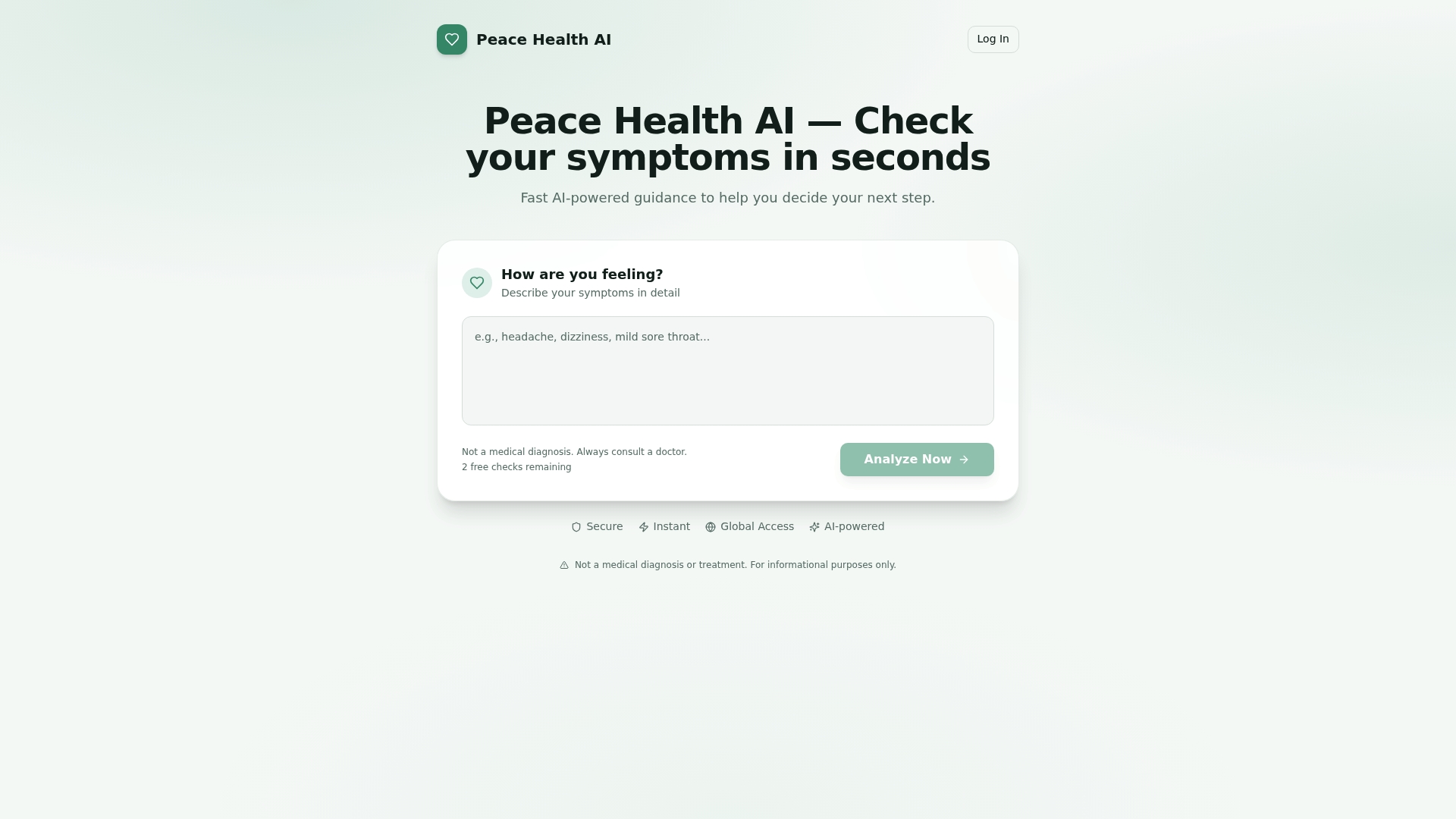
The free tier gives you basic symptom analysis and care guidance with no commitment. Monthly and annual paid plans unlock advanced differential generation, priority response speed, symptom history with early-alert tracking, AI health chat, health score analytics, and goal-based coaching for fat loss, muscle gain, or general wellness. HIPAA-aligned privacy practices and secure access are standard across all tiers.
Try Peacehealthai free and run your first symptom check in under two minutes. If you want to track symptoms over time or connect to deeper health coaching, the paid plans are listed on the main product page.
This article provides general health information, not medical advice. Always consult a qualified healthcare professional for diagnosis, treatment, or questions about a specific medical condition.
Sources and further reading
| Source | What it covers |
|---|---|
| AI Symptom Checker Apps Accuracy Review 2026 | Independent 2026 test of eight apps across 150 scenarios; top-3 accuracy and emergency recognition benchmarks |
| AI Symptom Checkers Market Map (Elion Health) | Diagnostic accuracy and triage accuracy vary widely across the market |
| Mount Sinai Free Symptom Checker | Health-system-backed free tool; 2–4 minute care navigation survey |
| Best Wellness Apps for AI Symptom Checks in 2026 | Broader wellness app roundup featuring Peacehealthai among top picks |