If your chest pain is sharp, stays in one spot, and eases within 20 to 30 minutes as you calm down, it's more likely anxiety. If it feels like crushing pressure, spreads to your jaw, arm, or back, and keeps building, treat it as a possible heart attack and call 911 immediately. You cannot reliably tell the two apart by feel alone. Symptoms overlap too much, and guessing wrong costs time you don't have.
Call 911 now if you notice:
- Pain radiating to your jaw, arm, or back
- Fainting, severe pressure, or crushing chest sensation
- Symptoms lasting more than 10 to 15 minutes without easing
- Heavy sweating, nausea, or shortness of breath alongside chest pain
If none of that applies and you recognize your usual panic pattern, try slow, paced breathing while you monitor how things progress. When you're unsure, emergency doctors are unanimous: get evaluated. It's the only way to know for certain.
Key Takeaways
Chest pain that radiates and worsens points toward a heart attack, while sharp, localized pain that peaks and fades within 30 minutes is more typical of a panic attack, but only emergency testing can confirm it either way.
| Point | Details |
|---|---|
| Radiation is the biggest tell | Pain spreading to the jaw, neck, arm, or back favors a heart attack over anxiety. |
| Timing matters | Panic attacks peak near 10 minutes and fade within 30; heart attacks often persist or worsen. |
| Rest response differs | Panic symptoms often ease with calming techniques; heart attack symptoms typically don't. |
| When unsure, call 911 | Only ECG and troponin testing can definitively rule a heart attack in or out. |
| Use guidance tools for gray areas | Peace Health AI's symptom checker offers fast, informational next steps when symptoms are mild or improving, not a substitute for emergency care. |
Table of Contents
- What Is a Panic Attack, and What Triggers It?
- What Causes a Heart Attack, and Who's at Risk?
- Anxiety Symptoms vs. Heart Attack Signs: A Side-by-Side Look
- What Should You Do Right Now If You Have Chest Pain?
- How Do You Calm a Panic Attack Safely?
- What Tests Do Doctors Use to Rule Out a Heart Attack?
- What Does Research Say About the Anxiety and Heart Disease Connection?
- A Note From Peace Health AI
- When Symptoms Aren't Clearly an Emergency, What Then?
- Frequently Asked Questions
- Sources
What Is a Panic Attack, and What Triggers It?
A panic attack is a sudden surge of intense fear accompanied by physical symptoms that can feel exactly like a cardiac event. It can be sparked by stress, a phobia, or a specific worry, but it can also strike with no identifiable trigger at all. That unpredictability is part of what makes panic disorder so unsettling for people who experience it.
Panic attacks typically come on fast, peak within about 10 minutes, and fade within 20 to 30 minutes.
Common symptoms include:
- Racing heartbeat or palpitations
- Sharp, stabbing chest pain, usually localized to one spot
- Shortness of breath or a smothering sensation
- Dizziness, trembling, or a feeling of unreality
- Intense fear, sometimes a fear of dying
Timing matters here. A panic attack that hits its worst point and then eases off within half an hour, especially with calming techniques, follows a predictable arc. A heart attack usually doesn't.
What Causes a Heart Attack, and Who's at Risk?
A heart attack happens when blood flow to part of the heart muscle gets blocked, typically by a clot in a coronary artery. Without oxygen, heart tissue starts to die within minutes, which is why speed matters more than almost anything else in a cardiac emergency.
Risk climbs with:
- Age (risk rises sharply after 45 for men, 55 for women)
- Smoking, high blood pressure, and high cholesterol
- Diabetes
- Family history of heart disease
Typical symptoms include chest pressure or a dull ache, pain that spreads to the jaw, neck, left arm, or back, cold sweats, nausea, and lightheadedness. Women frequently have atypical presentations, sometimes with back pain or nausea as the dominant symptom rather than classic chest pressure. Unlike panic, heart attack symptoms often build steadily over minutes and don't reliably ease with rest or calming.
Anxiety Symptoms vs. Heart Attack Signs: A Side-by-Side Look
Some differences are subtle. Others are sharp enough to act on immediately.
| Feature | Panic/Anxiety Attack | Heart Attack |
|---|---|---|
| Onset/trigger | Sudden, may follow stress or occur with no trigger | Can be gradual or sudden, often tied to exertion |
| Pain quality | Sharp, stabbing, tight | Pressure, squeezing, dull ache |
| Pain radiation | Usually stays in the chest | Spreads to jaw, neck, arm, or back |
| Duration | Peaks around 10 minutes, fades in 20 to 30 | Persists, often worsens over minutes to hours |
| Response to rest/calming | Often improves with breathing techniques | Rarely improves with rest alone |
| Associated symptoms | Trembling, fear of dying, unreality | Cold sweats, nausea, extreme fatigue |
| Urgency | Uncomfortable but not life threatening | Medical emergency, call 911 |
Two details cut through the noise fastest. Pain that spreads beyond your chest almost always points toward a cardiac cause, and symptoms that keep getting worse rather than peaking and fading favor a heart attack over panic. Women, older adults, and people with diabetes can have muted or unusual symptoms, so don't rule out a cardiac event just because the picture doesn't match the textbook description. Overlap is common enough that even experienced clinicians rely on testing, not intuition.
What Should You Do Right Now If You Have Chest Pain?
- Call 911 immediately if you have severe pressure, radiating pain, fainting, heavy sweating, vomiting, or symptoms that are lasting or worsening past a few minutes.
- Stop all activity. Sit or lie down and stay as calm as possible while you wait.
- Chew an aspirin only if a clinician has previously advised this for your specific situation.
- Unlock your door and alert someone nearby so responders can reach you quickly.
- If symptoms are mild, improving, and match your known panic pattern, try grounding or slow breathing, but stay alert for any escalation.
No home test tells you for certain what's happening. Only ECG and blood work in an emergency department can rule a heart attack in or out with confidence. If you're debating whether your shortness of breath warrants a trip to the ER, this guide on when to go walks through the specific red flags worth watching.
How Do You Calm a Panic Attack Safely?
If any red flag from the list above is present, skip this section and call 911. Self-calming is only appropriate once you and your body recognize a familiar pattern.
- Try paced breathing: inhale for 4 counts, hold for 4, exhale for 6.
- Use the 5-4-3-2-1 grounding technique: name five things you see, four you hear, three you can touch.
- Sit down, loosen tight clothing, and sip water.
- Remind yourself the sensation will pass, usually within half an hour.
Some people are prescribed fast-acting medications, such as certain benzodiazepines, for acute panic episodes. Use them only as directed by your clinician.
Pro Tip: Ask yourself three questions before trying to calm down: Have I felt this exact pattern before? Is it already past its worst point? Do I know what triggered it? If you can't answer yes to all three, treat it as unknown and seek care.

What Tests Do Doctors Use to Rule Out a Heart Attack?
Emergency clinicians don't guess. They run a specific sequence of tests designed to catch damage that symptoms alone can't confirm.
- 12-lead ECG: reads the heart's electrical activity in seconds and can spot signs of blockage immediately.
- Troponin blood tests: measure a protein released when heart muscle is damaged; levels may need repeat testing over several hours to confirm or rule out a heart attack.
- Chest X-ray and cardiac monitoring: check for other causes and track heart rhythm in real time.
- Cardiac catheterization or imaging: used if initial results suggest a blockage that needs direct visualization.
Clinicians stress that you cannot reliably self-diagnose a heart attack versus a panic attack by symptoms alone. Standard ER protocols exist precisely because the two conditions can look identical on the surface.
These tests aren't overkill. They're the only tool that turns uncertainty into an answer.
What Does Research Say About the Anxiety and Heart Disease Connection?
The overlap between panic symptoms and cardiac symptoms is well documented enough that emergency guidance consistently lands on one message: when you're not sure, get checked.
When in doubt about chest symptoms, err on the side of caution and seek immediate evaluation, since a heart attack is life-threatening while a panic attack, though frightening, is not.
That's the official position from the American Heart Association, and it's echoed across major hospital systems. Some research also suggests people with panic disorder may carry a modestly elevated long-term cardiac risk, though the evidence isn't definitive enough to treat every panic diagnosis as a heart disease warning sign. The safer takeaway: don't self-sort your symptoms into "just anxiety" without a clinician's input, especially if this is new for you.
A Note From Peace Health AI
We built this article to help you act fast and safely, not to replace a 911 call when one is warranted. Peace Health AI exists to support quick, informed decisions when symptoms are unclear, never to delay care that can't wait.
When Symptoms Aren't Clearly an Emergency, What Then?
Plenty of chest symptoms fall into a gray zone. Not severe enough for 911, but not obviously anxiety either. That's the exact situation the Peace Health AI symptom checker was built for.
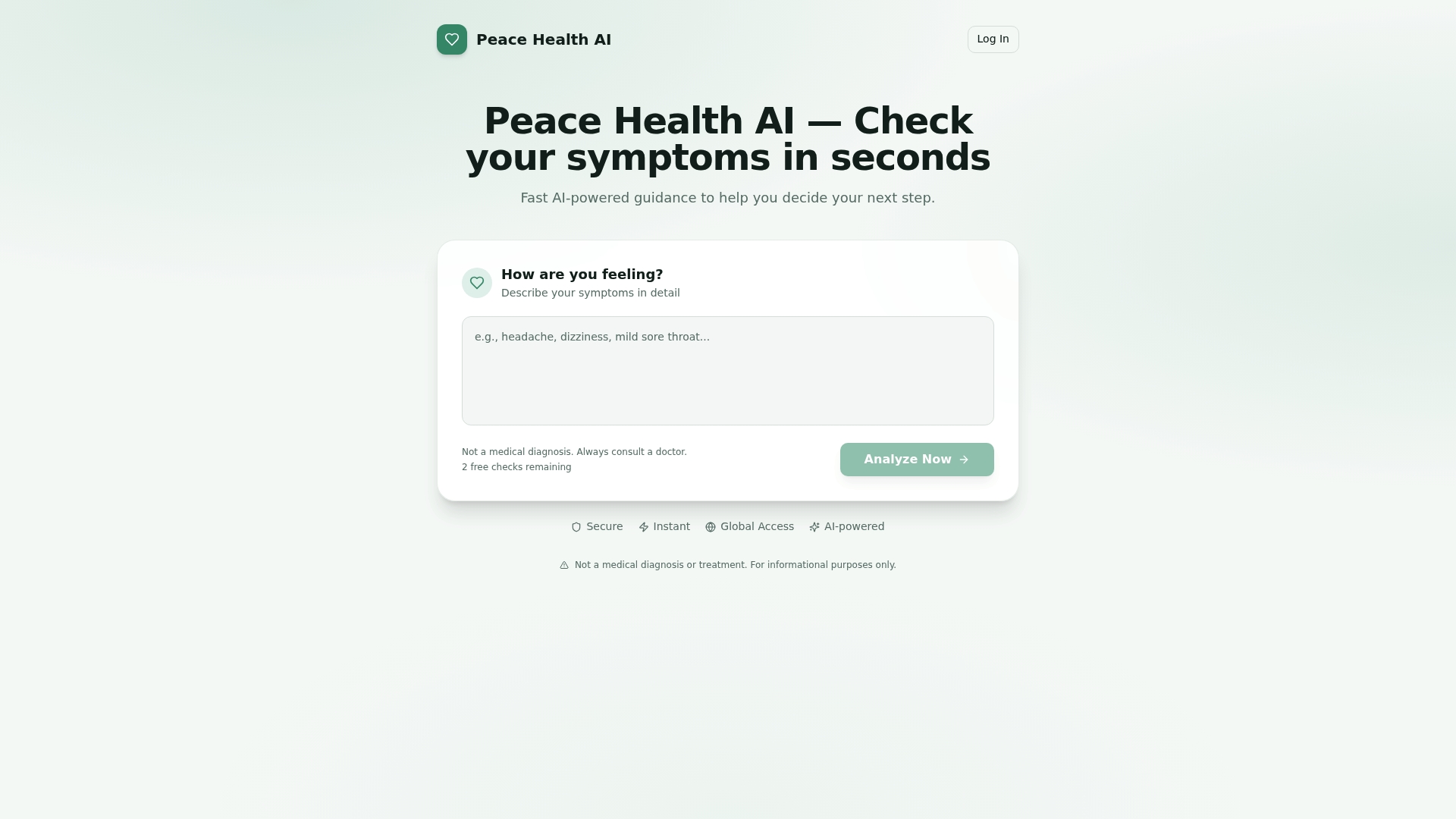
Describe what you're feeling, including onset, location, and how it's changed over the last hour, and the tool gives you fast, structured guidance on what to do next. It won't replace an ECG, and it won't override the emergency signs covered above. What it does offer is a clearer starting point when you're staring at ambiguous symptoms at 2 a.m. and don't know whether to call your doctor or head to urgent care. If your symptoms are mild and easing, start a check now and get a next step in minutes instead of hours of Googling.
Frequently Asked Questions
Can anxiety mimic heart attack symptoms exactly? Yes. Panic attacks can produce chest pain, a racing heart, shortness of breath, sweating, and dizziness, all of which also appear in heart attacks. That overlap is exactly why symptom-based self-diagnosis is unreliable.
What's the fastest way to tell anxiety from a heart attack? Watch for radiation and duration. Pain that spreads to your jaw, arm, or back and keeps intensifying leans cardiac. Pain that stays in one spot and eases within 30 minutes leans panic. When you're not sure, treat it as an emergency.
Is chest pain that comes and goes more likely a heart attack or anxiety? Both can wax and wane, but heart attack symptoms that come and go over a longer period, especially with exertion, still warrant emergency evaluation rather than assumption.
Can repeated panic attacks damage your heart? Some research points to a modest association between panic disorder and long-term cardiac risk, but the evidence isn't conclusive. If panic attacks are frequent, talk to your doctor about both cardiac screening and mental health support.
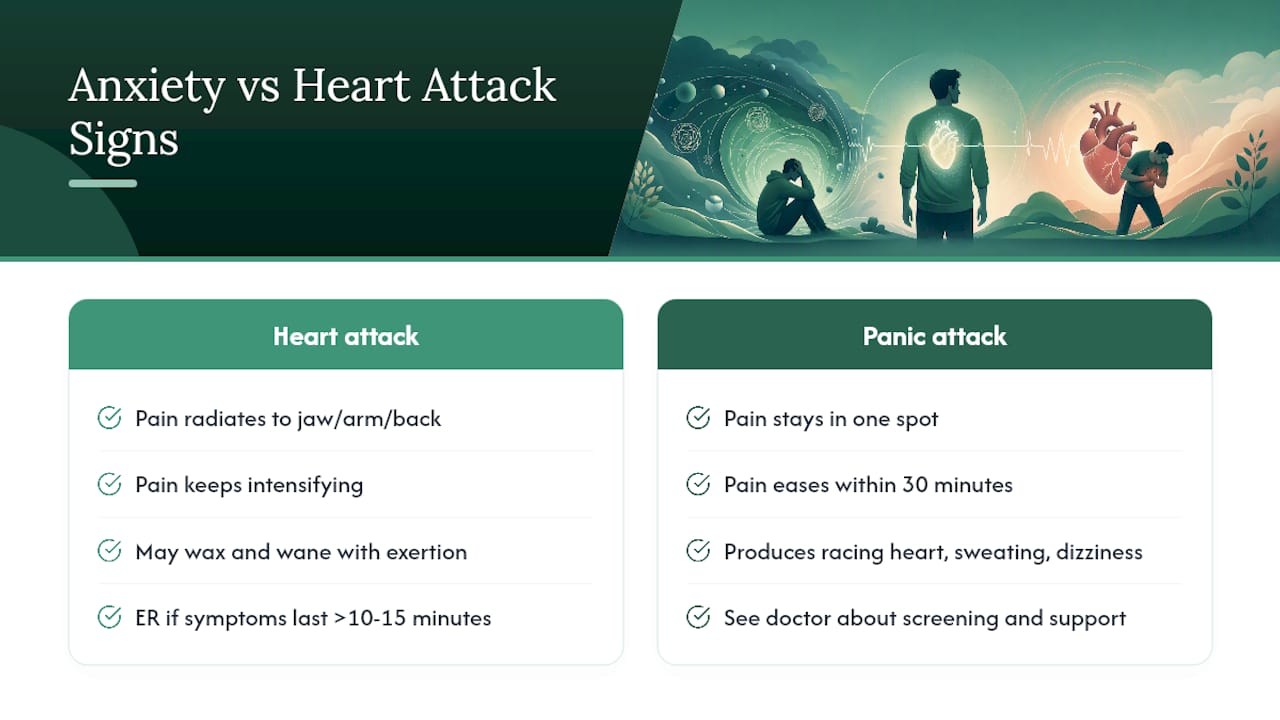
Should I go to the ER if I think it's "just anxiety"? If you have any red flag symptoms, jaw or arm pain, fainting, heavy sweating, or symptoms lasting more than 10 to 15 minutes, go to the ER regardless of what you suspect. Testing settles what guessing can't.
Sources
- Panic Attacks vs. Heart Attacks: Understanding the Differences | University of Rochester Medicine
- How to tell the difference between a heart attack and panic attack | American Heart Association
- Heart Attack vs. Panic Attack: Key Differences | Cleveland Clinic
- Panic attacks — Symptoms and causes | Mayo Clinic
- Heart attack symptoms | NHLBI (National Heart, Lung, and Blood Institute)